
THE SHORT ANSWER
A claim review checks whether a marketing statement says exactly what the available evidence supports. Wording, scope and visible conditions matter. Prioritize consequential claims and revise statements when support is missing or narrower than the wording suggests. The aim is clear communication that buyers can assess and specialists can stand behind with a defensible explanation.
To see how this step fits into your content strategy, read the pillar guide B2B content marketing: From useful expertise to qualified demand.
Extract statements that can be checked
Mark numbers, comparisons, technical commitments, timing promises and absolute terms such as “always” or “complete.” Include diagrams, headings and captions. A qualification in body copy may not repair an exaggerated headline. Create a review list with location and responsible role. Distinguish factual assertions from clearly identified ambitions. Split sentences containing several promises. Only then can you see whether all parts share the same support or whether one condition has been generalized beyond what the evidence actually establishes for the reader.
Compare evidence with wording
Open the original source and inspect what was documented or investigated. Check definitions, timeframe, configuration and exclusions. A case describing one implementation does not automatically establish a typical outcome. A feature does not prove a financial benefit. Summarize the evidence boundary in your own words. If support consists only of an internal assertion, leave the item unresolved. Judge the match between evidence and wording rather than the source's reputation; a trusted source may still address a different question from the claim under review. Explore this further in the guide Building research dossiers for credible B2B content.
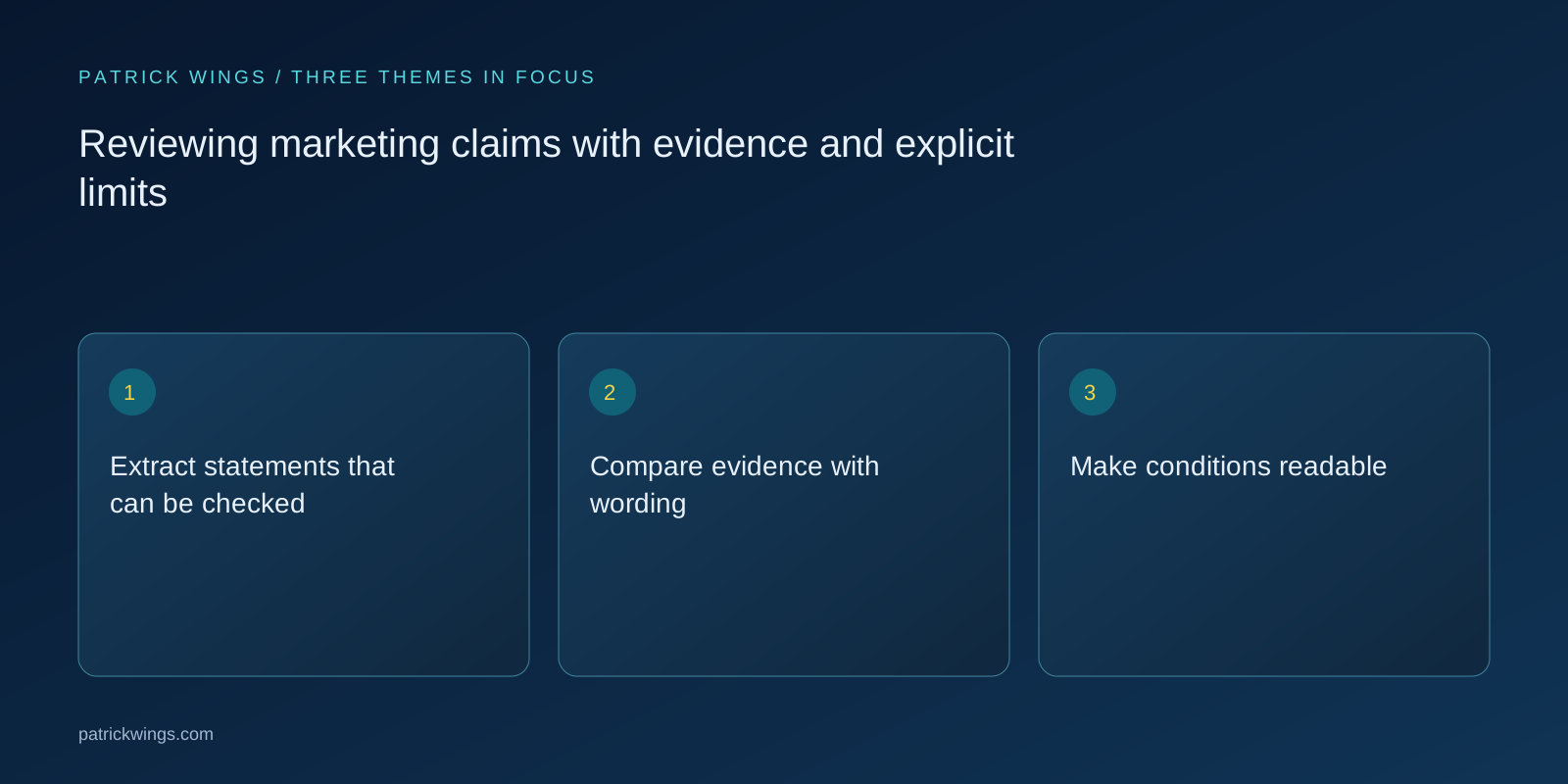
Make conditions readable
Place necessary prerequisites near the statement. A result limited to one configuration should not depend on a hard-to-find footnote. Avoid stacking so many qualifications into a sentence that it becomes incomprehensible. Narrow the assertion instead. Replace a broad automation promise with a description of the step actually automated. This preserves useful information while showing which work remains manual or depends on further configuration and approvals. Readers can then assess fit without having to infer important exclusions from vague language or scattered notes elsewhere on the page.
Show a hypothetical correction
Suppose a draft states, “Our solution eliminates all manual data checks.” Documentation confirms only automatic validation of specified mandatory fields. The revised statement describes that validation and explains that domain-specific checks may remain necessary. This hypothetical example describes no real product. It demonstrates the path from an expansive promise to a supported mechanism. The result is more precise rather than merely weaker: buyers now learn which actual function they could incorporate into their own process and which responsibility the product has not been shown to remove.

Assign the right reviewers
Send technical statements to a subject expert and results to the people responsible for the underlying data. Claims with legal significance need the appropriate organizational reviewers. Editorial precision does not replace those checks. Record responses against a dated version. When reviewers disagree, investigate assumptions before attempting a vote on factual correctness. Define who must review substantive wording changes again. Otherwise a previously approved statement can acquire a different meaning through later sharpening, even though everyone remembers that an earlier version received a positive response from the expert.
Maintain approvals over time
Keep the claim, evidence, limitations and approved wording together. Identify review triggers such as a product update or changed measurement method. Do not transfer approval automatically across channels: a shortened advertisement may lose conditions visible on the website. Check the actual presentation before release. During maintenance, prioritize errors most likely to influence purchasing decisions. A useful review ends with approval, a specific revision or a reasoned hold, rather than an indefinite request to be more careful that leaves the writer unsure what must change before publication.
Maintain a cross-format claims register linking each statement to its evidence, conditions, owner and known uses. If the same commitment appears in a whitepaper, sales deck and service page, relevant changes need to reach all three. The register tracks the substance and reuse of a claim, while approval of one page records only that document’s state. Record rejected wording as well, so an unsupported statement does not return in the next format disguised as a new editorial idea. Explore this further in the guide Sources in AI answers: verify evidence claim by claim.
INTERACTIVE / FROM READING TO ACTION
Three checkpoints for your implementation
Choose a checkpoint and track your reading progress. Checks are neither saved nor sent and do not score your business.
CHECKPOINT 01
Make conditions readable
Place necessary prerequisites near the statement.
Explore in the article ↗CHECKPOINT 02
Show a hypothetical correction
Suppose a draft states, “Our solution eliminates all manual data checks.” Documentation confirms only automatic validation of specified mandatory fields.
Explore in the article ↗CHECKPOINT 03
Assign the right reviewers
Send technical statements to a subject expert and results to the people responsible for the underlying data.
Explore in the article ↗Frequently asked questions
Is a link enough evidence?
Only when the source supports the specific claim and relevant conditions remain visible.
Must every promotional statement be removed?
No. Check factual assertions and express value concretely within supported boundaries.
When is another review needed?
After substantive wording changes, product changes or changes to the underlying data.
How can I put “Extract statements that can be checked” into practice?
Mark numbers, comparisons, technical commitments, timing promises and absolute terms such as “always” or “complete.” Include diagrams, headings and captions. A qualification in body copy may not repair an exaggerated headline. Create a review list with location and responsible role.
What matters when working on “Compare evidence with wording”?
Open the original source and inspect what was documented or investigated. Check definitions, timeframe, configuration and exclusions. A case describing one implementation does not automatically establish a typical outcome.