
THE SHORT ANSWER
A bibliography does not automatically make an article verifiable. Readers need to recognise which source supports a particular statement and under which conditions it applies. Editing a search-led article therefore means connecting the requested answer with suitable evidence, explicit limits and a practical route to the original material.
For the broader picture of technical foundations, useful content and visibility measurement, read the pillar guide SEO, GEO and AEO for SaaS: visibility that supports buying decisions.
Define the answer and burden of proof
Write down the reader’s central question and mark the statements on which a decision depends. Distinguish product facts, recommendations, research findings and your own working hypotheses. Each needs different support. A product comparison, for example, requires current information about the actual editions being compared. A recommendation may rest on a reasoned judgement, but should remain recognisable as a recommendation. Avoid decorating a predetermined draft with convenient links afterwards. Establish what the evidence can support and adjust the answer’s scope accordingly. A source should not become an apparent endorsement of a stronger unsupported sentence.
Select primary sources for their fit
Open the original material and locate the precise relevant passage. Check publication date, subject and scope. Vendor documentation can establish documented functionality without proving that the product outperforms alternatives. Research involving another population may inspire a hypothesis without providing a directly applicable B2B benchmark. Record those distinctions in the draft. If only a summary is accessible, make that limitation clear and avoid describing methods you have not inspected. Link to a stable detailed destination where possible. Readers should be able to find the supporting material without searching an entire website or relying on the writer’s interpretation.
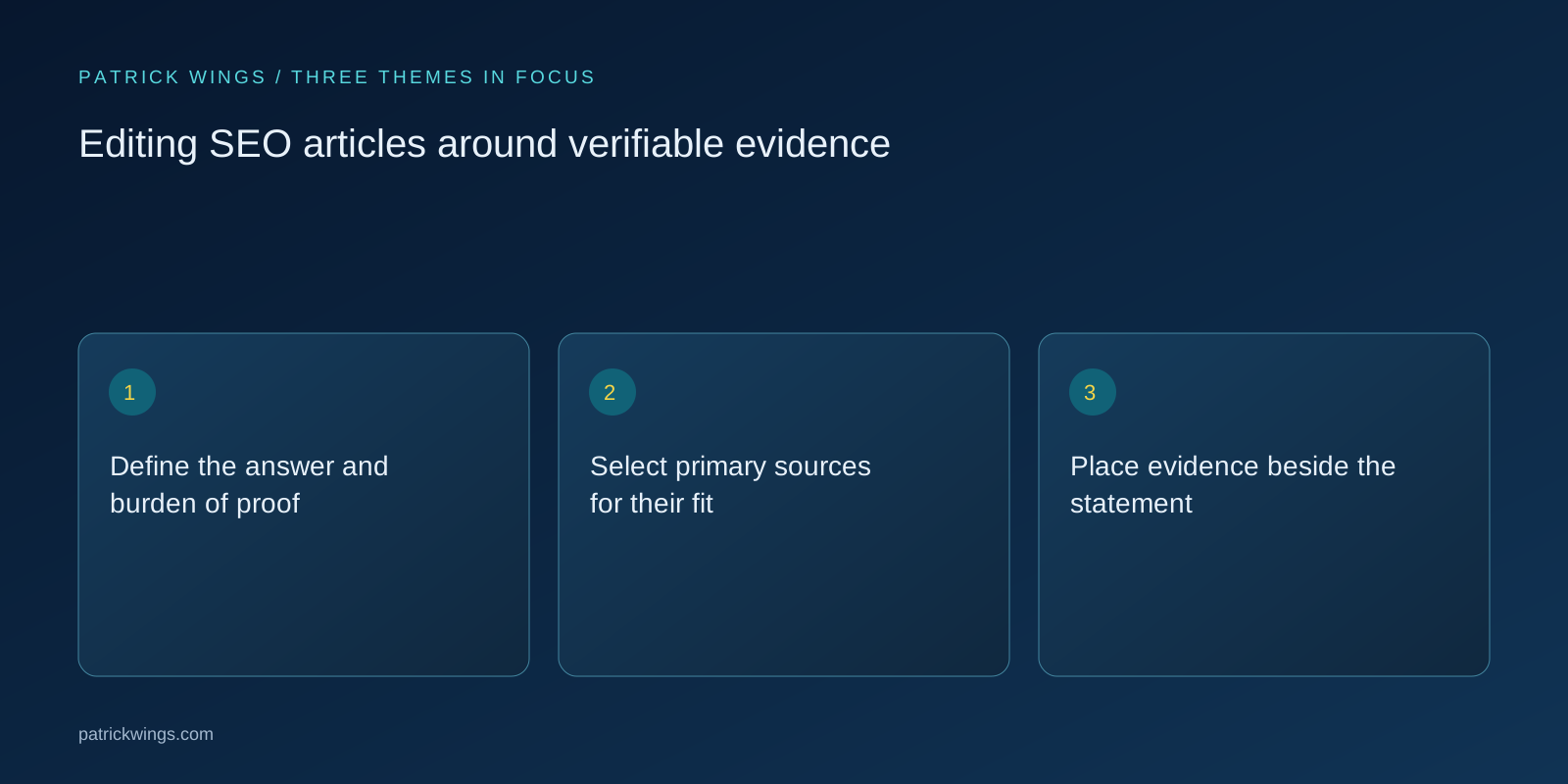
Place evidence beside the statement
Place attribution next to the statement or clearly bounded passage it supports. For quantitative findings, include the denominator, period and material limitations. A precise modest sentence is more useful than an impressive number without context. Use original wording and quote sparingly. Separate any direct quotation visibly from your interpretation. Where a paragraph contains several assertions, inspect each one; a link at the end does not automatically support them all. For graphics, include definitions and sources in the visible context so that an isolated image does not imply a stronger conclusion than the underlying evidence permits.
Example: correcting an overclaim
An illustrative draft states that clear answers guarantee inclusion in AI citations. Its linked Google documentation instead describes baseline requirements and explicitly does not guarantee indexing or serving. The editor replaces the sentence with a bounded claim: understandable accessible content supports a usable website, while citation remains the decision of the particular system. The adjacent text explains the relevant technical checks. This does not remove a useful recommendation; it separates advice from documented platform requirements. The example demonstrates an editorial correction rather than presenting an original study of how often AI systems cite particular writing styles. Explore this further in the guide Reviewing marketing claims with evidence and explicit limits.

Make contrary evidence and uncertainty visible
Look deliberately for conditions under which the proposed answer does not apply. Conflicting sources do not need to be reconciled through an artificially broad statement. Explain differences in method or context where relevant. If an important fact remains unresolved, name the question and the check required. Avoid language implying proof when the material supports only a plausible explanation. Technical assertions may also need a version or verification date where change affects validity. An explicit boundary is more useful than polished prose whose confidence exceeds the available evidence, particularly when a reader intends to act on the answer. Explore this further in the guide Maintaining technical claims through editorial review.
Release an inspectable article
Before publication, read the central answer alongside its supporting evidence without the surrounding promotional copy. Then inspect links, labels and mobile presentation. A broken reference or an important qualification buried in an unreadable graphic is not useful support. Record which changes require renewed expert review, such as product updates or new research. A wider approval process may cover several asset types; this article focuses on the evidence structure of a search-led explanation. The result is an answer whose origin and scope readers can assess. Search engines and AI systems still decide independently whether and how to use it.
INTERACTIVE / FROM READING TO ACTION
Three checkpoints for your implementation
Choose a checkpoint and track your reading progress. Checks are neither saved nor sent and do not score your business.
CHECKPOINT 01
Place evidence beside the statement
Place attribution next to the statement or clearly bounded passage it supports.
Explore in the article ↗CHECKPOINT 02
Example: correcting an overclaim
An illustrative draft states that clear answers guarantee inclusion in AI citations.
Explore in the article ↗CHECKPOINT 03
Make contrary evidence and uncertainty visible
Look deliberately for conditions under which the proposed answer does not apply.
Explore in the article ↗Frequently asked questions
Is vendor documentation sufficient?
It can support documented functionality but does not independently establish superiority.
Where should sources appear?
Beside the relevant statement or a clearly identified passage.
Do references guarantee AI citations?
No. They make statements inspectable without guaranteeing selection by a system.
How can I put “Define the answer and burden of proof” into practice?
Write down the reader’s central question and mark the statements on which a decision depends. Distinguish product facts, recommendations, research findings and your own working hypotheses. Each needs different support.
What matters when working on “Select primary sources for their fit”?
Open the original material and locate the precise relevant passage. Check publication date, subject and scope. Vendor documentation can establish documented functionality without proving that the product outperforms alternatives.