
THE SHORT ANSWER
A research dossier records what an editorial team knows about a question, what supports that knowledge and what remains unresolved. Organize material around questions and claims rather than links alone. A useful dossier lets another person trace a conclusion to the relevant evidence, inspect its limits and continue the work without repeating the entire investigation.
To see how this step fits into your content strategy, read the pillar guide B2B content marketing: From useful expertise to qualified demand.
Bound the research question
Write down the decision the research supports and the questions it must answer. Record audience, timeframe and relevant product versions. A dossier about interface requirements needs different sources from a historical market overview. State exclusions deliberately. These boundaries guide selection and prevent endless collection. As new questions arise, classify them as necessary, supplementary or future work. This makes it clear which gaps actually block publication and which would merely be interesting additions if more time became available later.
Record source provenance
Capture title, publisher, address, access date and relevant location. For changing documentation, add the version or product state described. Prefer official documentation for technical properties while checking its scope. A vendor page can establish a feature without proving general superiority. Write short summaries instead of copying extensive passages. Resolve permitted use of material intended for an image, table or substantial quotation with the responsible people. Preserve enough information for another editor to locate the same evidence without guessing which part you originally consulted.
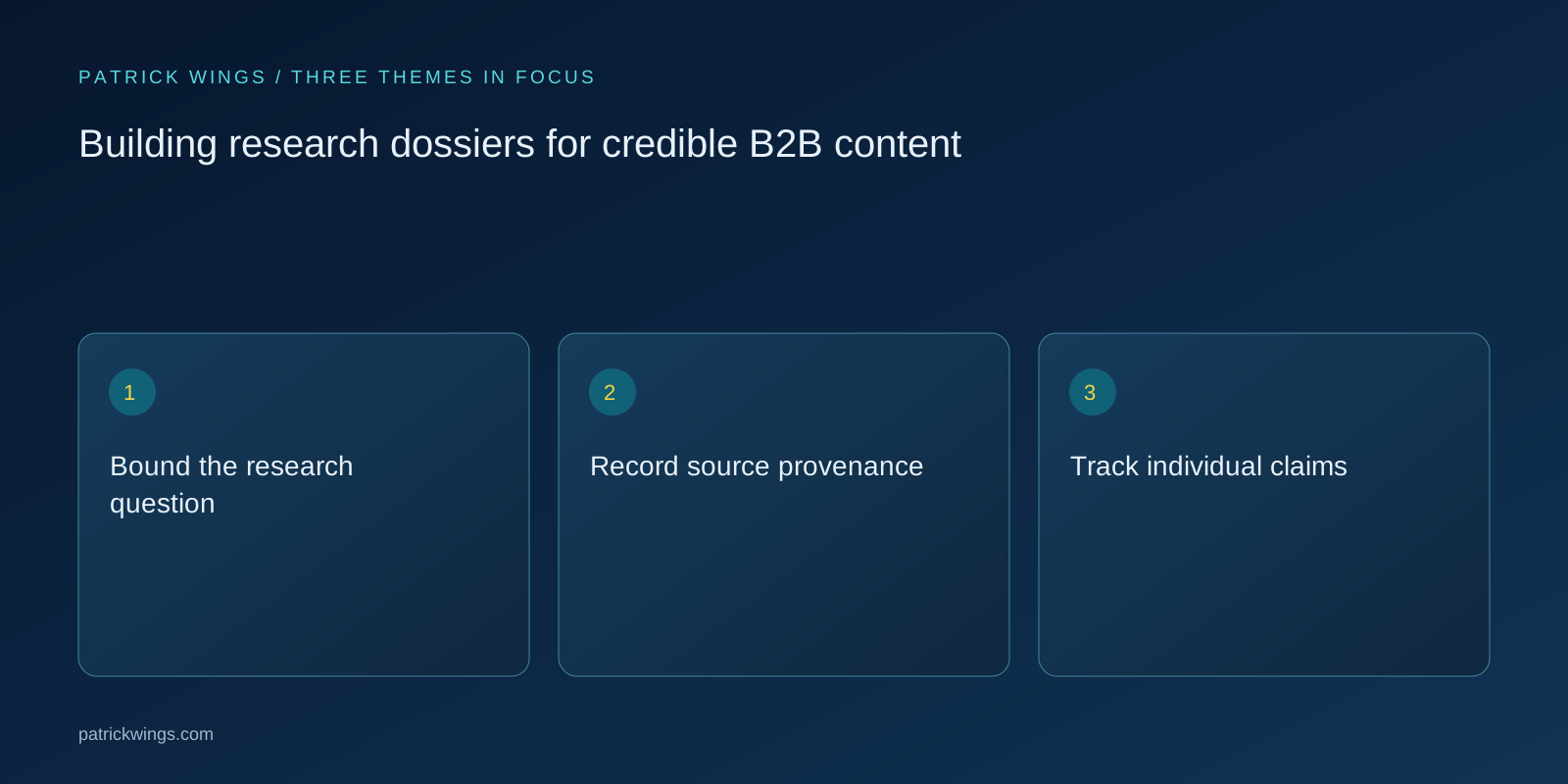
Track individual claims
Give each intended claim an entry containing its evidence and limits. Separate direct observation, interpretation and recommendation. Several pages repeating the same original study do not provide independent confirmation. Record conflicting findings and investigate differences in definitions or periods. Provisional claims are acceptable when their status is visible. Pay particular attention to numbers, superlatives and causal language: a small difference between the evidence and the manuscript can change the meaning substantially and create a misleading conclusion that appears well sourced at first glance. Explore this further in the guide Reviewing marketing claims with evidence and explicit limits.
Show a hypothetical research path
Suppose an article concerns choosing a data export. One documentation page confirms available formats; another explains size limits. The dossier connects both to a practical recommendation: check format and expected volume before choosing. A general assertion that an option is “always faster” remains unsupported and is removed. This hypothetical example does not describe a specific real product. It shows how bounded technical information can support a useful evaluation question without becoming a universal performance claim or an unjustified comparison with competing products. Explore this further in the guide SME interviews that turn expertise into useful editorial material.

Assign unresolved questions
Maintain a short open-issues list with next action, owner and desired timing. Distinguish absent information from contradictory evidence. An expert interview may fill a gap; conflicting documents first require checking scope. Decide which gaps permit qualified wording and which block publication. Record the reasoning. Silently ignoring unresolved questions may shorten the dossier, but it prevents later reviewers from understanding the uncertainty and its consequences. A named owner also makes the next step actionable instead of leaving a vague note that someone should investigate the issue eventually.
Maintain the dossier alongside publication
Connect the finished article to the entries it actually uses and retain the status of rejected leads where helpful. Recheck decisive sources for availability and changes before publication. During updates, hand over previous evidence together with known limitations. A dossier cannot guarantee every sentence is correct; it creates a traceable basis for scrutiny. Judge it by whether another person can quickly verify an important claim and understand which new information would require revision, rather than by the volume of links it contains.
INTERACTIVE / FROM READING TO ACTION
Three checkpoints for your implementation
Choose a checkpoint and track your reading progress. Checks are neither saved nor sent and do not score your business.
CHECKPOINT 01
Track individual claims
Give each intended claim an entry containing its evidence and limits.
Explore in the article ↗CHECKPOINT 02
Show a hypothetical research path
Suppose an article concerns choosing a data export.
Explore in the article ↗CHECKPOINT 03
Assign unresolved questions
Maintain a short open-issues list with next action, owner and desired timing.
Explore in the article ↗Frequently asked questions
Must every source be primary?
Not necessarily; prefer original documentation for technical properties and core data, and assess interpretations separately.
What if a source disappears?
Find a dependable original version or revise the claim; a dead link is not inspectable evidence.
Should the entire dossier be public?
No. Publish appropriate references and retain internal review notes separately.
How can I put “Bound the research question” into practice?
Write down the decision the research supports and the questions it must answer. Record audience, timeframe and relevant product versions. A dossier about interface requirements needs different sources from a historical market overview.
What matters when working on “Record source provenance”?
Capture title, publisher, address, access date and relevant location. For changing documentation, add the version or product state described. Prefer official documentation for technical properties while checking its scope.