
THE SHORT ANSWER
An alternatives page should do more than list competing vendors. It helps buyers decide whether changing their current approach addresses a specific problem and which new commitments a switch creates. Start with the trigger: a missing capability, changed workflow, support need or economic constraint. Then explain selection criteria and possible routes, including continuing or adapting the existing approach. This article addresses switching context rather than a direct two-product comparison table. A useful page may conclude that switching is not currently justified, even when your product could technically replace the incumbent.
To see how this step fits into your content strategy, read the pillar guide Content marketing for B2B SaaS: strategy, formats and qualified demand.
Diagnose the reason for considering a switch
Separate one disappointing experience from a persistently unsuitable solution. Ask what failed most recently, who was affected and which outcome is needed under which conditions. Missing training may require a different response from an unsupported integration requirement. Use real discovery questions without exposing confidential customer detail. A page for frustrated incumbent users needs different reasoning from a page for first-time buyers. Name the trigger explicitly and avoid a title that claims every possible dissatisfaction. Switching is a means; restoring a workable process is the underlying decision. A narrow diagnosis helps readers distinguish a solvable configuration issue from an actual product boundary. Explore this further in the guide Writing B2B comparison pages with defensible criteria.
Explain the universe of viable alternatives
Consider routes rather than brands alone: configure the existing system differently, add a specialist tool, simplify the process or replace the platform. Explain when each route is plausible. Include a vendor because it fits the task, not because its name attracts searches. Describe your selection method and the categories deliberately excluded.
Which alternatives belong in the comparison?
Missing information leaves suitability unresolved. A long list is not more complete when every entry repeats interchangeable promotional descriptions. Reduce the selection to options whose boundaries you can explain, and link to official sources for further checking. Readers should understand why an option was included and which requirement might rule it out.
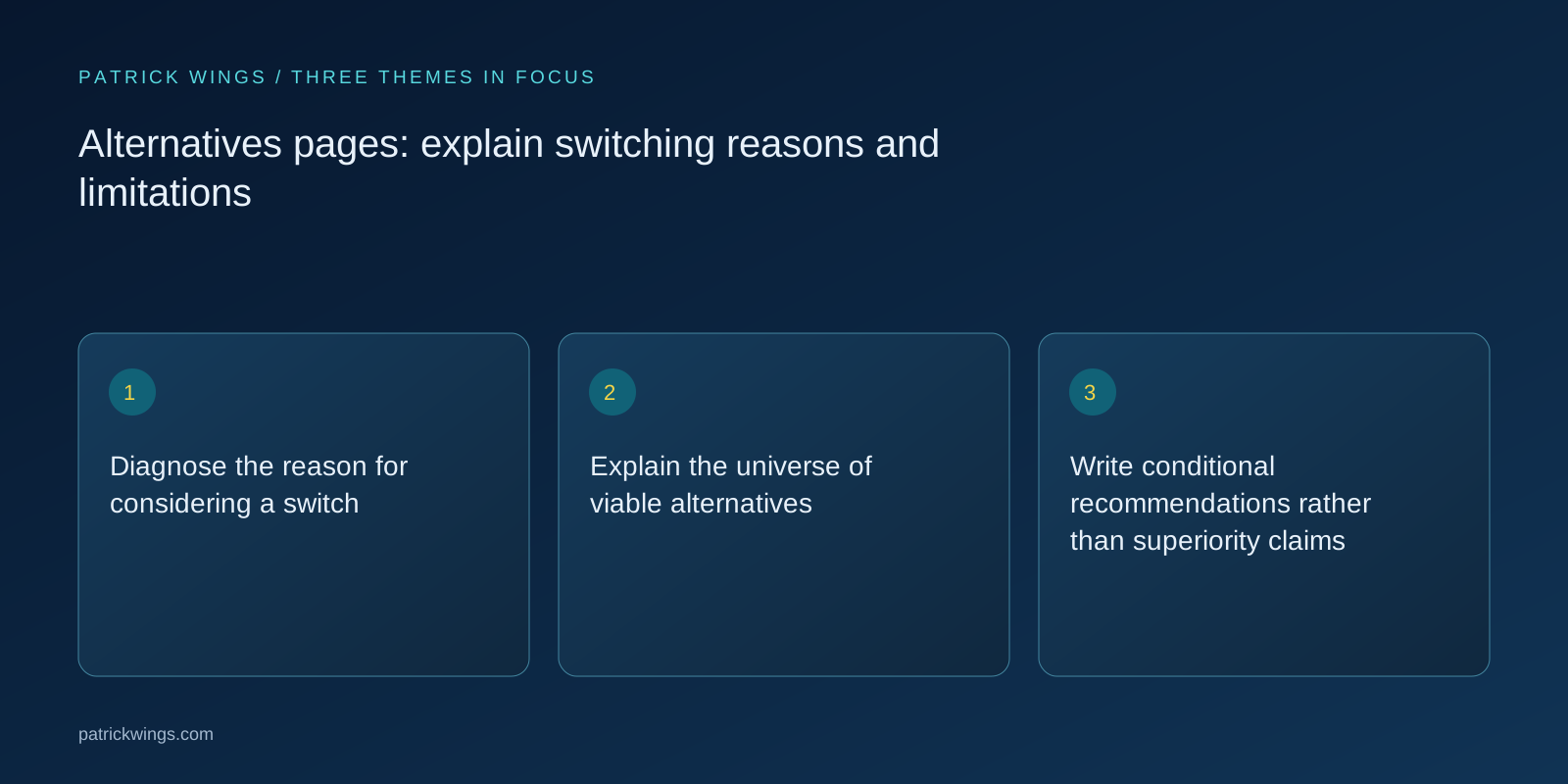
Write conditional recommendations rather than superiority claims
Express recommendations through conditions: if export access and administration rights are available, a phased transition can be assessed. That is more precise than “easy switching”. Name the prerequisites that must hold before your solution belongs on the shortlist. These might include data format, accountable owner, supported region and required permissions. Avoid a universal ranking across fundamentally different uses. Show which additional information would change your recommendation. A documented exclusion is more useful than a vague promise that tries to encompass every scenario. Review the conditions with delivery or customer success, not only sales, because the people implementing a promise can expose its practical limits.
| Review field | Evidence or observation | Next decision |
|---|---|---|
| Switching trigger | Actual problem and viable alternative | Switch, stay or investigate further |
| option | Actual problem and viable alternative | Switch, stay or investigate further |
| exit | Actual problem and viable alternative | Switch, stay or investigate further |
Explain effort and continuing obligations
A switch involves more than the new licence. Describe data review, process mapping, training, parallel operation and eventual retirement. You need not publish individual project quotes to explain the factors that determine effort. Link technical detail to verified migration documentation. An old contract does not end automatically when the new system works. Existing retention or operating requirements should be reviewed with the responsible specialists. Avoid turning general marketing information into legal assurances. After reading, buyers should identify the right participants and the missing information rather than mistake a reassuring headline for a binding implementation plan. Uncertain effort should remain visible instead of becoming a manufactured estimate.

Fictional example: frustration is not a migration case
This example is invented. SaaS vendor Riverpath reaches a team seeking to replace its reporting process. In the fictional assumptions, the main problem is an inconsistent internal metric definition rather than an export limitation in its current tool. A replacement would inherit the ambiguity. The alternatives page therefore offers a definition worksheet first, then explains which confirmed capability gap would justify evaluation. There are no real customer observations or measured success figures here. The scenario illustrates why a helpful vendor should not equate all frustration with readiness to switch. A later conversation can then begin with a more precise requirement and a clearer explanation of the alternatives.
Offer a decision path with distinct exits
Give readers three possible next steps: clarify the existing approach, verify an unresolved prerequisite or evaluate a new option. Match each exit to a useful aid. A technical checklist suits an unclear integration boundary; a consultation suits an already defined requirement.
Which next step is justified?
Do not funnel every answer into the same aggressive demo form. State when a decision should be deferred, such as when nobody can assess the data inventory or a critical prerequisite remains unknown. This path is editorial orientation, not an automated suitability verdict. A qualified person still needs to assess complex dependencies in the actual situation before a customer commits resources or accepts a migration promise.
Bound statements for search and answer use
Identify the category, switching trigger and main limitation in ordinary language. Use unambiguous names and state whether the page concerns a particular package, version or buyer group. Answer-ready sections address real questions completely, such as whether export should be checked before switching. Do not create identical pages for many competitor names when the text repeats the same generic statement. That adds little reader value and can disappoint expectations. Link directly to evidence and distinguish it from your editorial methodology. Clear structure can support discovery, but does not guarantee a ranking, citation or inclusion in an AI response. The method should remain understandable without an optimisation claim. Explore this further in the guide Explaining SaaS pricing through clear scope and cost content.
Make specialist maintenance part of publication
Have product marketing review reasoning, delivery review transition assumptions and an editor examine fairness. Each material capability needs a source and review trigger. When a vendor package changes, revisit the recommendation derived from it. Measure whether readers proceed with a clear task and whether sales conversations contain fewer foundational misunderstandings. A bounce rate can have several causes and is not a complete quality diagnosis. Use permitted session research or interviews to investigate concrete confusion. Stop promotion when essential switching promises can no longer be fulfilled. The appropriate correction may be a narrower audience, a revised prerequisite or a different next step rather than an additional persuasive paragraph.
INTERACTIVE / FROM READING TO ACTION
Three checkpoints for your implementation
Choose a checkpoint and track your reading progress. Checks are neither saved nor sent and do not score your business.
CHECKPOINT 01
Write conditional recommendations rather than superiority claims
Express recommendations through conditions: if export access and administration rights are available, a phased transition can be assessed.
Explore in the article ↗CHECKPOINT 02
Explain effort and continuing obligations
A switch involves more than the new licence.
Explore in the article ↗CHECKPOINT 03
Fictional example: frustration is not a migration case
This example is invented.
Explore in the article ↗Frequently asked questions
How does an alternatives page differ from a product comparison?
An alternatives page starts with the switching trigger and considers different solution routes. A direct comparison evaluates specific offers against shared criteria. The formats can complement one another while answering distinct questions.
Should we criticise the incumbent product?
Describe verifiable boundaries rather than sweeping judgements. A particular requirement may be poorly supported without the incumbent being generally bad or unsuitable for every other customer situation.
Must the page recommend switching?
No. Configuration, training or internal process clarification may address the problem. A replacement becomes assessable only when the reason for changing is clearly described and supported by relevant evidence.
What information is needed before evaluation?
At minimum, define the task, relevant data scope, required permissions and accountable people. Additional prerequisites depend on the actual systems and technical or organisational requirements involved.
How can we avoid interchangeable competitor pages?
Give each page a substantiated switching context. Without distinct buyer questions or verifiable details, one coherent selection guide is usually more honest and useful than many nearly identical landing pages.
Which call to action belongs at the end?
Offer the smallest suitable next step: verify a prerequisite, clarify the existing workflow or discuss a specific evaluation. Match the requested commitment to the maturity of the buyer's decision.