
THE SHORT ANSWER
Content measurement becomes more understandable when usage, decision support and commercial progress are examined separately. A page view initially indicates contact with material; an explanation may resolve a question; an opportunity requires its own sales evidence. These events can relate without being interchangeable. Before publication, define which observation would change your next editorial decision. This article develops an operational framework for B2B SaaS content rather than a universal attribution score. It avoids assuming that every long session represents interest or that subsequent revenue was directly caused by a particular article.
To see how this step fits into your content strategy, read the pillar guide Content marketing for B2B SaaS: strategy, formats and qualified demand.
Define the decision measurement should change
Begin with the editorial action that depends on the findings. Will you repair an unclear explanation, continue distribution or add a missing section? “Improve content performance” is too vague. Specify the target role, content unit and expected useful action. A large dashboard is unnecessary while the actual decision remains unresolved.
Set a comparison frame and review date. Do not judge a new specialist guide after a few days against a general article distributed for years. Record material changes to offer, distribution and measurement. When several interventions happen simultaneously, a subsequent difference cannot reliably identify one contribution. The analysis can still inform action, provided its observational character remains explicit rather than being presented as a clean experiment.
Describe usage precisely and cautiously
Define the events actually recorded: a page view, file download, contents-navigation action or start of an interactive exercise. Validate implementation using controlled cases.
Google Analytics describes engagement metrics through defined session conditions. These are operational definitions, not direct measurements of comprehension or purchase intent. Someone may remain because the explanation is confusing, or leave quickly after finding the correct answer. Report usage with its definition. A limited qualitative question can be more informative than another metric that appears to describe the same unknown intention with greater numerical precision.
Which use was actually observed?
An automatically fired download event may differ from a deliberate user action. Do not use one label for incompatible collection methods, and explain measurement changes within the reporting period.
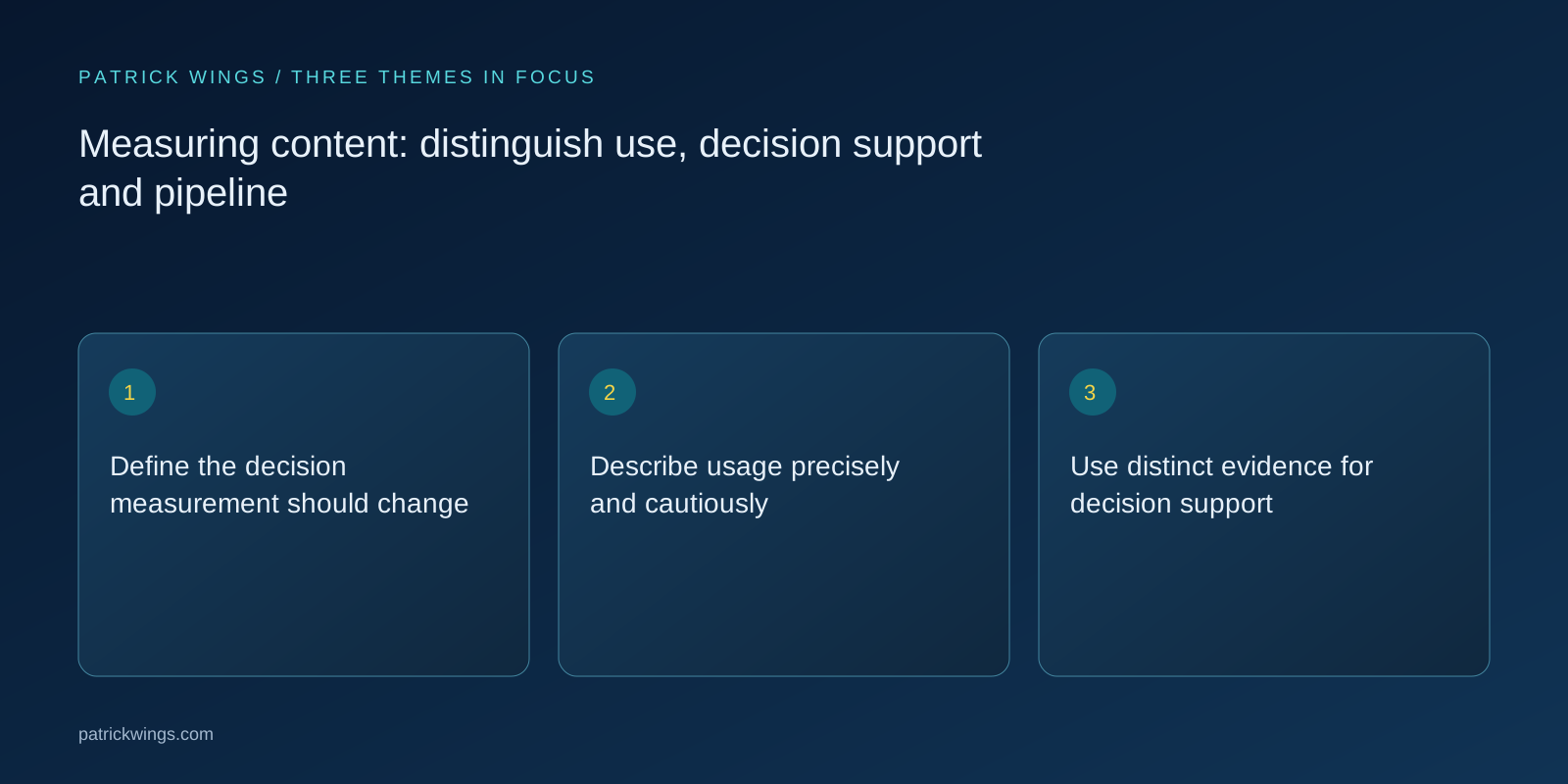
Use distinct evidence for decision support
Ask whether readers can perform the intended task with the material. A short usability exercise can show whether someone distinguishes prerequisites or formulates an appropriate next question. Match the exercise to the asset: a comparison guide and first-use tutorial serve different tasks. Describe in advance what an adequately understandable answer would look like.
Add specific sales and customer-success observations. “Customers like the guide” says little. Identify which question it resolved and what still required discussion, linked to the actual content version used. This makes the observation inspectable without inventing a representative effectiveness percentage from a handful of conversations. The evidence can justify revision while remaining bounded by who was observed and what they were asked to do. Explore this further in the guide Customer advisory content: use buyer perspectives without false consensus.
| Review field | Evidence or observation | Next decision |
|---|---|---|
| Use | Defined events at comparable maturity | Separate observation from impact claims |
| cohort | Defined events at comparable maturity | Separate observation from impact claims |
| assignment | Defined events at comparable maturity | Separate observation from impact claims |
Connect pipeline using disclosed rules
A commercial view needs a defined relationship between contact, organization, content and opportunity. State whether content was explicitly mentioned, used in a recorded sales process or connected through permitted analytics attribution. These methods have different gaps. Self-reported discovery is useful but depends on memory. A technical association records a relationship rather than proving the decisive purchase reason.
Decide whether an opportunity is counted per resource, topic group or organization. Avoid reporting the same complete contract as newly generated revenue in several content reports. Keep unknown origin unknown. Editorial should not fill missing links by speculatively joining identifiable browsing histories. Agree technical and organizational handling with the accountable teams before publishing commercial figures or treating a convenient data match as a complete buyer journey.

Fictional example of three measurement levels
The invented SaaS team Datensteg publishes an evaluation guide. This wholly fictional observation records thirty defined resource uses. Five conversation notes mention a resolved integration question, while three opportunities have a documented association with the topic group. Those invented quantities use different counting units and may overlap. They cannot be added into thirty-eight successes or treated as a demonstrated conversion chain. Explore this further in the guide Publishing original B2B research: methods, samples and limits.
The editor also notices two qualitative observations came from the same buying group. That dependency is recorded while remaining questions are examined. The next decision is to add missing preparation guidance, not to announce proven revenue returns from the article. Sales retains its own opportunity definition. The scenario demonstrates an inspectable analysis and explicitly supplies no benchmark for other businesses, assets or measurement periods.
Compare cohorts and periods fairly
Compare resources with similar observation time and purpose. A download immediately after an event has a different context from organic lookup months later.
Long B2B decisions leave some outcomes unresolved for a while. Label young cohorts immature rather than equating absent closed deals with zero effect. Conversely, a later contract does not prove every preceding content interaction mattered. Reports can show early usage beside later commercial observations. Do not retroactively change the attribution rule simply because another presentation produces a more attractive result.
Are the observation periods comparable?
Segment only as far as the data volume and question justify. Numerous tiny subgroups can make random variation look persuasive. Put the unit of analysis and missing observations beside the interpretation instead of hiding them in a footnote.
Translate findings into bounded changes
Connect each finding to an appropriate action. Incorrect entry points may suggest navigation or title changes. Usage without task comprehension calls for a clearer explanation. Useful material without distribution needs a suitable distribution test. These diagnoses should not all be replaced with the same general demand for more content.
Describe a small inspectable change and the strongest alternative explanation for any expected outcome. If sales changes qualification at the same time, opportunity counts may rise without the revised blog paragraph causing the increase. GOV.UK recommends combining performance information with other evidence. Our content application therefore means describing metrics, observing use, limiting inference and deciding a responsible next action. The framework does not turn every plausible correlation into a causal editorial success claim.
Maintain a report others can interpret
A useful report contains the question, event definition, period, content version, gaps, interpretation and agreed change. Give each important event an owner who can explain its meaning. Mark a comparison boundary after tracking changes, and preserve earlier definitions so previous reports are not silently reread using newer meanings.
Remove metrics that support no decision or merely recolour the same observation. A small dependable set makes collaboration easier across editorial, analytics and sales. Responsibilities remain distinct: analytics checks collection, editorial checks usability, and sales checks commercial progress. None fully replaces the others. The aim is a better justified content commitment, not one apparently complete number that automatically translates every article into revenue. Maintain only the reporting complexity the team can actually support.
INTERACTIVE / FROM READING TO ACTION
Three checkpoints for your implementation
Choose a checkpoint and track your reading progress. Checks are neither saved nor sent and do not score your business.
CHECKPOINT 01
Use distinct evidence for decision support
Ask whether readers can perform the intended task with the material.
Explore in the article ↗CHECKPOINT 02
Connect pipeline using disclosed rules
A commercial view needs a defined relationship between contact, organization, content and opportunity.
Explore in the article ↗CHECKPOINT 03
Fictional example of three measurement levels
The invented SaaS team Datensteg publishes an evaluation guide.
Explore in the article ↗Frequently asked questions
Which content metric matters most?
It depends on the decision being made. Usage, comprehension and commercial progress require different evidence; no single metric replaces all three perspectives.
Does high engagement time prove content quality?
No. It describes a defined usage observation. A long session may reflect interest or difficulty, so inspect the intended reader task with additional evidence.
Can influenced pipeline be described as revenue impact?
First disclose the association rule and known gaps. Documented involvement does not automatically establish that content caused incremental revenue.
How should new and old resources be compared?
Use comparable observation periods, purposes and distribution conditions. Identify immature cohorts and tracking changes instead of hiding different starting conditions inside a ranking.
Do qualitative comments need traceable sources?
Yes. Record the specific question resolved, content version used and known dependencies. General praise rarely translates into a useful editorial assignment.
When should a metric be removed?
When it changes no decision, lacks a dependable definition or merely restates an observation with extra complexity. Fewer reliable measures can improve collaboration.