
THE SHORT ANSWER
Treat competitor keywords as a bounded comparison test. Ask whether you can offer credible help to people evaluating alternatives or considering a switch. Establish the landing page, supporting evidence, spending limit and stopping rules before the first click.
For the broader picture of how target customers, channels and sales handoffs work together, read the pillar guide B2B demand generation: from attention to qualified pipeline.
Distinguish comparison from navigation
Not every search for another provider signals willingness to switch. Login, documentation and support searches often belong to an existing customer journey. A search for alternatives or a specific integration limitation may represent a different task. Examine complete query formulations rather than treating competitor names as one audience. Define the cases you can genuinely serve. If your product is not a credible alternative for a particular application, a strong click-through rate adds little. Write down why somebody should consider your solution. This assumption is the centre of the test and should later be examined through actual conversations rather than inferred from campaign engagement alone. Explore this further in the guide Competitive research beyond feature collection.
Prepare a verifiable comparison page
The landing page should explain differences through specific requirements: implementation, integrations, operating model, capabilities or support. Support statements with verifiable information and maintain them. Explain which needs your solution addresses and where its limitations lie. Avoid unsupported superiority claims. A fair comparison can also help unsuitable visitors leave early, saving effort on both sides. Offer suitable prospects an appropriate next step, such as reviewing an integration requirement. A generic home page with a standard demo invitation usually answers the visitor's comparison task poorly. It also makes subsequent campaign evaluation difficult because the offer did not clearly address the reason for the search. Explore this further in the guide SaaS comparison pages: help buyers choose without disparaging competitors.
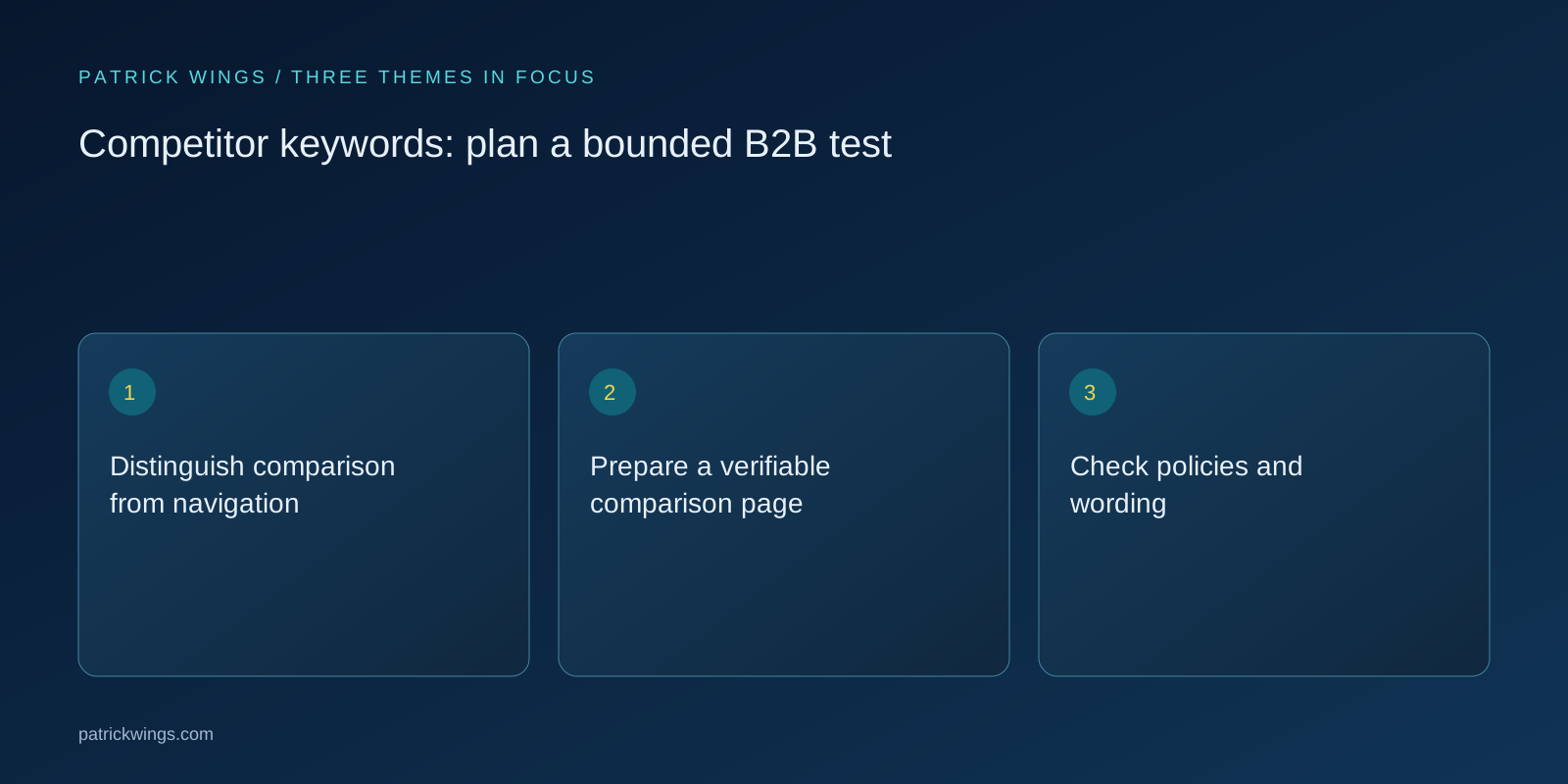
Check policies and wording
Google documents specific trademark rules for advertising. Review the current policy for your proposed execution and market before publishing copy. Technically available keyword targeting does not provide blanket permission for every trademark reference or comparison claim. Have uncertain cases assessed appropriately and avoid suggesting affiliation or partnership where none exists. Separate documented product differences from evaluative wording. Assign somebody to monitor changes in the competing product as well. Outdated comparisons damage credibility particularly with buyers who already know that product well. A disciplined maintenance process is therefore part of the acquisition experiment rather than an optional editorial task once the campaign has launched.
Divide an illustrative test budget
Imagine reserving €900 for a tightly bounded test. One portion addresses alternative searches and another a specific comparison task. This is an invented example, not a recommended budget. Agree beforehand which spending level without appropriate conversations triggers a pause and which questions sales will document. Record the current product, reason for considering change and conditions that would rule out migration. Two conversations about a concrete integration problem may teach you more than many vague form submissions. They still do not establish scalable economics. The first experiment should test an assumption, not certify a permanent growth channel from a handful of promising anecdotes.

Read costs alongside conversation quality
Competitor searches can be expensive while still providing relevant information. Evaluate them using the same economic discipline as other acquisition, but do not immediately blend them with generic category demand. Examine genuine comparison tasks, unsuitable navigational searches and useful next steps. Avoid explaining every lost conversation as an advertising failure. Product gaps, migration effort and existing contracts may be decisive. Conversely, a submitted form does not prove an intention to switch. Record observed statements rather than deriving readiness from the appearance of a competitor name. That keeps decisions defensible even when the number of cases is too small for confident statistical comparisons.
Continue, narrow or stop
After the test, decide whether you served a clearly identifiable comparison task at an acceptable cost. If only certain applications fit, restrict the campaign and page accordingly. If there is little genuine switching need, the experiment may end. A justified stop is a useful result. Document which assumption was contradicted and what remains uncertain. Revisit the question when the offer changes, a new integration appears or a different market event creates a reason. Without such a change, repeating the same test indefinitely turns learning expenditure into habitual spending and makes it harder to prioritise more promising acquisition opportunities. Give any continuation a fresh decision date.
INTERACTIVE / FROM READING TO ACTION
Three checkpoints for your implementation
Choose a checkpoint and track your reading progress. Checks are neither saved nor sent and do not score your business.
CHECKPOINT 01
Check policies and wording
Google documents specific trademark rules for advertising.
Explore in the article ↗CHECKPOINT 02
Divide an illustrative test budget
Imagine reserving €900 for a tightly bounded test.
Explore in the article ↗CHECKPOINT 03
Read costs alongside conversation quality
Competitor searches can be expensive while still providing relevant information.
Explore in the article ↗Frequently asked questions
Do competitor names automatically indicate switching intent?
No. Many searches concern navigation, support or existing usage.
Do we need a comparison page?
If you target comparison intent, provide a clear response to the specific requirements being assessed.
Is an unsuccessful test wasted spending?
Not necessarily. A bounded test can disprove an unsuitable acquisition assumption early.
How can I put “Distinguish comparison from navigation” into practice?
Not every search for another provider signals willingness to switch. Login, documentation and support searches often belong to an existing customer journey. A search for alternatives or a specific integration limitation may represent a different task.
What matters when working on “Prepare a verifiable comparison page”?
The landing page should explain differences through specific requirements: implementation, integrations, operating model, capabilities or support. Support statements with verifiable information and maintain them. Explain which needs your solution addresses and where its limitations lie.