
THE SHORT ANSWER
A content review workshop should produce concrete decisions about a draft. Start with the reader task and review criteria, collect observations in the text and then decide changes. Preferences need a reason connected to the assignment. A useful outcome identifies what changes, why it changes and who will resolve any remaining factual question before publication.
To see how this step fits into your content strategy, read the pillar guide B2B content marketing: From useful expertise to qualified demand.
Choose the question the workshop can answer
Establish whether the review concerns structure, comprehension, evidence or fundamental messaging. These do not always belong in one session. If positioning remains unresolved, collective punctuation edits accomplish little. Distribute the draft and brief with clear reading tasks. Invite roles that can contribute to the decision; a larger group does not automatically provide better review. Identify the final decision owner and statements needing separate expert verification, so the workshop does not imply responsibility or expertise it cannot actually provide for the material being assessed. Explore this further in the guide Test messaging before rewriting your website.
Agree criteria and boundaries
Start with the audience, its task and the intended outcome. Select concrete criteria, such as a recognizable main answer, explicit prerequisites and an applicable example. State what the session will not decide. Record new strategic questions with owners instead of redirecting the entire meeting. This protects scope and working time without ignoring legitimate problems. The important distinction is making a new decision visible rather than silently embedding it in manuscript feedback and expecting the writer to resolve it while implementing unrelated changes to the current draft.
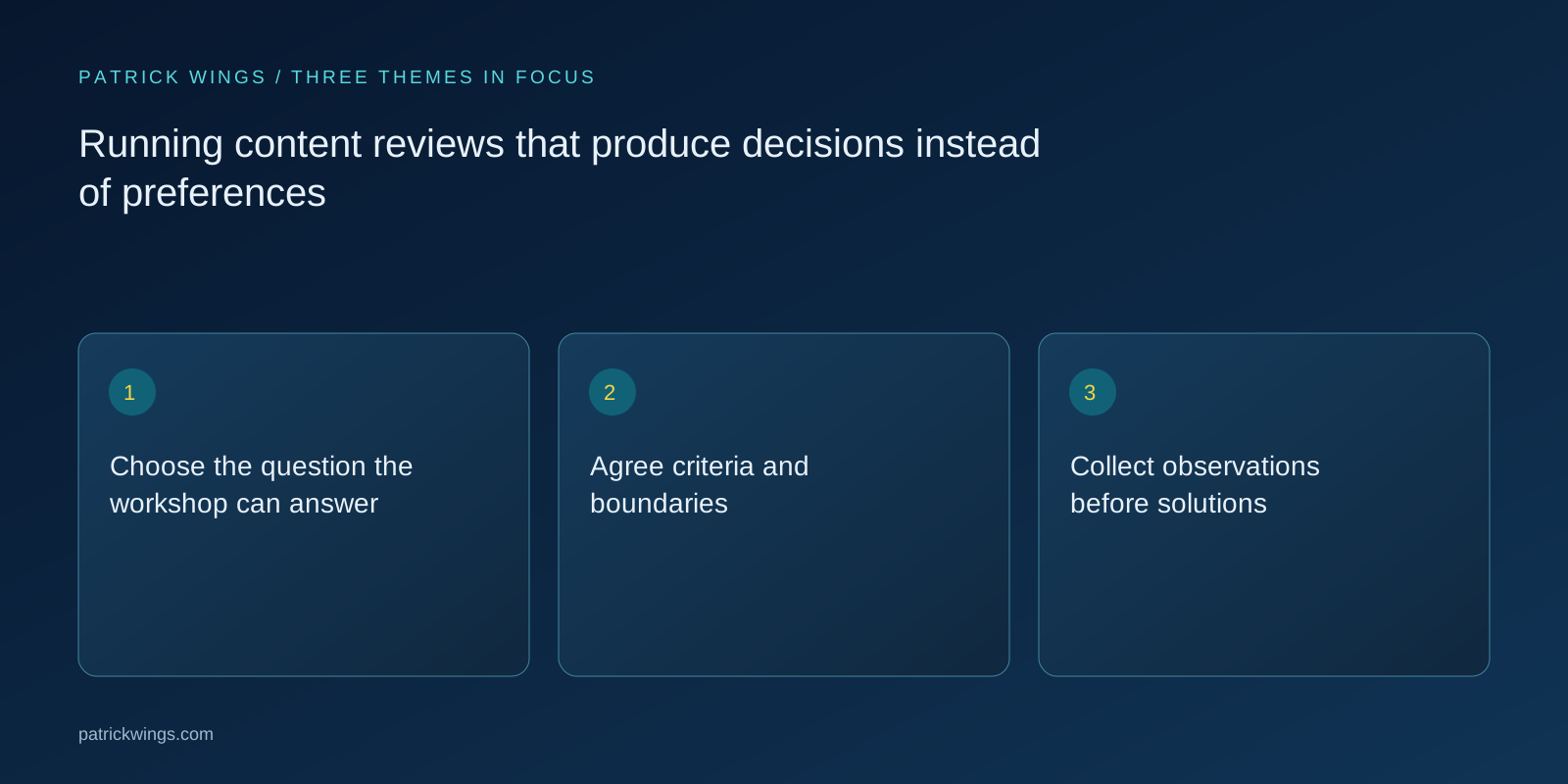
Collect observations before solutions
Ask for specific locations: where is a connection missing, a term unclear or a claim unsupported? Separate observations from proposed wording. “The second step assumes an unexplained approval” is more testable than “This does not feel right.” Allow individual review before discussion so the first forceful opinion does not determine everyone's perspective. Preserve identifiable strengths too. Otherwise revision may remove the explanation that already works while attempting to satisfy a vague concern, leaving the text different but no more useful for the person trying to follow its argument. Explore this further in the guide Editorial approvals with clear responsibilities and bounded review.
Translate hypothetical feedback
Suppose someone says a guide “needs more energy.” The facilitator asks where the reader's task stops moving forward. Discussion reveals that a long introduction hides the first practical action. The decision is to move the direct answer earlier and place background later. This hypothetical example establishes no universal rule about text length. It shows how to turn taste into a concrete observation and then a reasoned change, which still needs checking against the actual draft and its purpose rather than being adopted as a permanent stylistic rule.

Decide changes by consequence
Group feedback into comprehension, factual accuracy and optional presentation. Resolve errors that could cause wrong decisions first, then structure and wording. Proposed sentences need not be copied verbatim; solving the identified problem matters. Record decision, reason and owner. Conflicting factual assertions require investigation rather than a compromise sentence that merely satisfies both contributors. Define which changes need another check and which the editor can implement independently. This avoids creating an undefined review loop after the meeting when everyone expects a different level of involvement in the revised version.
Close with a usable handover
Summarize agreed changes, open questions and next checks. Give the writer a coherent assignment instead of competing comments. Review the revision against the original criteria. Label new requirements as additions. Later, assess whether the workshop resolved important problems or merely generated opinions. Improve the format through practice: retain questions that enable decisions and remove rituals that consume time without an identifiable contribution to quality or comprehension. The completed review should leave participants able to explain what changed and why the next draft will better serve its intended reader.
INTERACTIVE / FROM READING TO ACTION
Three checkpoints for your implementation
Choose a checkpoint and track your reading progress. Checks are neither saved nor sent and do not score your business.
CHECKPOINT 01
Collect observations before solutions
Ask for specific locations: where is a connection missing, a term unclear or a claim unsupported?
Explore in the article ↗CHECKPOINT 02
Translate hypothetical feedback
Suppose someone says a guide “needs more energy.” The facilitator asks where the reader's task stops moving forward.
Explore in the article ↗CHECKPOINT 03
Decide changes by consequence
Group feedback into comprehension, factual accuracy and optional presentation.
Explore in the article ↗Frequently asked questions
Who should attend?
People with specific review responsibilities or authority for the necessary decisions.
How should preferences be handled?
Ask for the affected passage and its consequence for the reader task.
Must everyone read the entire draft together?
No. Preparation and selected passages can focus shared time on decisions.
How can I put “Choose the question the workshop can answer” into practice?
Establish whether the review concerns structure, comprehension, evidence or fundamental messaging. These do not always belong in one session. If positioning remains unresolved, collective punctuation edits accomplish little.
What matters when working on “Agree criteria and boundaries”?
Start with the audience, its task and the intended outcome. Select concrete criteria, such as a recognizable main answer, explicit prerequisites and an applicable example. State what the session will not decide.