
THE SHORT ANSWER
Validate lead scoring against later commercial outcomes and practical readiness.
For the broader picture of how target customers, channels and sales handoffs work together, read the pillar guide B2B demand generation: from attention to qualified pipeline.
Treat prioritisation as a testable hypothesis
Validate lead scoring against later commercial outcomes and practical readiness. A points system starts as a hypothesis about priority. Many clicks can indicate interest, but also students, existing customers or intensive research without a suitable project. Separate fit, behaviour and confirmed need rather than collapsing them immediately.
Identify the scarce resource the score allocates: initial review, specialist conversation or substantial advisory work. A rule may help one task and fail another. Choose an outcome that can later be confirmed so validation does not merely use more activity to declare that an activity-based priority was correct. Explore this further in the guide B2B conversion goals: organise meaningful business signals.
Document fit and behaviour separately
Document each rule with rationale, source, expiry and expected relationship to the outcome. Keep negative criteria separate from missing information. Check that scoring uses data available when prioritisation happens; later contract information must not leak into historical validation and make the system appear more accurate than it was.
The rule register contains attribute, point effect, commercial rationale, source and expiry logic. Separate unknown from negative. Missing company size does not establish poor fit. Hard exclusions need their own rule that unlimited click points cannot offset. Also specify whether the calculation uses individual information, company information or an explicitly defined combination.
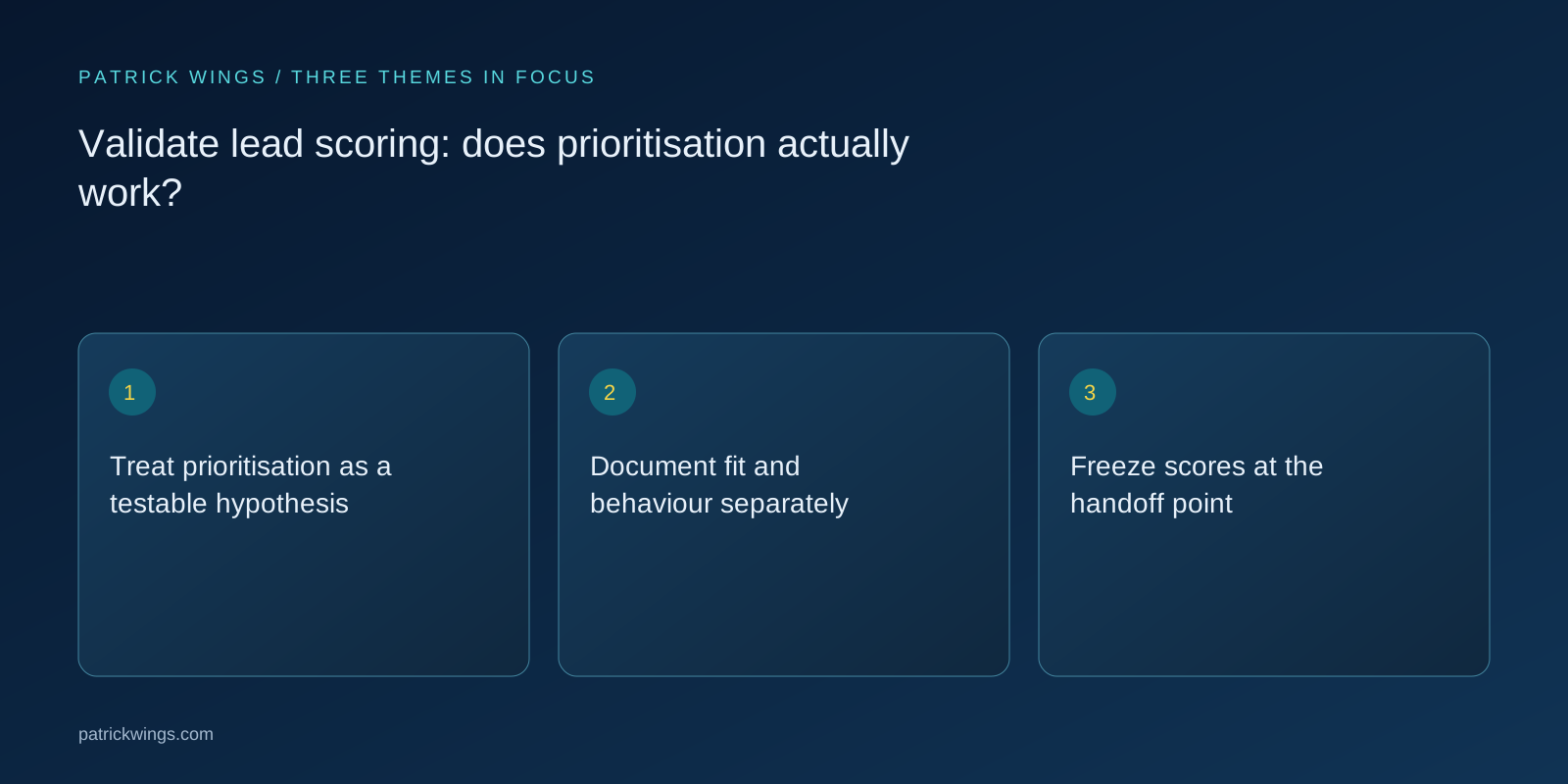
Freeze scores at the handoff point
Freeze the score at handoff and observe comparable groups for equal time. Review high and low scores plus an unscored sample. Account for sales treatment: if only highly rated contacts receive attention, the resulting outcome difference cannot be attributed entirely to the quality of the scoring system.
Store score, version and available input data at handoff. Later enrichment must not invisibly improve the historical rating. Check individual cases against what was known at that moment. If an account later becomes a customer, that outcome must not retrospectively become an input supposedly demonstrating that the earlier prediction already identified the winner.
Recognise unequal handling in an example
An invented test places one hundred contacts in a high group and one hundred in a low group. Twenty high-scored and five low-scored contacts produce suitable conversations. If the second group was barely approached, the difference alone does not validate scoring. A fairer test needs comparable handling or explicitly limited interpretation.
The invented high and low groups need a comparable opportunity for substantive review. Otherwise the test partly measures the decision about who received attention. Label that as a treatment difference. A controlled sample outside the priority group helps discover suitable missed cases without requiring equally intensive handling of the entire remaining workload.

Check data gaps and false precision
Points create false precision when weights are invented without evidence. Company size explains fit only when relevant to the offer. Repeated activity should not endlessly compensate for a permanent exclusion criterion. Also investigate whether missing data systematically lowers scores for particular groups that might still contain suitable buyers. Explore this further in the guide Account engagement: distinguish activity from credible demand.
Investigate false positives by cause: unsuitable fit, unclear role, stale activity or unconfirmed project. For false negatives, examine what necessary information was missing. Tuning the model to one large won customer may overfit an exceptional case. Look for repeated defensible patterns before allocating additional points or relaxing exclusions to make a single anecdote fit.
Measure useful priorities and missed cases
Evaluate useful cases among priorities, missed suitable cases and additional workload. Better scoring should allocate scarce attention more effectively. If handoff volume rises while quality stays unchanged, the threshold may simply have been loosened; that is a volume decision rather than demonstrated improvement in predictive performance.
Report useful cases among prioritised contacts and suitable cases found outside that group. Include handling effort. A higher hit rate can result from an extremely narrow selection while overlooking many worthwhile projects. The appropriate threshold therefore depends on available attention and the commercial cost of missed cases, rather than maximising one percentage regardless of its consequences.
Improve rule versions with sales feedback
Version rules and changes. Sales provides reasoned feedback on false positives and missed cases while operations checks data collection. Adjust a small number of justified rules and test again, preserving an understandable system instead of accumulating exceptions until the original logic can no longer be explained.
Changes receive a version date, rationale and intended review horizon. Sales supplies concrete rejection evidence rather than general complaints about quality. Operations checks whether available data can reliably calculate the proposed rules. Compare old and new logic on the same prepared sample before live allocation changes and unequal subsequent handling makes the comparison harder to interpret again.
INTERACTIVE / FROM READING TO ACTION
Three checkpoints for your implementation
Choose a checkpoint and track your reading progress. Checks are neither saved nor sent and do not score your business.
CHECKPOINT 01
Freeze scores at the handoff point
Freeze the score at handoff and observe comparable groups for equal time.
Explore in the article ↗CHECKPOINT 02
Recognise unequal handling in an example
An invented test places one hundred contacts in a high group and one hundred in a low group.
Explore in the article ↗CHECKPOINT 03
Check data gaps and false precision
Points create false precision when weights are invented without evidence.
Explore in the article ↗Frequently asked questions
How many points for a download?
An arbitrary number is not defensible; test its relationship with later suitable outcomes.
Why review low scores?
Reviewing low-scored cases reveals suitable prospects the system may miss. Give a sample meaningful assessment rather than assuming low priority proves poor commercial fit.
Is a higher close rate at the top enough?
Not without considering handling, maturity and possible data leakage.
How can I put “Treat prioritisation as a testable hypothesis” into practice?
Validate lead scoring against later commercial outcomes and practical readiness. A points system starts as a hypothesis about priority. Many clicks can indicate interest, but also students, existing customers or intensive research without a suitable project.
What matters when working on “Document fit and behaviour separately”?
Document each rule with rationale, source, expiry and expected relationship to the outcome. Keep negative criteria separate from missing information. Check that scoring uses data available when prioritisation happens; later contract information must not leak into historical validation and make the system appear more accurate than it was.