
THE SHORT ANSWER
Organise conversion goals by business significance and measurement reliability.
For the broader picture of how target customers, channels and sales handoffs work together, read the pillar guide B2B demand generation: from attention to qualified pipeline.
Order commercial signals
Organise conversion goals by business significance and measurement reliability. A page view, download, suitable enquiry and signed contract are different signals. A hierarchy helps observe behaviour without treating every interaction as equally valuable commercial progress or automatically making it a bidding objective. Explore this further in the guide B2B bidding needs trustworthy conversion signals.
Start with action, interpretation and missing proof. A product-page visit is observation, an enquiry expresses interest and qualification confirms suitability. This also helps sales understand what a handoff already establishes and what still requires investigation before a project can proceed.
Define entry to every stage
For each stage, describe entry criteria, validation owner and relationship to the next step. Separate observable micro-actions from business-confirmed events. Google Ads settings for primary, secondary and custom goals must then reflect the hierarchy; inspect how campaigns actually use those goals rather than relying on names alone.
Define the information and reviewer required for qualified status. An automatically applied form label is not identical to human-confirmed fit. If both share a technical name, resolve the difference or report them separately before treating the field as a common business definition. Explore this further in the guide Offline conversions: return qualified CRM events to advertising.
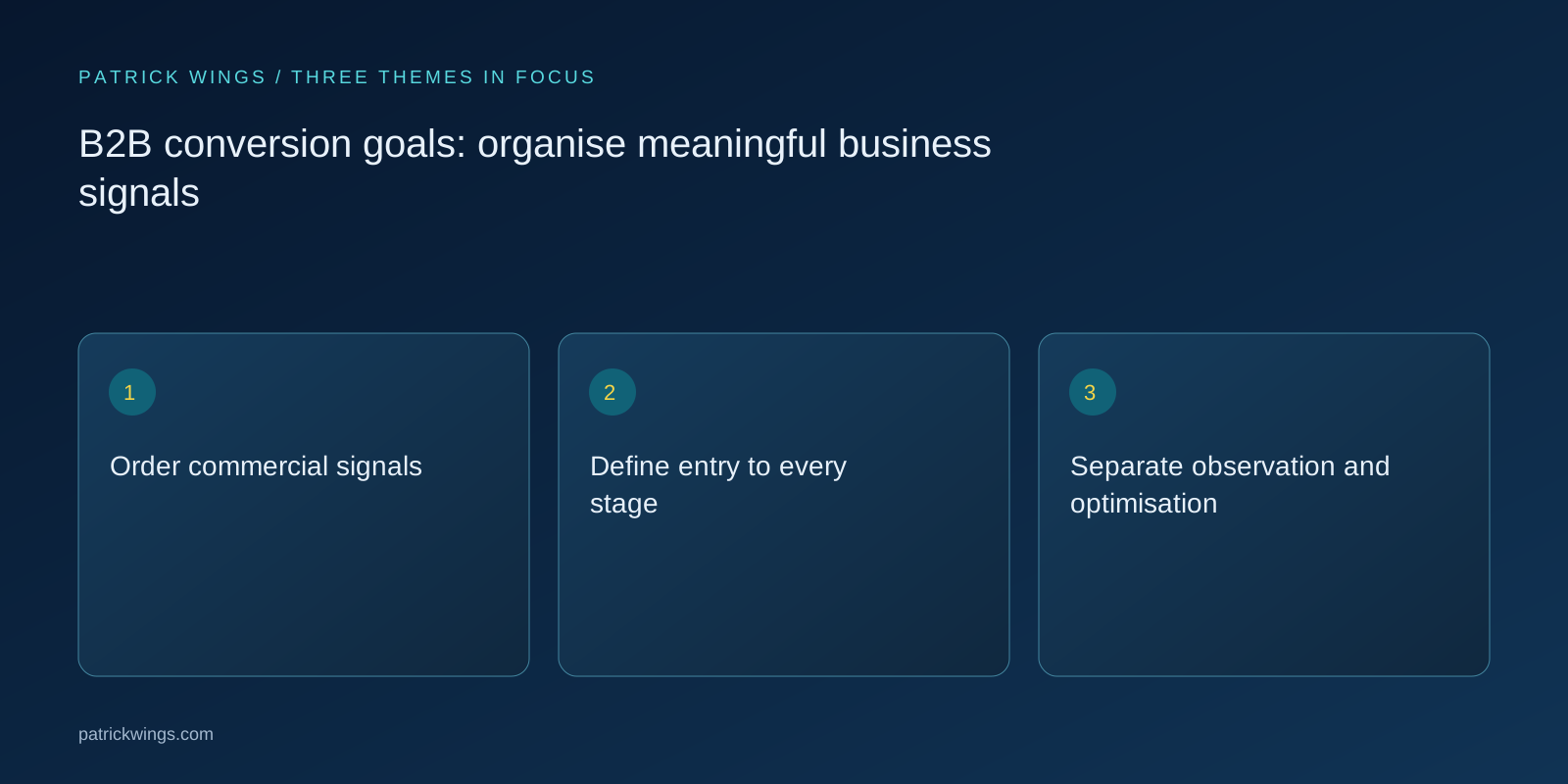
Separate observation and optimisation
Map the path from initial interest to a qualified opportunity. Mark which events are automatic and which require human confirmation. Check duplicates and repeated counting of one buying decision. Select a reliable optimisation objective while retaining earlier signals separately for diagnosis and investigation.
Give each action a technical identifier and business unit. Downloads may be contact-level while opportunities are project-level. Without that distinction, additional colleagues in one project can appear to represent new demand or more commercial progress when the underlying purchasing decision has not changed.
Why 236 events are not one outcome
A hypothetical account records two hundred downloads, thirty advisory requests and six qualified opportunities. Summing all three as equivalent produces 236 events dominated by downloads. The hierarchy instead shows three kinds of progress and reveals that the same person may have passed through several of those stages.
Check how many of the thirty enquiries already appear among the two hundred downloads. Unique contacts require reconciliation; stage analysis can legitimately retain both events. Counting distinct people is therefore a different calculation from counting completed process steps and should be labelled accordingly.

Validate early and late signals
A later stage is not automatically the best current bidding signal if it is rare, delayed or incompletely captured. An early event should not be declared commercially meaningful solely because it happens frequently either. Examine the relationship between stages using actual cases rather than assuming every transition is inevitable.
An earlier stage may be a provisional signal when its relationship with later business is plausible and reviewed. Label that role as a proxy. Otherwise a pragmatic temporary choice can become an unsupported permanent assumption that every micro-action has equivalent commercial value.
Review transitions through cases
Review transitions, coverage and definition stability. If downloads increase but suitable enquiries do not, inspect the offer and audience. If qualification falls, also check changes in sales rules. The hierarchy should prompt these investigations rather than imply a compulsory linear journey followed by every buyer.
Include numerator, denominator and observation age with every transition rate. Ten qualifications from twenty mature enquiries differ from ten in a young group. When rates shift abruptly, first check whether entry criteria or data coverage changed simultaneously with the reported performance.
Version the conversion register
Maintain a goal register with definition, collection method, usage and change date. Marketing, sales and analytics should confirm the mapping together. Classify new micro-actions as observations first rather than allowing them to inflate the headline conversion count without checking their relationship with business outcomes.
Add validation status, consuming campaigns and review dates to the register. Preserve labels for historical definitions when a goal changes. Otherwise a time series can imply progress that merely reflects an easier entry criterion rather than improved commercial results.
INTERACTIVE / FROM READING TO ACTION
Three checkpoints for your implementation
Choose a checkpoint and track your reading progress. Checks are neither saved nor sent and do not score your business.
CHECKPOINT 01
Separate observation and optimisation
Map the path from initial interest to a qualified opportunity.
Explore in the article ↗CHECKPOINT 02
Why 236 events are not one outcome
A hypothetical account records two hundred downloads, thirty advisory requests and six qualified opportunities.
Explore in the article ↗CHECKPOINT 03
Validate early and late signals
A later stage is not automatically the best current bidding signal if it is rare, delayed or incompletely captured.
Explore in the article ↗Frequently asked questions
Should micro-conversions be deleted?
No. They can remain useful diagnostics without becoming equivalent business goals.
Is the latest stage always better?
Only when availability, quality and delay suit the decision.
Can stages be added together?
Only with an explicit interpretation; the sum often counts one buying decision repeatedly.
How can I put “Order commercial signals” into practice?
Organise conversion goals by business significance and measurement reliability. A page view, download, suitable enquiry and signed contract are different signals. A hierarchy helps observe behaviour without treating every interaction as equally valuable commercial progress or automatically making it a bidding objective.
What matters when working on “Define entry to every stage”?
For each stage, describe entry criteria, validation owner and relationship to the next step. Separate observable micro-actions from business-confirmed events. Google Ads settings for primary, secondary and custom goals must then reflect the hierarchy; inspect how campaigns actually use those goals rather than relying on names alone.