
THE SHORT ANSWER
Lead qualification answers different questions: can a business benefit from your solution, is a person showing relevant interest, and is there a concrete reason for a conversation? Separating those dimensions makes campaign decisions and sales handovers easier to understand.
For the broader picture of how target customers, channels and sales handoffs work together, read the pillar guide B2B demand generation: from attention to qualified pipeline.
Start with actual product suitability
Define the few conditions without which a useful implementation is unlikely. These may concern the use case, available integrations, market or organisational prerequisites. Separate them from attractive additional attributes. An impressive job title does not compensate for an unsuitable requirement. Also identify which information you know reliably and which needs discovery. Unknown information is not negative evidence. For an illustrative IT product, a particular existing system may matter much more than exact employee count, which only provides rough context. This prioritisation prevents artificial precision and keeps qualification connected to whether your product can solve a meaningful problem for the organisation.
Do not confuse engagement with intention
An article view, download or webinar attendance can represent professional learning. That has value but does not establish an active procurement process. Consider the substance of an interaction: a specific integration question may suggest evaluation more strongly than several general blog visits. Even that remains an interpretation until confirmed. Give sales observed facts rather than exaggerated claims about intention. Record the subject requested and any question voluntarily provided. This creates a useful conversation starter without attributing buying readiness the prospect never expressed. It also makes qualification less dependent on the volume of easily collected digital activity.
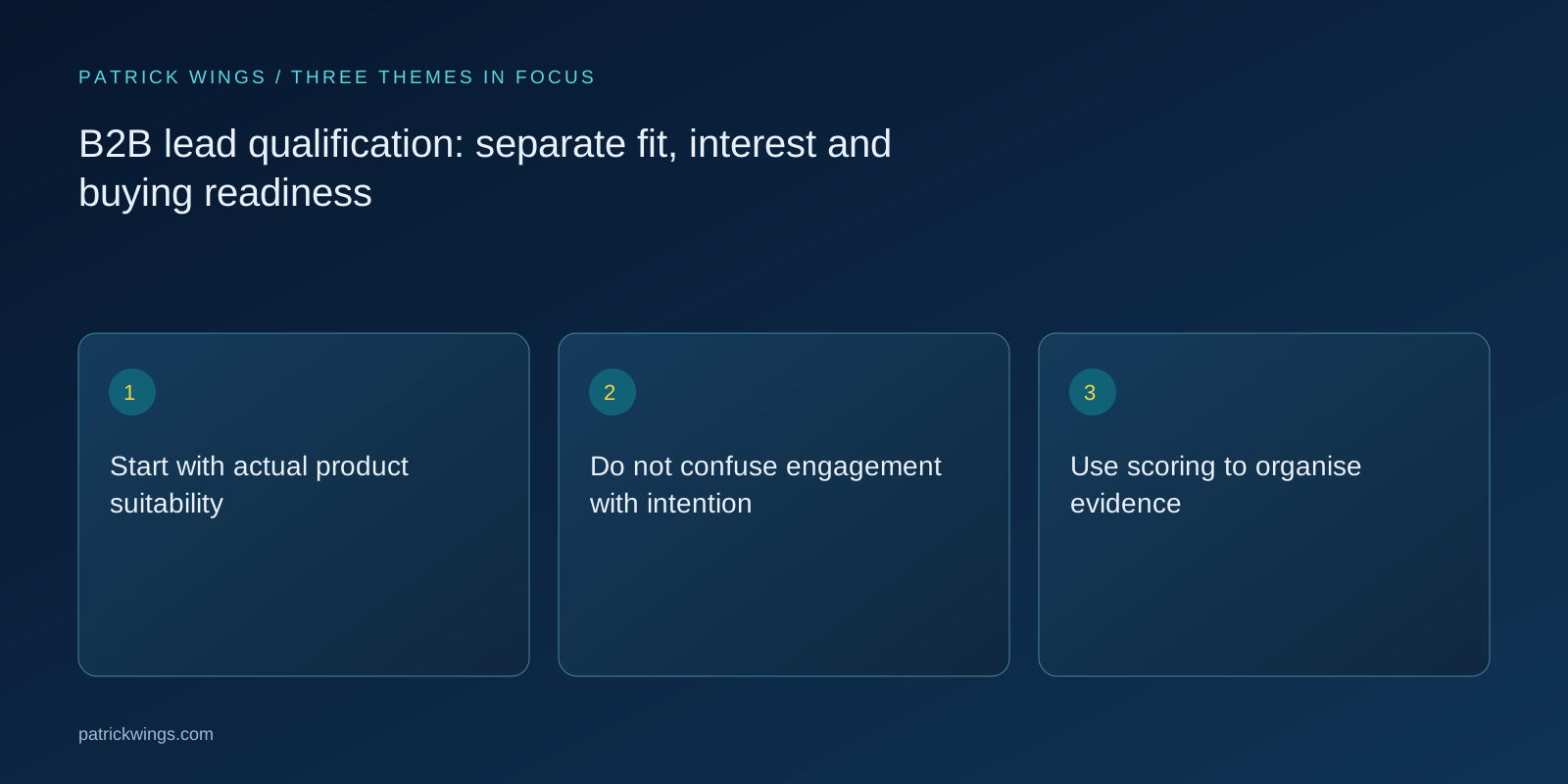
Use scoring to organise evidence
A simple model can show fit and engagement separately. HubSpot documents these scoring approaches; available functionality depends on the subscription. Establish criteria, weighting and limits before representing them in software. Begin with a few explainable signals and test them against real cases. If repeated interactions accumulate points without limits, curious students or suppliers can become accidental priorities. Manage repetition and consider recency. A score should support a reasoned decision rather than imply a precise closing probability you have never validated. Make the underlying observations accessible so the person receiving a contact understands what the number means and where uncertainty remains.
Check conversation readiness directly
For a genuine enquiry, use open and respectful questions about the problem, current approach and desired change. Understand who is involved and which next action would help both sides. A rigid interrogation about budget and authority may be premature when the person is still organising requirements. Explain why information is useful instead. For example, understanding the existing system landscape helps determine whether a technical review is necessary. Keep confirmed statements separate from assumptions in the record. If there is no active project, a useful resource may be a better response than forcing a demonstration meeting merely to satisfy an internal conversion target.

Connect every status to a next action
Each qualification decision should have an operational consequence: sales accepts ownership, someone asks a clarification question, the contact receives relevant nurturing or the enquiry is excluded with a reason. Define accountable roles and observable rules for these paths. Record why a status changed. Marketing can then distinguish a targeting problem from a timing issue or follow-up failure. Prevent conflicting automation when someone appears in multiple lists or expresses interest in several products. Where several people belong to one company, the account situation matters more than evaluating each person's isolated activity without its shared commercial context. Explore this further in the guide B2B lead nurturing: support unresolved buying decisions.
Review the model against actual cases
Compare qualified and excluded contacts with their later journeys. Which criteria helped, and which rejected suitable businesses too early? Check whether data quality or different handling distorts the comparison. Poor follow-up must not be reclassified retrospectively as poor lead quality. Supplement reports with shared case reviews involving sales. Revise the model when the product, target market or offers change. Record material adjustments so historical cohorts remain understandable. A simple, maintained system is more useful than an elaborate score whose rules nobody can explain. The goal is consistent, appropriate treatment of prospective customers rather than a larger collection of qualification fields. Explore this further in the guide Marketing and sales alignment: clear handovers instead of MQL arguments.
INTERACTIVE / FROM READING TO ACTION
Three checkpoints for your implementation
Choose a checkpoint and track your reading progress. Checks are neither saved nor sent and do not score your business.
CHECKPOINT 01
Use scoring to organise evidence
A simple model can show fit and engagement separately.
Explore in the article ↗CHECKPOINT 02
Check conversation readiness directly
For a genuine enquiry, use open and respectful questions about the problem, current approach and desired change.
Explore in the article ↗CHECKPOINT 03
Connect every status to a next action
Each qualification decision should have an operational consequence: sales accepts ownership, someone asks a clarification question, the contact receives relevant nurturing or the enquiry is excluded with a reason.
Explore in the article ↗Frequently asked questions
Does a high score equal buying intent?
No. A score combines the signals you selected. Its usefulness depends on criteria, data quality and regular validation.
How do fit and engagement differ?
Fit describes suitability. Engagement describes observed interactions. Neither alone proves a current project.
How should missing information be handled?
Mark it as unknown and clarify important questions appropriately. Missing information should not automatically become confirmed disqualification.
How can I put “Start with actual product suitability” into practice?
Define the few conditions without which a useful implementation is unlikely. These may concern the use case, available integrations, market or organisational prerequisites. Separate them from attractive additional attributes.
What matters when working on “Do not confuse engagement with intention”?
An article view, download or webinar attendance can represent professional learning. That has value but does not establish an active procurement process. Consider the substance of an interaction: a specific integration question may suggest evaluation more strongly than several general blog visits.