
THE SHORT ANSWER
Account engagement describes observed company-level activity. It does not automatically establish a funded buying plan. Translate signals into a justified next question rather than turning a high activity total directly into a sales priority. Identity, context and confirmed need determine how useful an observation actually is.
For the broader picture of how target customers, channels and sales handoffs work together, read the pillar guide B2B demand generation: from attention to qualified pipeline.
Define the company unit first
Decide whether an account represents a legal entity, regional branch or entire corporate group. A multinational may run independent projects alongside central procurement. Domain and company name are then insufficient for assigning activity to a particular project. Associate known contacts with the relevant unit and flag ambiguous matches. Technical recognition through network information does not reliably identify a particular person. Keep known contact activity, estimated company visits and explicitly confirmed project information separate. This preserves the distinction between statements you can support and questions that still need research before anybody should act on them. Explore this further in the guide Recognise and interpret B2B buying triggers.
Order signals by evidential strength
Build an event record containing time, source, role, material and possible meaning. A visit can indicate curiosity; a question about a planned integration provides more specific context. Several interactions from one person are not several independent interested buyers. Group repeated technical events and exclude internal testing. Preserve contradictory information too: somebody may inspect a feature while their project remains officially deferred. A score assembled from numerous weak events should not overwrite a known reason for postponement without review. Evidence becomes stronger through what happened and what was said, rather than through an accumulating event count alone. Explore this further in the guide Buying committees: reach several roles in demand development.
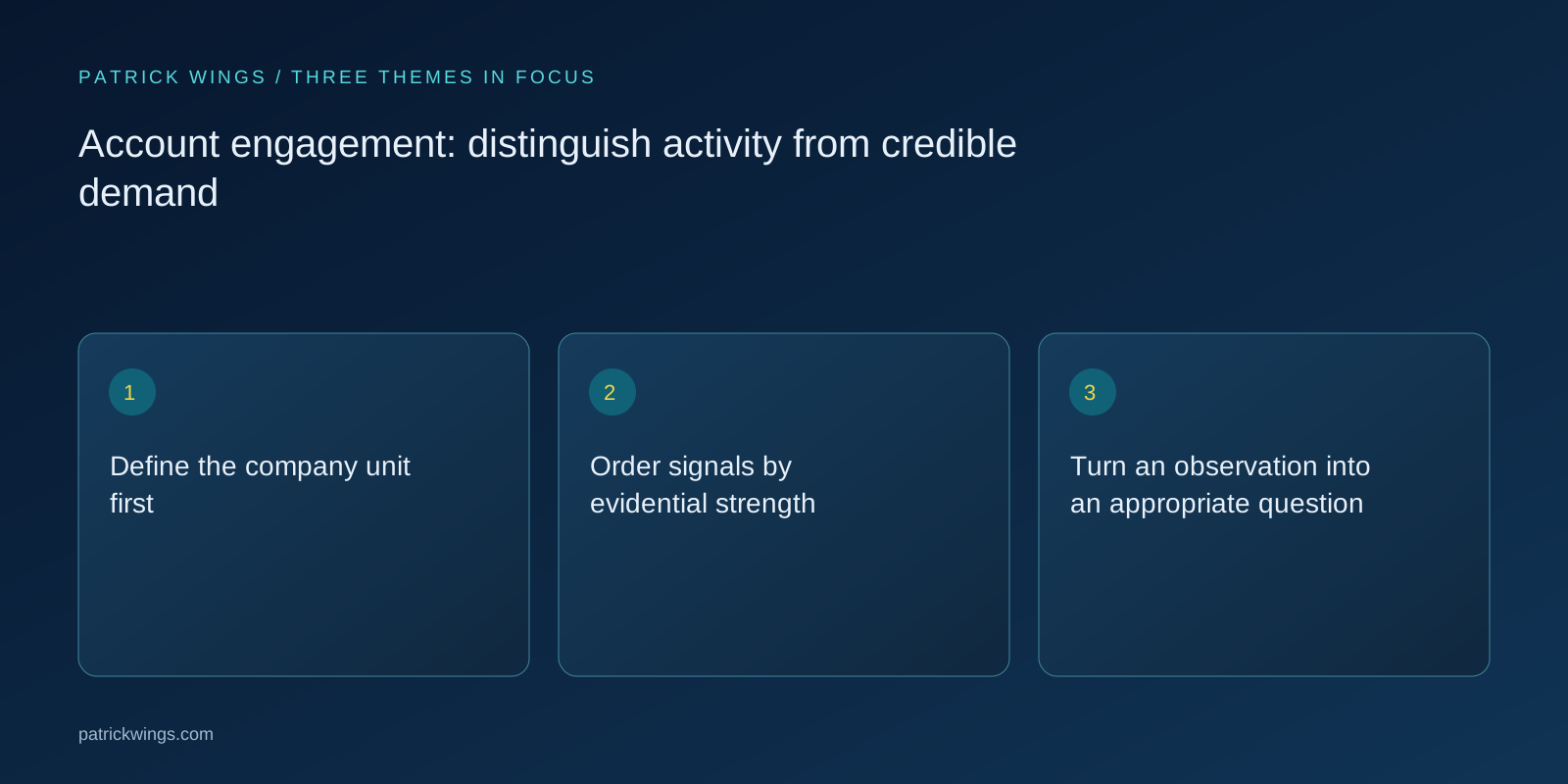
Turn an observation into an appropriate question
Connect each usable pattern with a restrained working question. Repeated reading about integration can justify making relevant technical material available. It does not justify announcing that the company is ready to buy. When a known contact requests a conversation, ask about the use case, participants and unresolved conditions. Respect existing ownership and communication preferences. Internal notes should state observation and inference separately. Sales can then respond appropriately without implying that every online movement is being monitored or that the supplier knows more about the project than has actually been confirmed. Relevant help is usually a better response than an exaggerated buying-intent claim.
Interpret a hypothetical pattern
An invented software supplier observes twelve technical events associated with a corporate group. Eight are repeat visits from one known contact, two are internal tests and two remain uncertain matches. This is not evidence of twelve participating buyers. In conversation, the contact describes only a preliminary review for the following financial year. The useful response is a technical information pack and an agreed later discussion. These invented figures illustrate how cleaning and conversation context make activity interpretable. They also show why raw totals cannot replace an explicit definition of an opportunity or demonstrate that multiple stakeholders support the project.

Measure activity and project progress separately
Report account activity alongside confirmed commercial steps, such as a named problem owner, resolved prerequisites or a mutually planned next meeting. Without those facts, the project stage remains unknown. HubSpot’s target account view can bring contacts, activities and deals together; that does not automatically evaluate their commercial significance. Also check whether existing customers, applicants or partners inflate activity. Technical documentation may support customer service without indicating acquisition demand. Different purposes require different follow-up processes so a useful support visit does not unexpectedly trigger an unsuitable prospecting campaign. Keep those interpretations visible to the person reviewing the next action.
Maintain a compact signal review record
For each reviewed account, record the latest observation, confidence, confirmed context, contradictory evidence and next permitted action. An owner decides the response, while a review date prevents old signals from appearing permanently current. Later compare which patterns led to suitable conversations and which regularly produced false alarms. Change the interpretation rather than merely adding more points. Retire expired assumptions from prioritisation while retaining necessary history. The output should be an explainable recommendation: research further, provide relevant help, coordinate with the established contact or deliberately take no action yet. That is more operationally useful than a rising number without an agreed meaning.
INTERACTIVE / FROM READING TO ACTION
Three checkpoints for your implementation
Choose a checkpoint and track your reading progress. Checks are neither saved nor sent and do not score your business.
CHECKPOINT 01
Turn an observation into an appropriate question
Connect each usable pattern with a restrained working question.
Explore in the article ↗CHECKPOINT 02
Interpret a hypothetical pattern
An invented software supplier observes twelve technical events associated with a corporate group.
Explore in the article ↗CHECKPOINT 03
Measure activity and project progress separately
Report account activity alongside confirmed commercial steps, such as a named problem owner, resolved prerequisites or a mutually planned next meeting.
Explore in the article ↗Frequently asked questions
Do many visits prove buying intent?
No. They show observed activity; project, need and ownership require separate confirmation.
Should anonymous signals be ignored?
No. Use them as uncertain research clues, not confirmed person or project information.
How does engagement differ from an opportunity?
Engagement is activity. An opportunity needs explicit commercial entry criteria and confirmed business context.
How can I put “Define the company unit first” into practice?
Decide whether an account represents a legal entity, regional branch or entire corporate group. A multinational may run independent projects alongside central procurement. Domain and company name are then insufficient for assigning activity to a particular project.
What matters when working on “Order signals by evidential strength”?
Build an event record containing time, source, role, material and possible meaning. A visit can indicate curiosity; a question about a planned integration provides more specific context. Several interactions from one person are not several independent interested buyers.