
THE SHORT ANSWER
Lead recycling develops deferred demand instead of repeatedly redistributing rejected contacts.
For the broader picture of how target customers, channels and sales handoffs work together, read the pillar guide B2B demand generation: from attention to qualified pipeline.
Separate postponement from lack of fit
Lead recycling develops deferred demand instead of repeatedly redistributing rejected contacts. Distinguish lack of fit from lack of timing. A suitable company without an active project needs different treatment from someone whose requirements the business cannot fundamentally serve with its current offer.
A deferral reason should explain what is missing now: priority, available resources, a technical prerequisite or an agreed date. A permanently unsupported use case does not belong in the same waiting process. Define the possible change for each reason so a later click cannot automatically invalidate every earlier rejection or qualification decision.
Record re-entry and contact preference
Record deferral reason, potential review date, communication preference and requalification conditions. Use appropriate process logic for temporary handling status. Resetting historical lifecycle stages can change reporting; inspect your CRM’s behaviour before overwriting history simply to represent a current waiting condition in the operational workflow.
The waiting profile contains last confirmed context, review deadline, permitted contact route and new information sales needs. An unknown review date remains unknown rather than becoming falsely precise through an invented value. Preserve earlier opportunity outcomes separately. Current handling can wait without rewriting historical qualification or completed losses simply to represent the present operational situation. Explore this further in the guide Segment nurturing around the unresolved buyer task.
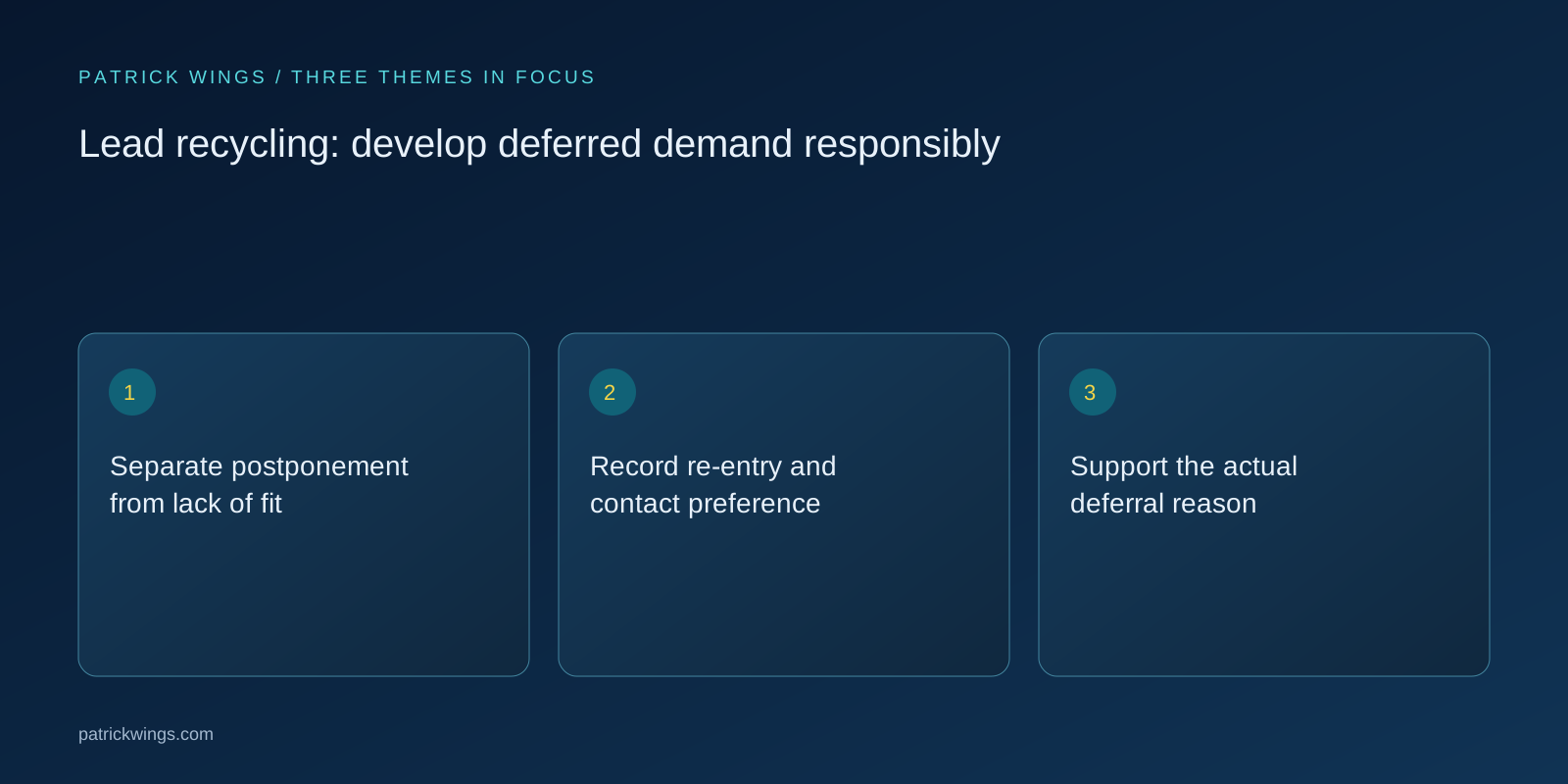
Support the actual deferral reason
Group cases by budget timing, priority, internal dependency or permanent misfit. Plan relevant communication and a substantive review. When new activity appears, check whether the original condition changed first; an engagement event does not automatically invalidate a documented reason that the enquiry could not proceed. Explore this further in the guide Lost opportunities: reactivate around a genuine change.
Give each group useful material that can address the missing prerequisite. For an integration dependency, preparation guidance is more relevant than weekly demo offers. An internal budget discussion may benefit from a defensible business case. Before handoff, explicitly check whether the original obstacle has been resolved or still prevents meaningful commercial handling.
Review a project dependency in an example
A hypothetical manufacturer postpones a software decision until an ERP migration next spring. The team records the dependency and offers a relevant integration guide. In spring it reviews migration progress. Another newsletter click in December is not sufficient to declare the same contact ready for sales again.
The hypothetical manufacturer needs a check on ERP migration progress before the planned spring review. If the timetable moved, the review date changes; if migration finished, an appropriate integration assessment can begin. A new contact from the same company first needs to be associated with this context rather than triggering a second parallel re-entry merely through a different email address.

Prevent endless handback loops
Recycling must not become an invisible endless loop for unsuitable contacts. Without clear re-entry conditions, scores and workflows repeatedly hand over the same unresolved problem. Respect rejected contact channels and outdated details too; an old enquiry does not justify every future form of outreach indefinitely.
Count repeated handbacks by case and retain the new rejection reason. When several returns cite the same unchanged prerequisite, reactivation logic is too weak. Accumulated opens should not independently remove a waiting status. Also check whether apparently absent activity reflects unreliable collection before permanently discarding a suitable case on the basis of silence alone.
Evaluate genuine re-entry and false alarms
Assess how many returned cases are genuinely workable and which reasons stop them again. Repeated false reactivation suggests weak re-entry rules. Recognise useful preparation as well as new handoffs: the objective is appropriate demand development rather than artificially inflating the volume passed to sales.
A useful review distinguishes waiting cases examined, confirmed changes, accepted re-entry and renewed postponement. Keep the original reason available for analysis. Do not assess only the number of records sent to sales. A smaller, well-prepared return can create more useful conversations than a large ambiguous batch of automatically reprioritised contacts whose circumstances remain unchanged.
Own deferred groups explicitly
Assign responsibility for each deferred group and a rule-review date. Marketing maintains relevant content and observation while sales defines business re-entry conditions. Permanently unsuitable cases should leave acquisition processing so the waiting list does not become an unmanageable archive of every person who once made contact.
Each waiting reason needs an owner for relevant content and another for substantive requalification. Review expired contact details and communication preferences before further outreach. A permanent stop must be possible. The maintained list should describe real unresolved prerequisites and appropriate next actions rather than preserve every historical contact indefinitely without an identifiable ongoing purpose.
INTERACTIVE / FROM READING TO ACTION
Three checkpoints for your implementation
Choose a checkpoint and track your reading progress. Checks are neither saved nor sent and do not score your business.
CHECKPOINT 01
Support the actual deferral reason
Group cases by budget timing, priority, internal dependency or permanent misfit.
Explore in the article ↗CHECKPOINT 02
Review a project dependency in an example
A hypothetical manufacturer postpones a software decision until an ERP migration next spring.
Explore in the article ↗CHECKPOINT 03
Prevent endless handback loops
Recycling must not become an invisible endless loop for unsuitable contacts.
Explore in the article ↗Frequently asked questions
Should every rejected lead be recycled?
No. Temporary deferral needs different handling from permanent lack of fit. Recycle only when a plausible changed condition could make the enquiry suitable again.
Is a new click sufficient?
Only if it actually satisfies a meaningful re-entry condition.
Should lifecycle be reset?
Not without review. Preserve history and model temporary status appropriately.
How can I put “Separate postponement from lack of fit” into practice?
Lead recycling develops deferred demand instead of repeatedly redistributing rejected contacts. Distinguish lack of fit from lack of timing. A suitable company without an active project needs different treatment from someone whose requirements the business cannot fundamentally serve with its current offer.
What matters when working on “Record re-entry and contact preference”?
Record deferral reason, potential review date, communication preference and requalification conditions. Use appropriate process logic for temporary handling status. Resetting historical lifecycle stages can change reporting; inspect your CRM’s behaviour before overwriting history simply to represent a current waiting condition in the operational workflow.