
THE SHORT ANSWER
An implementation guide should let a reader prepare, perform and verify a bounded task. Write prerequisites, ordered actions, observable outcomes and recovery paths before adding background explanations. The guide is ready when a representative user can follow it without relying on the author to fill gaps during the exercise.
To see how this step fits into your content strategy, read the pillar guide B2B content marketing: From useful expertise to qualified demand.
Choose a task with a finish line
Name the starting state and the verified final state. “Implement our platform” is too broad for a usable guide; “prepare a pilot workspace with approved sample data” gives an author something testable. Specify the intended role and the authority that role needs. Separate administrator work from actions ordinary users can complete. This distinction prevents a technically correct sequence from becoming unusable when readers discover halfway through that they lack the required permissions.
Make prerequisites observable
Replace vague preparation advice with checks a reader can perform. Identify supported environments, required access, dependencies and the information they should collect beforehand. Do not publish credentials or real customer datasets in examples. Explain what to do when a prerequisite fails, including when to involve an administrator. Conditions that vary by product version need a visible scope statement and a named owner who can update the instructions after product changes. Explore this further in the guide Technical one-pagers that connect value and prerequisites.
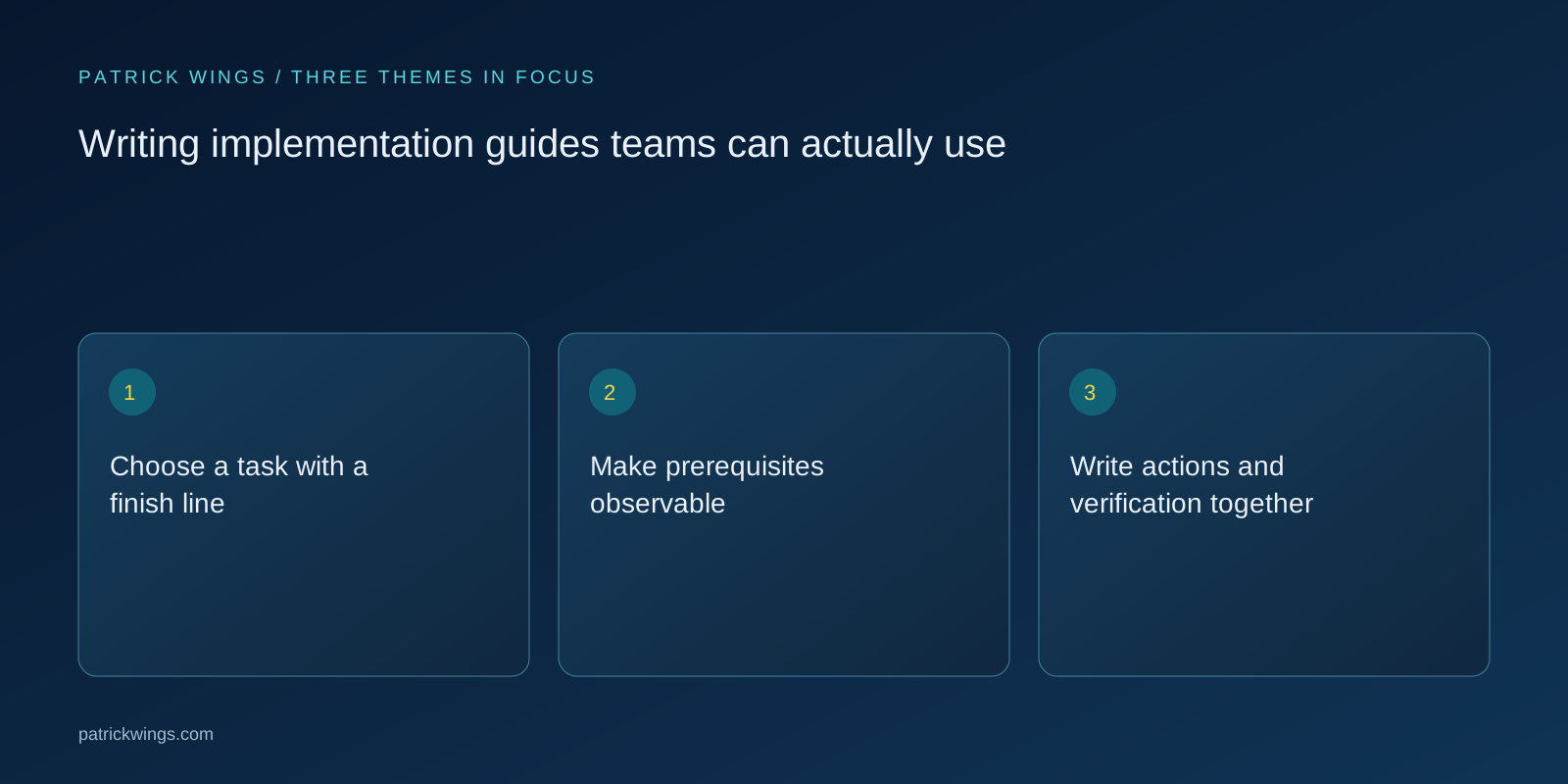
Write actions and verification together
Each step should contain an action, its expected result and a way to recognize a problem. Keep one significant action per step where possible. Explain why an irreversible operation deserves extra attention before the reader reaches it. Use interface labels accurately, while ensuring a screenshot is not the only place the instruction appears. Descriptive headings make it easier to return to the right stage after an interruption or an internal handoff.
Demonstrate a hypothetical pilot
For example, imagine a fictional analytics service being piloted with synthetic event records. The guide asks the reader to create a test workspace, connect a sample source and check whether a known sample event appears. It then explains how to disconnect the test source. This is an illustration, not an assertion about a real product. Its value lies in making success and cleanup concrete rather than ending at a vague “configuration completed” message.

Design for predictable failure
Ask implementation specialists which step most often requires a clarification. Add troubleshooting organized by visible symptoms instead of internal component names alone. Distinguish safe checks from changes that require support. Avoid presenting an untested workaround as a standard procedure. When an error could have several causes, state the diagnostic order and the evidence to collect. Readers should know when to stop rather than repeating a destructive operation in hope of a different result.
Test the instructions with a fresh reader
Observe someone who matches the intended audience performing the task in an appropriate test environment. Ask them to describe their understanding, but do not coach every hesitation away. Record missing information, mismatches with the interface and assumptions about prior knowledge. A successful internal walkthrough by the person who configured the system is weak evidence of usability. Repeat the affected steps after changes rather than assuming an editorial fix also resolves the practical problem. Explore this further in the guide Testing whether readers can actually use your content.
Use a release and maintenance checklist
Check permissions, prerequisites, current terminology, action order, expected results, fallback paths, image descriptions and links to detailed documentation. Date the verified version and define the event that triggers review. Offer a contact route for reporting a broken step. Keep marketing claims separate from task completion criteria: finishing a pilot configuration does not prove business value. If the document is promotional, make its limits as an implementation reference explicit before anyone relies on it.
INTERACTIVE / FROM READING TO ACTION
Three checkpoints for your implementation
Choose a checkpoint and track your reading progress. Checks are neither saved nor sent and do not score your business.
CHECKPOINT 01
Write actions and verification together
Each step should contain an action, its expected result and a way to recognize a problem.
Explore in the article ↗CHECKPOINT 02
Demonstrate a hypothetical pilot
For example, imagine a fictional analytics service being piloted with synthetic event records.
Explore in the article ↗CHECKPOINT 03
Design for predictable failure
Ask implementation specialists which step most often requires a clarification.
Explore in the article ↗Frequently asked questions
Should marketing own technical accuracy?
Marketing can coordinate the guide, but a qualified technical owner must verify procedures.
Are screenshots required?
Only when they help identify a relevant state; written actions and checks must remain understandable.
How often should we update it?
Use product and interface changes as triggers, supplemented by a scheduled ownership review.
How can I put “Choose a task with a finish line” into practice?
Name the starting state and the verified final state. “Implement our platform” is too broad for a usable guide; “prepare a pilot workspace with approved sample data” gives an author something testable. Specify the intended role and the authority that role needs.
What matters when working on “Make prerequisites observable”?
Replace vague preparation advice with checks a reader can perform. Identify supported environments, required access, dependencies and the information they should collect beforehand. Do not publish credentials or real customer datasets in examples.