
THE SHORT ANSWER
Security content helps B2B buyers ask the right questions and locate appropriate evidence. It should neither simulate a security assessment nor promise absolute protection. Start with the product, operating scope and actual procurement question. Distinguish publicly explainable principles from documents available only through an agreed review process. This article addresses the editorial design of those materials. Technical security assessment, contract review and legal interpretation remain responsibilities of qualified specialists, not a marketing article or an automatically generated vendor score. The practical goal is a clearer evidence handover rather than an unsupported declaration that a buyer is safe.
To see how this step fits into your content strategy, read the pillar guide Content marketing for B2B SaaS: strategy, formats and qualified demand.
Identify the review decision and its participants
Ask which procurement decision the material should support. Early orientation about product access differs from technical acceptance of a particular operating model. Security, the business team, procurement and, where relevant, privacy specialists have distinct questions. State which phase the material addresses. A public overview can prepare a specialist review without predetermining its conclusion. CISA's Secure by Demand material supplies questions for software procurement; it is a starting point, not a quality seal for your product. Do not turn it into a general compliance claim. A specific question with an appropriate evidence route is more useful than an abstract promise of maximum security. Explore this further in the guide Proof-of-concept content: clarify evaluation criteria before testing.
Separate product security from corporate security
A supplier may have internal security processes without thereby proving every product capability. Distinguish statements about the company from statements about specific functions and configurations. When mentioning a report or certificate, keep its assessed scope understandable. Ask the accountable specialist which legal entity, service, period and restrictions are covered.
Which security layer is being described?
Do not equate the existence of a document with complete protection across all services offered. Buyers need to establish whether their intended use falls within the stated scope. If that remains unclear, they need a specialist answer, not a decorative trust badge. Clear distinctions prevent unrelated evidence from being used to support an attractive but materially broader public statement.
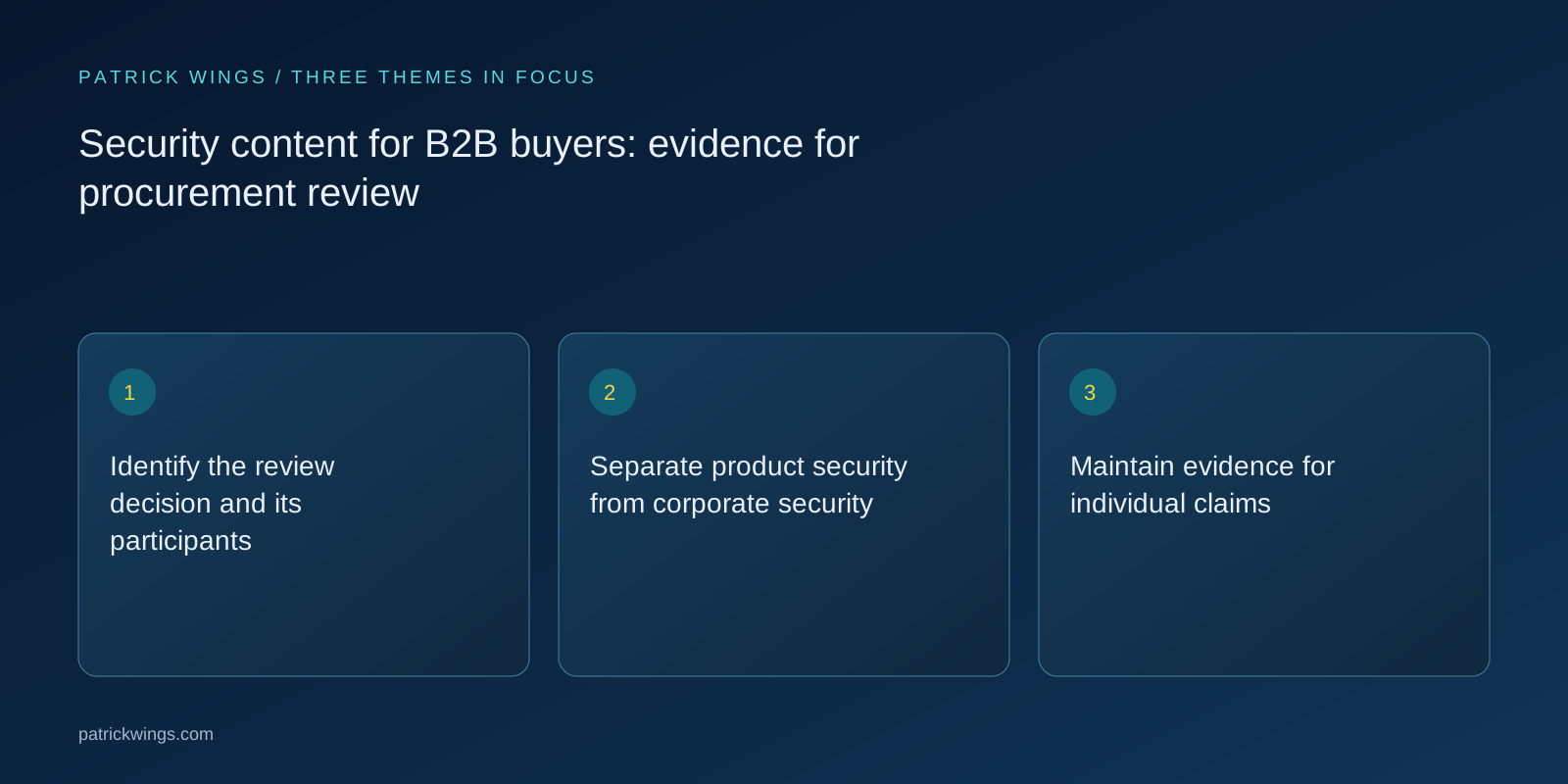
Maintain evidence for individual claims
For each claim, record approved public wording, specialist owner, supporting document, version and permitted access. Connect a claim about user permissions to current product documentation rather than attaching a general company brochure. Identify capabilities enabled by default and those requiring customer configuration. If conditions differ across plans or operating models, put that scope beside the claim. The register supports maintenance and prevents an old sales sentence from surviving unchecked. Not every document belongs in public. A register entry may therefore describe a controlled assessment process without placing confidential details or access information in an open blog. Editors should know which claims can be explained and which require a designated evidence handover.
| Review field | Evidence or observation | Next decision |
|---|---|---|
| Requirement | Current domain-confirmed scope | Substantiate, narrow or request specialist review |
| evidence | Current domain-confirmed scope | Substantiate, narrow or request specialist review |
| access | Current domain-confirmed scope | Substantiate, narrow or request specialist review |
Design public explanations and controlled evidence access
Publish enough orientation for buyers to recognise their review needs: the service concerned, principal responsibilities, a general contact route and the process for requesting additional material. Explain what information an enquiry requires and what happens next. Do not request sensitive system details unnecessarily at this stage. Controlled access must not become an excuse to withhold every factual answer until a sales call. Equally, editors should not expose internal controls without approval. Agree the boundary with security and, where needed, legal specialists. A transparent process explains access and handling without implying that an available document is automatically appropriate evidence for every customer's proposed use. Explore this further in the guide Migration content: address switching risk before the sales call.

Fictional example: narrow a security promise
This scenario is invented. SaaS provider Reviewpath initially advertises “fully controlled access”. Under the fictional product assumptions, administrator and end-user permissions differ, and some logging information is available only through an additional package. Editors replace the general sentence with a descriptive overview and a link to current package conditions. Every capability and package boundary here is an illustrative assumption, not a claim about an actual vendor. The editorial improvement produces a more precise procurement question: which roles and evidence does the intended deployment require? It demonstrates no measured security improvement, legal compliance or successful technical assessment. The value lies in accurate scope and a useful next question.
Explain boundaries and changes without false certainty
A credible security explanation identifies current information and accountable contacts. It does not assert that incidents are impossible. Incident communication, reporting routes and specific disclosures must be agreed with the responsible specialists. Editors can make terminology understandable and keep approved information consistent across channels.
Which boundary must remain explicit?
Product changes can affect existing claims; a new authentication route or operating option should therefore trigger editorial review. Remove absolute wording when its basis cannot be inspected. An unavailable document is not replaced by an invented trust score. Unknowns remain assessment tasks with named ownership rather than positively coloured cells in a promotional matrix. Appropriate uncertainty is part of a useful handover to procurement.
Write readable answers rather than acronym clouds
Answer a specific question in a bounded sentence, then explain the conditions. Use technical terms consistently and define them at the first important occurrence. Link descriptively to product documentation or the approved evidence process. A question about role management needs more than a collection of security acronyms. Explain which evidence supports the statement and who can answer further questions. This improves human comprehension and may facilitate reuse in search and answer systems, without guaranteeing rankings, AI citation or automatic acceptance by a security team. Do not add certification claims to structured data unless the visible content accurately explains and substantiates their scope. Search presentation cannot repair an unsupported product claim.
Bind editorial approval to specialist accountability
Every public security claim needs a responsible specialist; marketing remains accountable for its presentation and distribution. Define changes that trigger review and the route for updating old PDFs or sales slides. An annual calendar is insufficient if a material product change occurs earlier. Ask procurement or IT readers whether they understand the scope and can locate the right evidence. Form submissions do not demonstrate security or procurement readiness. Suspend claims whose supporting evidence is expired, contradictory or no longer applicable. A narrower correct explanation is more usable than an unchanged broad promise resting on uncertain foundations. Record the changed wording so sellers do not continue distributing an older, stronger interpretation.
INTERACTIVE / FROM READING TO ACTION
Three checkpoints for your implementation
Choose a checkpoint and track your reading progress. Checks are neither saved nor sent and do not score your business.
CHECKPOINT 01
Maintain evidence for individual claims
For each claim, record approved public wording, specialist owner, supporting document, version and permitted access.
Explore in the article ↗CHECKPOINT 02
Design public explanations and controlled evidence access
Publish enough orientation for buyers to recognise their review needs: the service concerned, principal responsibilities, a general contact route and the process for requesting additional material.
Explore in the article ↗CHECKPOINT 03
Fictional example: narrow a security promise
This scenario is invented.
Explore in the article ↗Frequently asked questions
What is the purpose of security content?
It helps buyers recognise review needs and obtain appropriate evidence. It does not replace technical assessment, contract review or an individual decision about the customer's proposed operating model and risk context.
Can we promise absolute security?
A universal promise of absolute protection is not a useful editorial basis. Explain inspectable capabilities, responsibilities and conditions, and have appropriately qualified specialists confirm the meaning of each material statement.
Should every document be publicly available?
Not necessarily. Specialists agree disclosure scope and access procedures. Public content should explain what information exists, which scope it covers and how a legitimate assessment request will be handled.
Does a certificate prove every product is covered?
Not automatically. Explain the assessed scope, relevant entity and validity period. Additional specialist review may be needed to determine relevance to the customer's actual planned use and configuration.
Who should approve the text?
The specialist accountable for the individual security claim confirms it. Marketing reviews clarity, consistency and distribution; any further review depends on the actual subject and the organisation's responsible roles.
How should usefulness be measured?
Check whether relevant buyers understand boundaries and find the correct evidence route. Download volume and form completion demonstrate neither product security nor successful completion of a procurement assessment.