
THE SHORT ANSWER
Improve CRM quality around concrete decisions rather than the largest possible collection of required fields.
For the broader picture of how target customers, channels and sales handoffs work together, read the pillar guide B2B demand generation: from attention to qualified pipeline.
Prioritise decision-relevant quality
Improve CRM quality around concrete decisions rather than the largest possible collection of required fields. Marketing needs understandable origin, ownership, status and commercial associations. A fully completed record can still be wrong; an explicitly unknown field may be more honest and operationally useful.
Prioritise fields whose errors change actions. A wrong country can break routing and a duplicate deal can inflate pipeline. A missing optional interest field is often less urgent. This prevents large cleanup projects that consume effort without improving current commercial decisions.
Build field contracts
Create a field contract covering meaning, type, source, owner and update rule. Distinguish current status from historical progression. Keep contact, company and deal identity separate so several people in one project do not become several independent opportunities or receive conflicting ownership simply because they submitted different forms.
For origin, retain raw values and normalised reporting categories separately. Status needs entry time and change source. Associations should distinguish project participants from other company contacts. Otherwise apparently precise reports can rest on relationships that have the wrong business meaning.
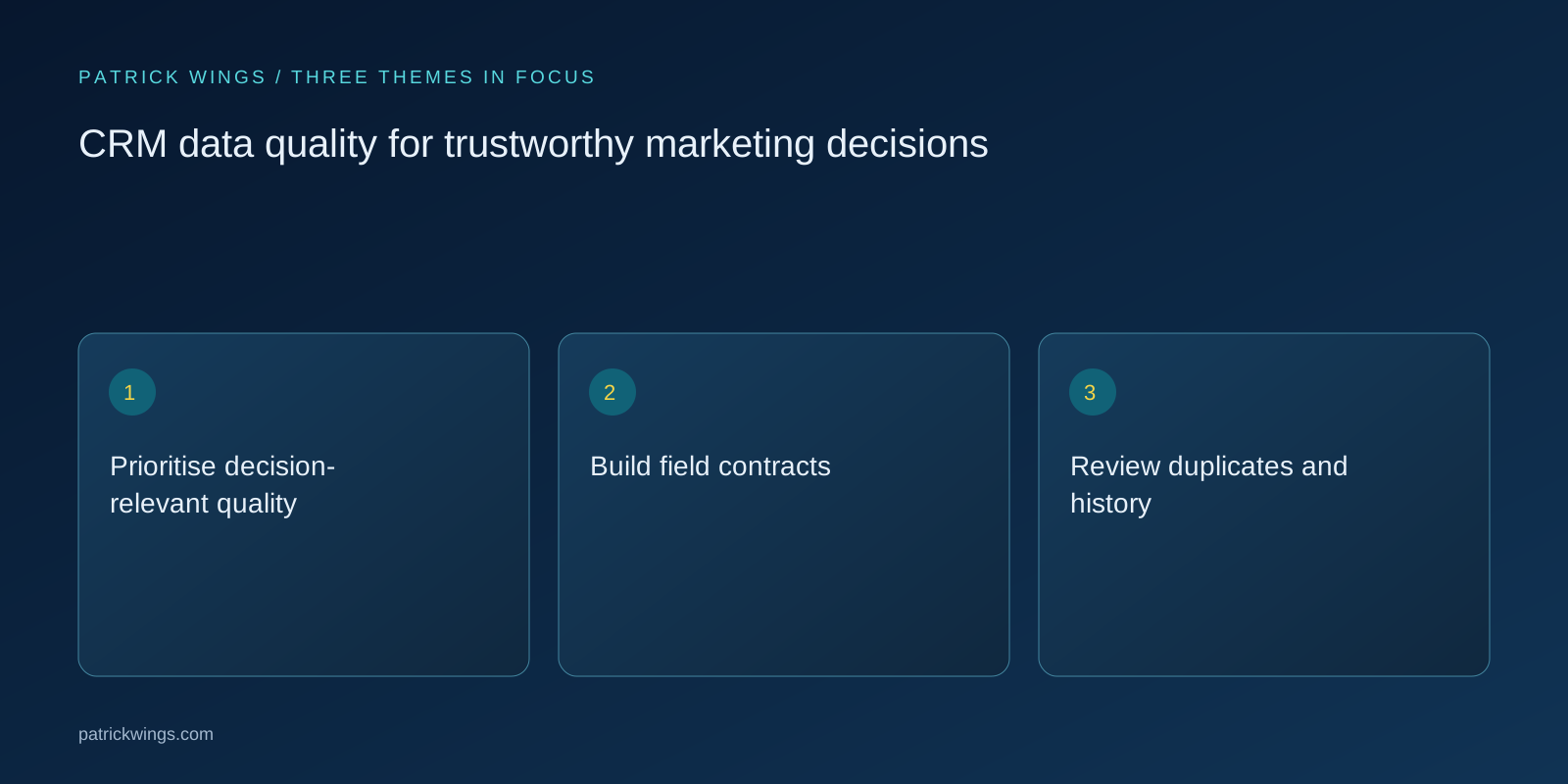
Review duplicates and history
Sample won, lost and open cases first. Inspect duplicates, timestamps, source changes and associations. HubSpot documents duplicate-review tools, but candidate pairs still require business judgement. Similar names alone do not justify automatically merging different people, business units or regional branches with separate commercial responsibilities. Explore this further in the guide Checking CRM data with AI: handle duplicates and conflicts carefully.
For possible duplicates, examine identity, project scope and conflicting history. Record which fields survive and which integrations react. A small controlled merge reveals side effects before a large cleanup changes many owners or attribution records at once.
Reconcile twenty-four opportunities
An invented report shows twenty-four opportunities. Four pairs each describe one project, leaving twenty actual projects. If five records also lack entry timestamps, duration analysis remains incomplete. Correcting the report improves its representation; it does not create lost demand or additional sales performance in the underlying business.
The team corrects four project pairs and flags five incomplete timelines. Reporting now shows twenty projects and the valid duration base. An honest incomplete timeline is more useful than a complete-looking calculation containing invented entry dates or zero days for unknown values.

Control required values and overwrites
Required fields can encourage invented default answers when colleagues do not yet know the information. Automated overwrites can destroy original source history. Before cleanup, inspect effects on attribution, routing and integrations. A local correction may unexpectedly trigger workflows in connected systems that treat the change as new activity.
A default other value may represent genuine uncertainty or convenient completion. Examine frequency and source. If a required field is regularly unknown, allow later collection rather than forcing colleagues to supply inaccurate details at first enquiry simply to save the record.
Relevant failures beyond completeness
Measure decision-relevant failures: incorrect owners, missing qualification, duplicate projects and impossible timestamp sequences. Show the sample and unresolved cases. A broad completeness score is insufficient when a few errors in essential fields cause more damage than many blank optional properties that do not affect the decision.
Build a control list with failure type, affected decision and repair owner. Include examples and recurring causes. If the same field arrives incorrectly after every cleanup, improve collection or integration; repeated manual repair alone does not address the source of the problem.
Organise traceable corrections
Assign field ownership and an explainable correction process. Colleagues need an easy way to flag uncertainty without redefining fields informally. Record bulk changes and retain sufficient history so later reporting jumps can be explained as data corrections rather than mistakenly presented as changes in commercial performance. Explore this further in the guide UTM conventions: measure campaigns without fragmented data.
Log scope, date, rule and known effects of bulk corrections. Keep business identity decisions distinguishable from technical execution. Later reviewers can understand why opportunities were merged and whether a reporting jump reflects actual demand or a corrected underlying data base.
INTERACTIVE / FROM READING TO ACTION
Three checkpoints for your implementation
Choose a checkpoint and track your reading progress. Checks are neither saved nor sent and do not score your business.
CHECKPOINT 01
Review duplicates and history
Sample won, lost and open cases first.
Explore in the article ↗CHECKPOINT 02
Reconcile twenty-four opportunities
An invented report shows twenty-four opportunities.
Explore in the article ↗CHECKPOINT 03
Control required values and overwrites
Required fields can encourage invented default answers when colleagues do not yet know the information.
Explore in the article ↗Frequently asked questions
Should every field be required?
Only information necessary and realistically known at that point.
Should duplicates merge automatically?
Only with validated identity logic and controlled exceptions.
What should be cleaned first?
Errors materially affecting routing, business counts and current decisions.
How can I put “Prioritise decision-relevant quality” into practice?
Improve CRM quality around concrete decisions rather than the largest possible collection of required fields. Marketing needs understandable origin, ownership, status and commercial associations. A fully completed record can still be wrong; an explicitly unknown field may be more honest and operationally useful.
What matters when working on “Build field contracts”?
Create a field contract covering meaning, type, source, owner and update rule. Distinguish current status from historical progression. Keep contact, company and deal identity separate so several people in one project do not become several independent opportunities or receive conflicting ownership simply because they submitted different forms.