
THE SHORT ANSWER
A B2B workbook is useful when readers finish with their own decision artifact: an inventory, a comparison or a draft plan. Start with that output, then design the prompts, examples and instructions needed to create it. A workbook should expose unanswered questions instead of manufacturing a confident answer from arbitrary scores.
To see how this step fits into your content strategy, read the pillar guide B2B content marketing: From useful expertise to qualified demand.
Choose the artifact readers will produce
Decide whether the user needs a requirements list, a dependency map or an internal discussion record. These outputs require different prompts. Name who will use the completed workbook and what decision follows. If another stakeholder needs to approve the result, include space for their unresolved questions. Avoid promising a complete strategy from a few generic exercises. The useful promise is a better prepared conversation with a tangible record of assumptions and evidence. Explore this further in the guide Plan B2B pilots with clear decision criteria.
Collect inputs before asking for conclusions
List the information a participant needs to complete each exercise. Separate facts they can retrieve from judgments requiring discussion. For example, current system owners may be identifiable, while future ownership remains undecided. Let participants mark an answer as unknown and assign a person to investigate. Forced answers create clean looking worksheets but weak decisions. Include a preparation note explaining whether someone should complete the workbook alone or bring colleagues with complementary knowledge.
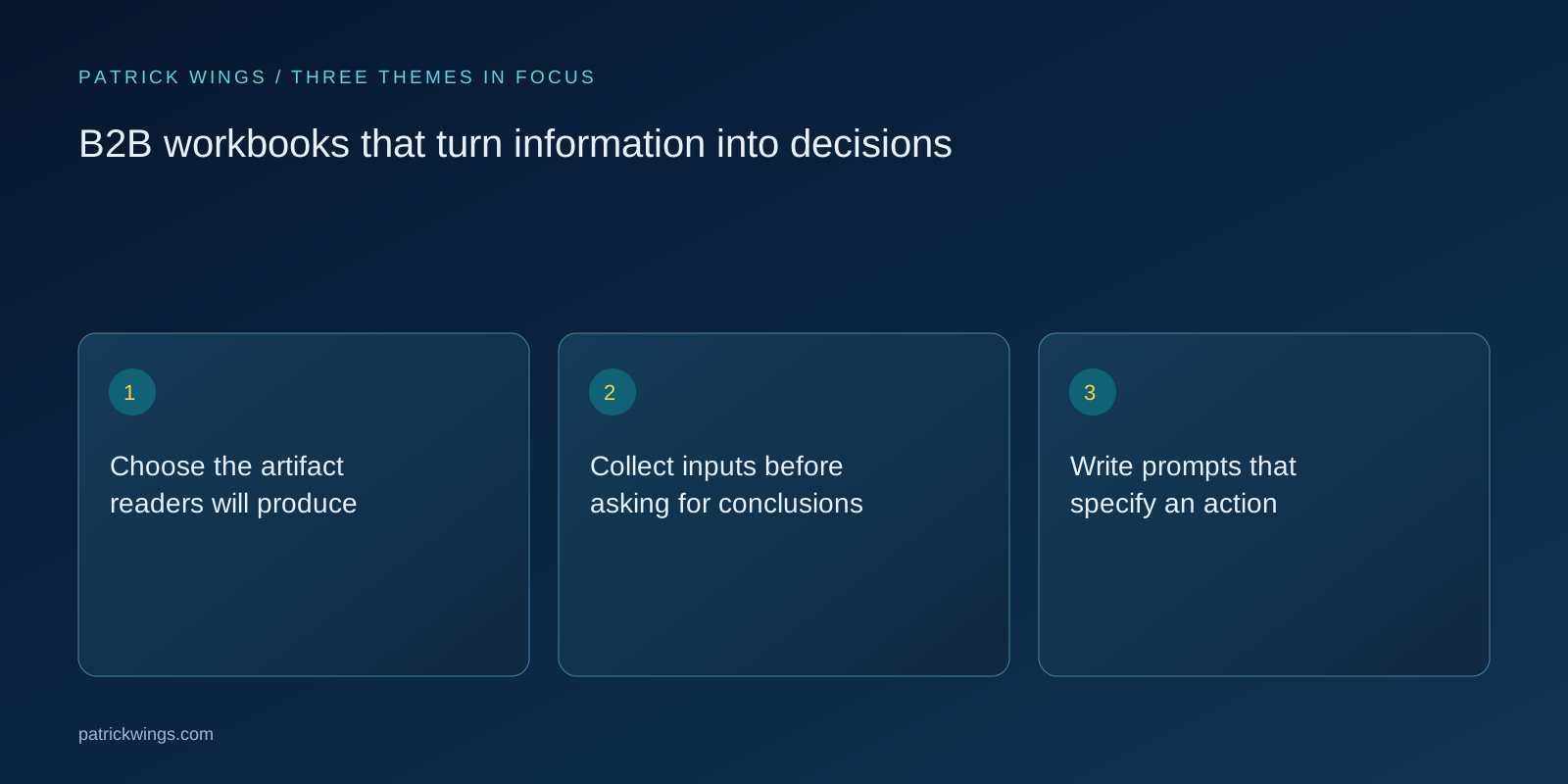
Write prompts that specify an action
Replace “think about your requirements” with an instruction such as “list the workflows that must continue during a migration, then identify their owners.” Explain how detailed the answer should be and show one completed row. Use clear section labels and avoid relying on color to communicate meaning. Provide a text explanation for any visual exercise. The format should let a reader distinguish the task, supporting guidance and the space where their own answer belongs.
Demonstrate a hypothetical selection exercise
Imagine a fictional operations team evaluating scheduling software. One worksheet records recurring scheduling problems; another converts each problem into an observable evaluation question. “Handoffs disappear” becomes “can we see the receiving owner and the handoff status?” The example is hypothetical and implies no real product capability. It shows how to transform a complaint into a testable requirement. Include an incomplete example too, so readers recognize when a requirement still needs clarification.

Handle scoring with explicit caution
A weighted matrix can organize discussion, but its output reflects chosen weights and inputs. Describe who selected the weights and why. Keep nonnegotiable conditions separate from preferences: a missing essential requirement should not disappear inside a high average score. Invite readers to change uncertain inputs and observe whether the ranking changes. Where a simple checklist is sufficient, avoid introducing mathematical precision that the underlying judgment cannot support. Explain the limits beside the exercise.
Test completion instead of visual appeal
Ask representative users to complete a sample exercise using realistic information. Observe where they hesitate, skip instructions or interpret fields differently. Time spent is useful context, but it does not establish learning by itself. Ask them to explain the result to a colleague. If the colleague cannot understand what was decided, revise the output labels or add a summary page. Test editable files in the software readers are actually expected to use. Explore this further in the guide Designing expert webinars around a useful learning outcome.
Review the workbook as a working tool
Check inputs, example labels, instructions, unknown-answer paths, field sizes, logical reading order and the handoff summary. Clarify whether entered information remains local or is submitted anywhere. Do not request sensitive internal details merely to make the workbook feel thorough. Offer a next step appropriate to the result, such as reviewing unresolved dependencies. Evaluate whether readers can reuse their completed output in a real conversation rather than counting blank workbook downloads as evidence of value.
INTERACTIVE / FROM READING TO ACTION
Three checkpoints for your implementation
Choose a checkpoint and track your reading progress. Checks are neither saved nor sent and do not score your business.
CHECKPOINT 01
Write prompts that specify an action
Replace “think about your requirements” with an instruction such as “list the workflows that must continue during a migration, then identify their owners.” Explain how detailed the answer should be and show one completed row.
Explore in the article ↗CHECKPOINT 02
Demonstrate a hypothetical selection exercise
Imagine a fictional operations team evaluating scheduling software.
Explore in the article ↗CHECKPOINT 03
Handle scoring with explicit caution
A weighted matrix can organize discussion, but its output reflects chosen weights and inputs.
Explore in the article ↗Frequently asked questions
Should every workbook include scoring?
No. Use scoring only when its assumptions are explicit and it improves the decision.
Should the workbook be editable?
If readers need to preserve or share their answers, provide a usable editable format or a clear alternative.
Can the exercises replace consulting?
They can prepare a discussion; their scope and missing context determine how far the result can be relied on.
How can I put “Choose the artifact readers will produce” into practice?
Decide whether the user needs a requirements list, a dependency map or an internal discussion record. These outputs require different prompts. Name who will use the completed workbook and what decision follows.
What matters when working on “Collect inputs before asking for conclusions”?
List the information a participant needs to complete each exercise. Separate facts they can retrieve from judgments requiring discussion. For example, current system owners may be identifiable, while future ownership remains undecided.