
THE SHORT ANSWER
An editorial calendar connects topics to actual capacity and visible dependencies. Plan research, expert review, design and maintenance as well as publication dates. A workable calendar shows what can move next and why other work is waiting. A smaller, dependable plan is more useful than a long list with no confirmed owners or prepared inputs.
To see how this step fits into your content strategy, read the pillar guide B2B content marketing: From useful expertise to qualified demand.
Collect demand and commitments
Gather fixed occasions, important reader questions and maintenance tasks. Distinguish commitments from ideas: an announced webinar differs from a possible article. Record audience, task and expected output for each proposal. Check whether suggestions answer the same question and should be combined. This prevents internal volume from determining the plan. Include a topic because it serves a recognizable need and can be produced under your conditions, rather than because an empty date field invites someone to fill it with another subject. Explore this further in the guide Build a GTM review cadence that produces decisions.
Consider capacity by role
Estimate available time separately for research, writing, expert review, design and publication. One person may perform several roles, but their capacity remains finite. Include absence, ongoing projects and promised maintenance. Avoid universal weekly production quotas. Use your own working history as a guide and label uncertain estimates. If expert review is consistently constrained, additional drafts do not solve the problem. Discuss sequence, scope or review availability rather than moving more work into the same queue and treating writing output as completed editorial progress.
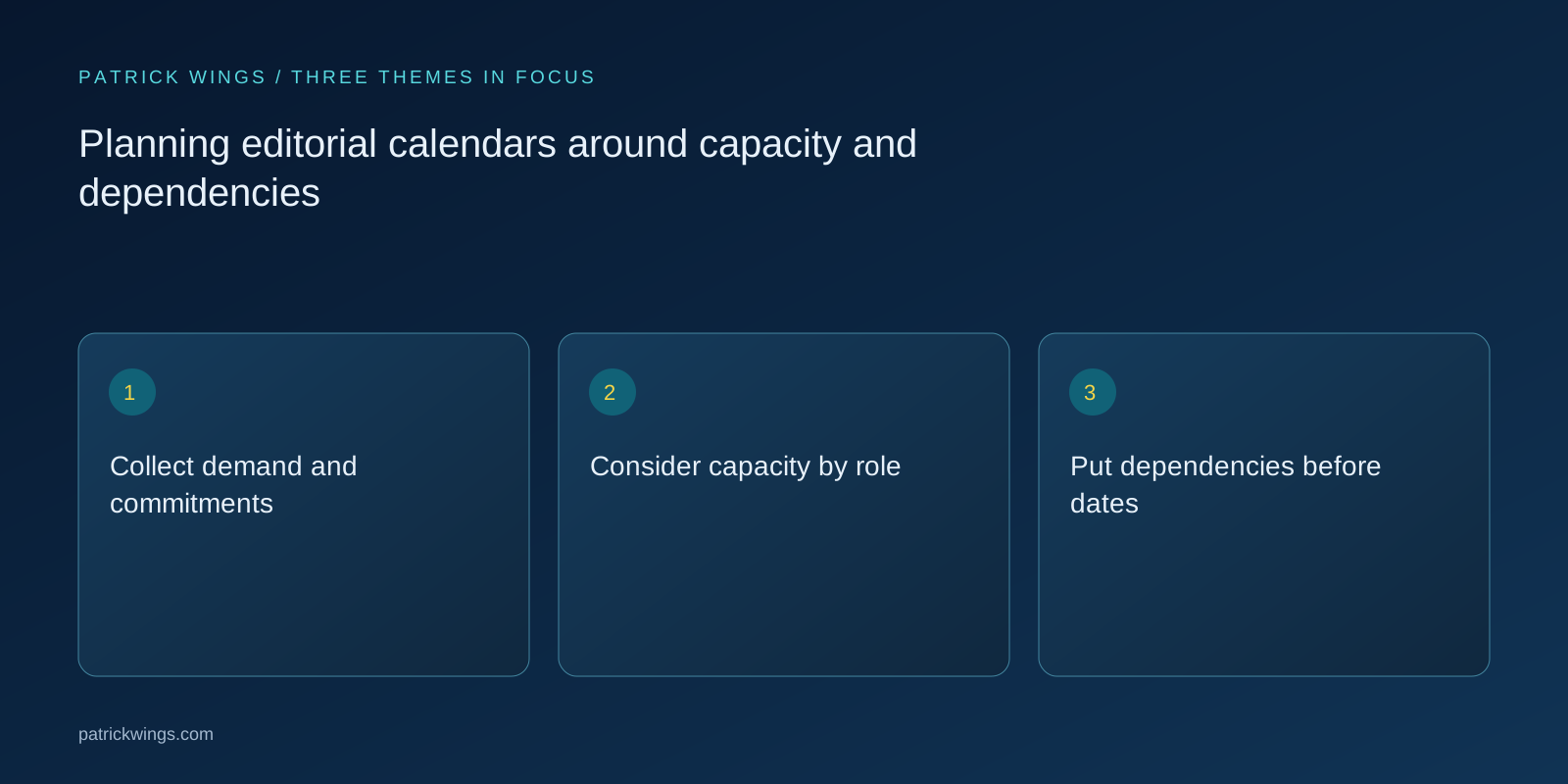
Put dependencies before dates
Make necessary interviews, data, approvals and visual assets visible for each piece. Place them before publication and name the next action. A start date does not make work ready. Define readiness simply: is the assignment clear, core evidence available and the expert scheduled? Blocked work needs an owner and specific reason. Otherwise everyone sees a late date while the actual missing prerequisite remains unaddressed, and nobody knows which decision or contribution would allow the article to move into its next practical stage.
Plan a hypothetical week
Suppose a team schedules a guide, a partner interview and two urgent corrections. The guide's expert is unavailable until later, while the corrections rely on confirmed information. The team advances the corrections and prepares interview questions meanwhile. The guide receives a justified new date. This hypothetical example claims no productivity increase. It illustrates how a calendar reveals readiness and adapts sequencing to real prerequisites instead of making every task artificially urgent through unchanged dates that no longer reflect the conditions needed to complete it.

Decide changes deliberately
New requests require a priority decision with visible consequences. When urgent work enters, identify what moves later or loses scope. Record the reason briefly so stakeholders understand the change. Avoid hidden parallel priorities scattered across messages and spreadsheets. The shared calendar should show the current sequence even if detailed tasks live elsewhere. Short regular discussions should resolve blockages and decisions, rather than reciting every entry. This gives the calendar operational value while keeping it manageable for people whose primary responsibility is producing and reviewing the content itself.
Learn from the flow
Compare planned and actual stages and investigate recurring causes of deviation. Are interviews underestimated, briefs missing or requirements changing late? Improve the relevant process. One delayed piece does not establish a general planning failure. Check whether maintenance is repeatedly displaced. A useful calendar represents the full editorial responsibility and reserves attention for updates. Judge it by understandable decisions and reliable handovers, not by the number of occupied cells or an apparently uninterrupted publishing sequence that conceals unfinished research, unreviewed claims and growing obligations elsewhere in the team. Explore this further in the guide Editorial approvals with clear responsibilities and bounded review.
INTERACTIVE / FROM READING TO ACTION
Three checkpoints for your implementation
Choose a checkpoint and track your reading progress. Checks are neither saved nor sent and do not score your business.
CHECKPOINT 01
Put dependencies before dates
Make necessary interviews, data, approvals and visual assets visible for each piece.
Explore in the article ↗CHECKPOINT 02
Plan a hypothetical week
Suppose a team schedules a guide, a partner interview and two urgent corrections.
Explore in the article ↗CHECKPOINT 03
Decide changes deliberately
New requests require a priority decision with visible consequences.
Explore in the article ↗Frequently asked questions
How far ahead should we plan?
As far as demand and capacity are credible; later topics may remain provisional ideas.
Does every topic need a fixed date?
No. Commit dates according to readiness and dependencies.
How should urgent additions be handled?
Decide explicitly which work moves, shrinks or receives additional capacity.
How can I put “Collect demand and commitments” into practice?
Gather fixed occasions, important reader questions and maintenance tasks. Distinguish commitments from ideas: an announced webinar differs from a possible article. Record audience, task and expected output for each proposal.
What matters when working on “Consider capacity by role”?
Estimate available time separately for research, writing, expert review, design and publication. One person may perform several roles, but their capacity remains finite. Include absence, ongoing projects and promised maintenance.