
THE SHORT ANSWER
Editorial approval works when subject responsibility meets a workable process. Define who checks which claims, who resolves disagreements and what makes a version ready for publication. Useful review makes feedback specific and bounds its scope. It prevents every draft from reopening strategy, tone, factual accuracy and personal preferences at the same time without a clear route to resolution.
To see how this step fits into your content strategy, read the pillar guide B2B content marketing: From useful expertise to qualified demand.
Separate types of decision
Distinguish factual correctness, brand style, commercial positioning and publication approval. These questions need not share one owner. Assign responsibility and explain the expected feedback. A specialist can identify technical errors without restructuring the entire argument. An editor can improve language without replacing technical verification. Name deputies for absences as well. This keeps accountability specific without making every release depend on simultaneous availability of everyone who might have an opinion about the subject or the way the article has been presented.
Determine review needs before drafting
Choose the approval route according to content and consequences of error. A new technical commitment requires different checks from an introduction revised without new facts. Define typical cases and necessary roles. Include images, diagrams and translations because claims do not exist only in body copy. The assignment should state purpose, required assertions and unresolved questions. Resolve strategic gaps before manuscript review. Otherwise a language feedback round becomes an unlimited substitute for an incomplete brief and writers must repeatedly solve decisions that belong elsewhere.
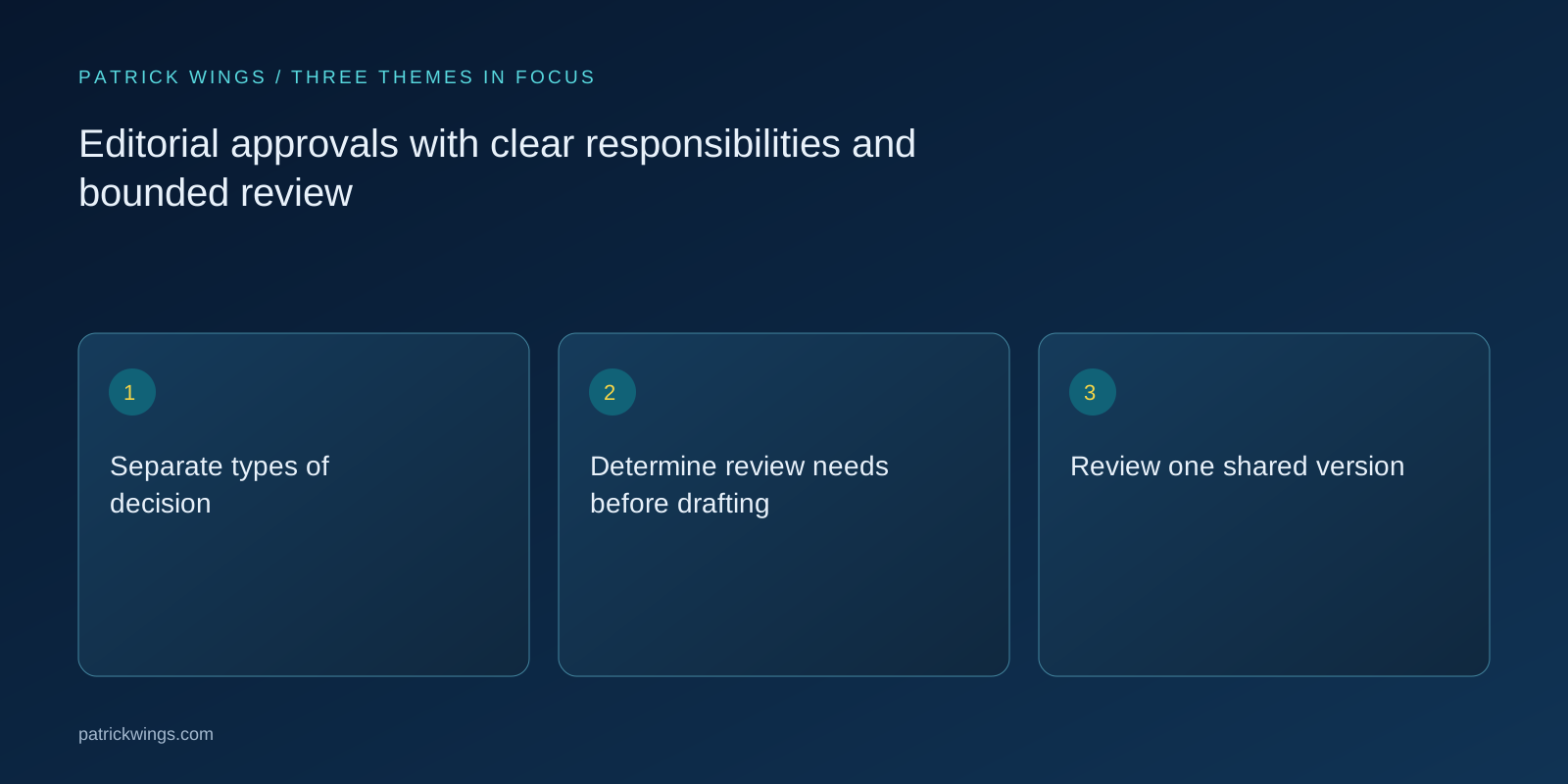
Review one shared version
Select a definitive working version and collect comments at identifiable locations. Label feedback as error, question or suggestion. Ask reviewers to connect changes to the reader task or agreed criteria. Avoid parallel files with ambiguous status. When confidential supporting material is necessary, preserve its relationship to the text. Set a response deadline and explain how missing responses are handled. Silence becomes a clear procedure only when responsibilities and requirements for explicit approval have already been agreed, rather than inferred after someone misses a deadline.
Resolve a hypothetical disagreement
Suppose product management wants “fully automated,” while the technical review identifies manual approvals. The editor asks about the actual process instead of collecting preferences. The technical owner confirms the required approval and the claim is made precise. An additional paragraph about company history remains outside the assignment. This hypothetical example contains two different decisions: product facts determine accuracy, while the brief determines scope. Neither should be settled through a vote on favorite wording, and both should leave a short explanation that later contributors can understand. Explore this further in the guide Running content reviews that produce decisions instead of preferences.

Manage the consequences of changes
A comma correction need not reopen every review. Substantive changes may require another check. Define meaningful triggers: new figures, altered prerequisites, additional commitments or a different next action. Record the change and send affected material to the responsible role. Inspect final presentation because cropped footnotes or displaced captions can change meaning. Approval applies to a specific statement in a particular version, not indefinitely to every asset later derived from it. This distinction allows efficient revisions while preserving the basis on which specialists originally accepted the content. Explore this further in the guide Maintaining technical claims through editorial review.
Improve from observed blockages
After publication, record where work waited and why. Missing evidence, unclear ownership and late strategy changes need different remedies. Do not shorten every deadline when an incomplete assignment causes delay. Review roles and deputies periodically. A working process enables reasoned decisions and protects quality; additional stages require identifiable purposes. For each review step, state the error it should prevent and the evidence that the check occurred. This makes governance maintainable instead of creating a ritual whose participants approve documents without knowing what they were expected to verify.
INTERACTIVE / FROM READING TO ACTION
Three checkpoints for your implementation
Choose a checkpoint and track your reading progress. Checks are neither saved nor sent and do not score your business.
CHECKPOINT 01
Review one shared version
Select a definitive working version and collect comments at identifiable locations.
Explore in the article ↗CHECKPOINT 02
Resolve a hypothetical disagreement
Suppose product management wants “fully automated,” while the technical review identifies manual approvals.
Explore in the article ↗CHECKPOINT 03
Manage the consequences of changes
A comma correction need not reopen every review.
Explore in the article ↗Frequently asked questions
Must everyone approve everything?
No. Assign review questions to the roles responsible for them.
What if feedback does not arrive?
Follow the agreed deputy and escalation procedure; do not assume factual approval without a basis.
When does a correction need another review?
When it changes a claim, condition, evidence or expected action in substance.
How can I put “Separate types of decision” into practice?
Distinguish factual correctness, brand style, commercial positioning and publication approval. These questions need not share one owner. Assign responsibility and explain the expected feedback.
What matters when working on “Determine review needs before drafting”?
Choose the approval route according to content and consequences of error. A new technical commitment requires different checks from an introduction revised without new facts. Define typical cases and necessary roles.