
THE SHORT ANSWER
A buyer-question backlog starts with observed decision friction rather than the longest possible keyword list. Collect original questions from relevant conversations, describe the task behind each one, and check whether existing content already answers it. Prioritize significance, defensible answers and deliverable scope. Search data can enrich the picture but does not replace a recognizable buyer task. The method below is an editorial decision aid, not a scientifically validated score. It helps B2B SaaS teams concentrate limited expert time on useful content. A question's frequency in your records is explicitly not treated as market share or proof of demand across the entire target market.
To see how this step fits into your content strategy, read the pillar guide Content marketing for B2B SaaS: strategy, formats and qualified demand.
Capture original questions and their trigger
Collect questions from discovery calls, demonstrations, support handoffs and lost opportunities within the agreed rules for using that material. Alongside the wording, record role, situation, product relevance and decision stage. “Is this secure?” may concern data handling, operational interruption or a poorly understood access model. Without the trigger, the short question can easily generate the wrong article.
Keep observation separate from interpretation. The register first records the question actually asked, then your proposed reader task and remaining uncertainty. Remove unnecessary personal information. A seller should not copy sensitive call notes into an openly accessible editorial backlog. Use a sufficiently informative summary when the original context is not approved for every member of the working group. The goal is useful evidence, not a larger collection of private conversations.
Distinguish repetition from independent evidence
Do not count every repetition in a CRM as another independent demand signal. One question can travel through several people, notes and presentations.
A single serious objection can still matter. A procurement question concerning a mandatory prerequisite may deserve attention before numerous casual topic suggestions. Record significance separately from frequency. Small convenience samples show what appeared in observed situations, not prevalence across the entire market. For important decisions actively seek missing roles and contrary cases instead of accumulating more statements that repeat the same comfortable interpretation.
How independent are the observations?
Associate sources with a traceable conversation or account unit and mark known dependencies. The precise unit depends on how research was collected; what matters is that the team understands it and applies it consistently rather than changing the denominator during discussion.
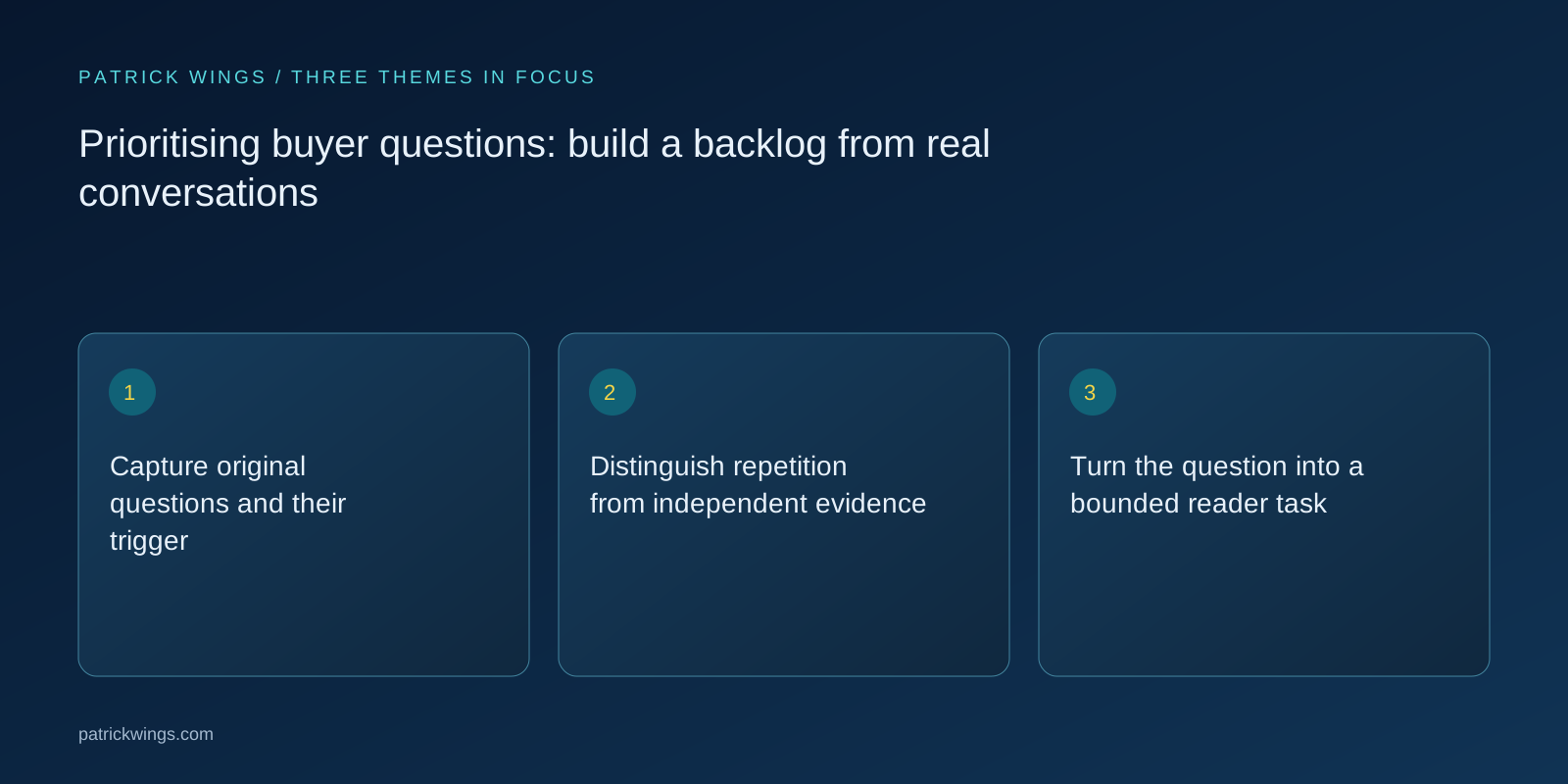
Turn the question into a bounded reader task
Describe one task with an outcome for each entry: an IT owner needs to identify prerequisites before evaluating SSO. This is more precise than “security content.” Add the knowledge assumed and what the resource deliberately will not cover. Another colleague should be able to explain the task without having attended the original conversation or relying on the seller to fill in missing context.
Check whether several questions concern the same task or merely share a term. A question about price and one about invoice review do not necessarily need the same content. A subject can justify several formats, but every extra format requires an identifiable purpose. This step prevents a new backlog from simply reproducing an old topic list with friendlier headings and no clearer connection to actual buyer decisions. Explore this further in the guide Blog, documentation or help centre: assign content to its purpose.
| Review field | Evidence or observation | Next decision |
|---|---|---|
| Question | Independent situations rather than repetition | Address the next blocked decision |
| evidence | Independent situations rather than repetition | Address the next blocked decision |
| priority | Independent situations rather than repetition | Address the next blocked decision |
Inspect existing answers before commissioning
First look for an existing explanation, authoritative reference or usable sales asset. Assess whether it answers this particular question directly and accurately. Strong content that is difficult to discover may need a better entry point rather than another production. An obsolete guide needs factual repair before a shorter social post can responsibly be derived from it.
Classify the issue as discoverability, comprehension, missing evidence or an actual content gap. This diagnosis changes the assignment. Editorial does not own every obstacle: a missing capability or unresolved delivery scope cannot be repaired through persuasive wording. Pause production of the relevant claim and return the decision to product, implementation or sales. A clearly explained boundary is more helpful than an evasive answer that appears complete while hiding an unresolved product question.

Prioritize using explicit decision questions
Compare entries through a few questions: what decision is blocked, can we provide a defensible answer, who owns the facts, what minimum scope creates value, and what maintenance follows? Use understandable categories such as produce now, investigate first or revisit later. Elaborate scoring may conceal judgment when arbitrary weights merely turn opinions into apparently precise arithmetic.
GOV.UK describes user research as a basis for understanding needs and informing priorities. Its application to this B2B backlog is our own editorial method. Challenge each priority using the strongest contrary observation. An influential seller may champion a favourite topic with little evidence of buyer usefulness. In that case, approve a small clarification exercise before assigning full production rather than treating internal volume as proof of external importance.
Fictional example: a small buyer backlog
The invented SaaS team Werkspur collects questions from several planned customer conversations. All quantities and situations in this example are illustrative.
The team prioritizes a short preparation guide with verified conditions. A general future-trends report requested at the same time remains deferred because neither the reader task nor available expert review is clear. After drafting, an uninvolved seller checks whether the guide adequately addresses the original question. That assumed acceptance outcome drives revision; it is not an invented claim about increased conversion, additional contracts or overall market demand.
What justifies the example priority order?
Three notes concern the same unresolved integration prerequisite within one account; another account raises a similar issue. The register therefore records two known account situations rather than claiming five independent market signals. The product owner can explain the prerequisite but has not yet approved a public summary.
Convert priority into an inspectable assignment
An accepted backlog entry identifies the role, core question, direct answer, required evidence, format and factual reviewer. Specify the useful next action as well: collect preparation details, compare prerequisites or arrange a bounded evaluation. One substantive promise keeps the assignment coherent. Other interesting questions become separate candidates instead of causing each article to grow without a controlled purpose.
Choose an acceptance exercise that tests the original task. Colleagues might use the draft to distinguish three supplied prerequisite situations. The exercise should follow the topic, not pretend to be a universal industry benchmark. If review uncovers fundamental uncertainty, move the item back to investigation. That is a useful correction to the plan, not a reason to hide the missing answer behind a longer introduction or a more confident headline.
Maintain the backlog through actual use
After publication record where the asset was used and which question remained unanswered. A newly precise follow-up can mean the issue is better understood; it is not automatically failure. Separate new learning, a wrong entry point and a factual error. The last requires correction of the claim itself, whereas the others may call for navigation changes or a separate follow-up resource.
Schedule a modest recurring review with editorial and customer-facing colleagues. Remove resolved duplicates, update changed product prerequisites and preserve declined priorities with short reasons. The backlog does not need to be large. It should make the next responsible assignment easier to select. If nobody can own an entry or explain its buyer task, retain it as a research lead rather than treating it as a committed production request. Explore this further in the guide Product release narratives: connect features to meaningful change.
INTERACTIVE / FROM READING TO ACTION
Three checkpoints for your implementation
Choose a checkpoint and track your reading progress. Checks are neither saved nor sent and do not score your business.
CHECKPOINT 01
Turn the question into a bounded reader task
Describe one task with an outcome for each entry: an IT owner needs to identify prerequisites before evaluating SSO.
Explore in the article ↗CHECKPOINT 02
Inspect existing answers before commissioning
First look for an existing explanation, authoritative reference or usable sales asset.
Explore in the article ↗CHECKPOINT 03
Prioritize using explicit decision questions
Compare entries through a few questions: what decision is blocked, can we provide a defensible answer, who owns the facts, what minimum scope creates value, and what maintenance follows?
Explore in the article ↗Frequently asked questions
How many conversations are necessary?
There is no universal minimum for every editorial decision. Inspect significance, independence and limitations, then choose a smaller investigation where uncertainty remains.
Are frequent questions automatically most important?
No. Frequency and decision significance are different attributes. A rare mandatory procurement question may need attention before a frequently mentioned general subject.
Does every question require another blog?
Inspect existing answers first. Better navigation, a precise correction or an understandable public summary of the authoritative source may be sufficient.
How should confidential conversation notes be handled?
Use them only within agreed rules and access permissions. The editorial backlog often needs a factual summary without unnecessary personal details.
How can internal favourite topics be challenged?
Require a specific buyer task and traceable trigger. Examine contrary observations and approve investigation before full production when evidence is weak.
What makes a useful backlog?
Another person can explain the next assignment, supporting evidence and accountable review. Backlog size or number of entries is not an adequate quality measure.