
THE SHORT ANSWER
A useful release narrative explains which task changes for which users under which conditions. It complements technical release notes rather than replacing them. Start with the previous workflow and an inspectable change, not a feature inventory. State availability and prerequisites early. This article addresses the editorial translation of a product state into understandable content rather than a general launch plan. The objective is accurate expectations, specialist-approved examples and an explanation maintained after the first announcement, so an attractive launch sentence does not outlive the capability or conditions it originally described.
To see how this step fits into your content strategy, read the pillar guide Content marketing for B2B SaaS: strategy, formats and qualified demand.
Describe the changed task before naming the feature
Ask a specialist to demonstrate the previous and new workflow. Which action disappears, which becomes possible and which remains unchanged? A new button is not yet an understandable buyer benefit. Write an inspectable statement about a specific use case and identify the affected role. If the change concerns rare exceptions, avoid a headline implying universal transformation. Distinguish established customer demand from an internal product hypothesis. Either may justify communication, but they support different claims. A useful opening explains the practical difference first and introduces the product term afterward, allowing someone outside the development team to understand the relevance without decoding an internal feature name.
State product status and access conditions precisely
Record whether the capability is generally available, limited to selected users, offered as a preview or merely planned. Explain supported packages, regions, account types and activation requirements. Future-facing wording must not make development work sound available today. Keep terminology consistent across the blog, pricing and documentation.
Who can access the capability?
GitHub describes releases as publishable product states with associated information; that does not define your organisation's own status model. Agree which terms you use and what each permits you to claim. Publish only after product confirms status and support knows how to handle questions. An unconfirmed availability date remains unconfirmed rather than becoming an optimistic editorial commitment.
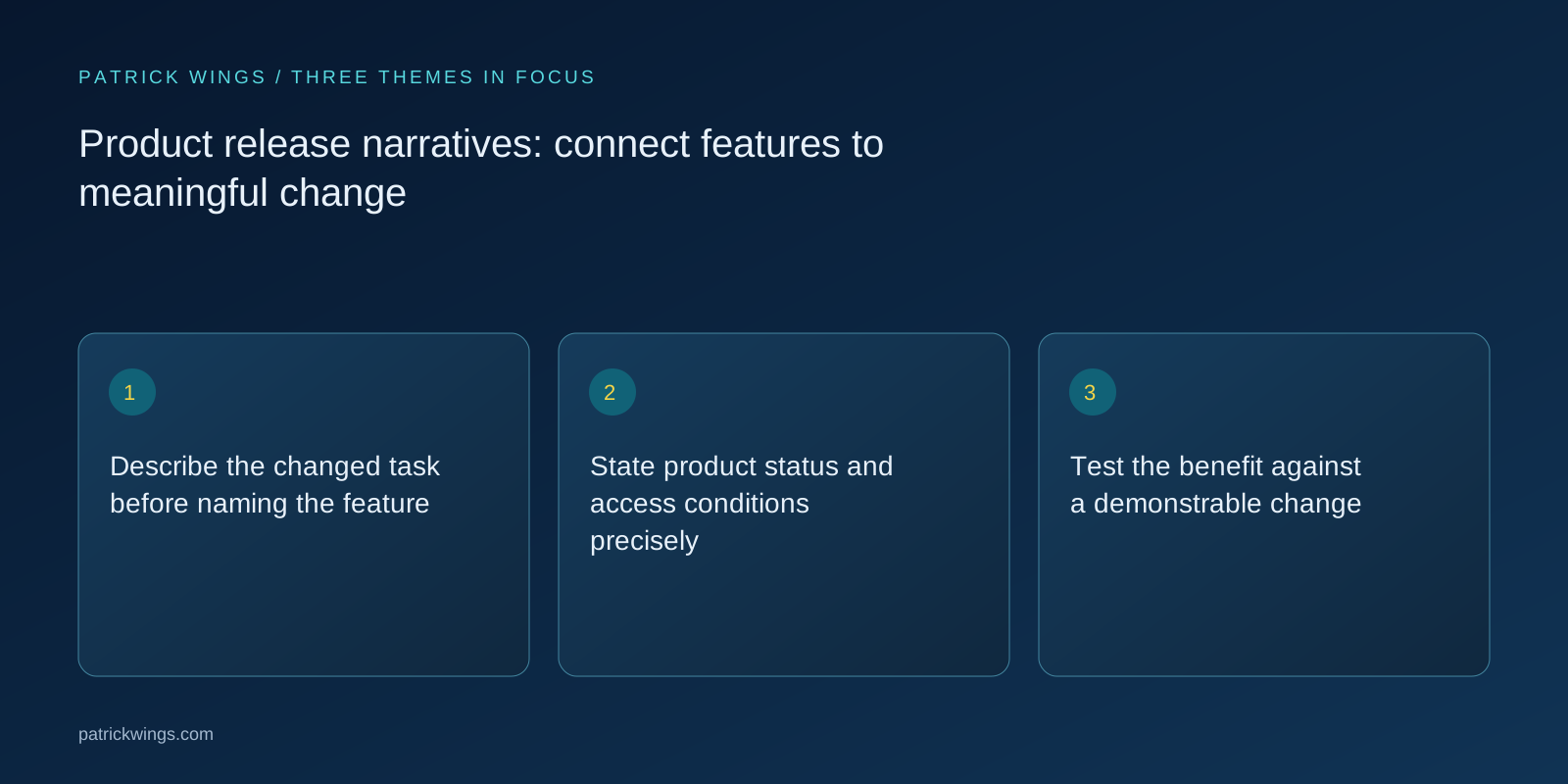
Test the benefit against a demonstrable change
Show a permitted example with a clear starting state. Observe what the capability actually does and which judgements remain human. A shorter click path does not demonstrate time saved across the entire workflow. Without reliable measurement, describe changed steps instead of inventing percentages. Check whether new preparation is required, such as configuration or data cleaning. Value depends on those tasks, not simply feature existence. The editorial statement should survive reproduction: someone repeating the example should recognise the same supported scope. Resolve discrepancies with the product team before publication rather than obscuring them with more general promotional language that makes the promise harder to inspect.
| Review field | Evidence or observation | Next decision |
|---|---|---|
| Status | Verified availability and changed workflow | Explain value without a roadmap promise |
| access | Verified availability and changed workflow | Explain value without a roadmap promise |
| change | Verified availability and changed workflow | Explain value without a roadmap promise |
Serve different readers with distinct information
Existing users need to know whether they must change anything. Administrators assess prerequisites, buyers evaluate relevance to their own use and partners investigate dependencies. One central story can connect these perspectives while answering their questions separately. Link technical changes and possible incompatibilities to maintained documentation. A blog paragraph does not replace a necessary transition instruction. Provide an appropriate next step for each role: try the feature, request activation, assess impact or obtain more detail. Say explicitly when no action is required. This turns an announcement into orientation instead of another notification whose practical consequence each recipient must work out independently from vague product language.

Fictional example: announce a preview accurately
In this invented scenario, SaaS company Waymark releases a preview for collaborative review of proposal drafts. The fictional assumptions limit access to invited teams and exclude automatic transfer of existing approval workflows. The announcement states those boundaries, demonstrates one draft and identifies the feedback route. It promises neither general availability nor fully automated governance. Every capability and access condition here is invented, not a claim about a real supplier. The example shows that an interesting narrative can retain visible limitations. A later article can describe expanded scope, but older links and statements should be updated so the two editions do not create contradictory expectations for readers arriving through historical posts.
Connect visuals and short answers to product context
Use screenshots from the approved product state and explain what they demonstrate. Remove confidential information and avoid examples that could be mistaken for actual customer use. A short clip needs an understandable start and end state plus a text alternative for the essential point. Answer questions such as “Who can use this?” and “Must existing workflows change?” directly.
What should readers recognise in the image?
A precise answer should make sense outside the complete announcement. Use product names, version context and prerequisites consistently. That supports discovery and reuse but guarantees no particular search display, indexation or AI citation. Visual excitement cannot substitute for a confirmed account of what the product currently supports.
Approve individual launch claims before publishing
List the material statements: capability, availability, prerequisite, example and call to action. Product confirms functionality, delivery confirms introduction tasks and support confirms question handling. Marketing checks that headings and short excerpts retain the same limits as the main text. A correct qualification in paragraph eight cannot repair a misleading social card. Link to a stable current explanation and record the approved version. Pause promotion when an announced prerequisite is missing or the demonstrated workflow cannot be reproduced. Approval should enable a specific, correctly understood use; it is not merely evidence that all participants attended a launch presentation or approved an attractive set of slides. Explore this further in the guide Prioritising buyer questions: build a backlog from real conversations.
Respond to understanding and use after release
Observe questions, activation problems and mistaken expectations. Distinguish a product failure from an explanation gap. If users cannot find access instructions, improve the content route; if the feature does not behave as described, involve product as well. Revisit old announcements when status changes. A preview article may remain as history but should visibly point to current information. Measure meaningful actions appropriate to the role and release stage rather than calling every visit adoption. Derive the next update from observed questions. Fewer clicks after more precise audience framing may be appropriate when the communication now generates fewer unsuitable expectations and more informed attempts to use the supported capability. Explore this further in the guide Gated or ungated: decide how buyers access B2B resources.
INTERACTIVE / FROM READING TO ACTION
Three checkpoints for your implementation
Choose a checkpoint and track your reading progress. Checks are neither saved nor sent and do not score your business.
CHECKPOINT 01
Test the benefit against a demonstrable change
Show a permitted example with a clear starting state.
Explore in the article ↗CHECKPOINT 02
Serve different readers with distinct information
Existing users need to know whether they must change anything.
Explore in the article ↗CHECKPOINT 03
Fictional example: announce a preview accurately
In this invented scenario, SaaS company Waymark releases a preview for collaborative review of proposal drafts.
Explore in the article ↗Frequently asked questions
How does a release blog differ from release notes?
The blog explains relevance and changed tasks for particular readers. Release notes document specific product changes. They should complement one another and agree on functionality, version context and availability.
How should unavailable capabilities be described?
Label the actual status and restrict statements to confirmed information. A planned capability must not look like a generally usable product feature; unconfirmed dates should remain explicitly unresolved rather than implied commitments.
Must the announcement quantify a percentage benefit?
No. Without reliable measurement, describing changed steps is more accurate. A demonstration can establish functionality without proving universal time savings, lower cost or improved results for all users.
Which call to action suits a preview?
State the action genuinely available, such as checking eligibility or registering interest in a bounded feedback programme. Do not imply immediate activation when the reader has not yet been admitted.
Can old announcements remain online?
Yes, provided historical status and the route to current information are clear. When availability changes, older articles should not continue generating the same inaccurate expectations as an outdated launch-day statement.
Which metric demonstrates communication success?
Observe appropriate activation and accurate expectations within released scope. Visits alone demonstrate neither actual adoption nor realised business value or successful introduction into a customer's working process.