
THE SHORT ANSWER
The appropriate content type follows the reader's task, rather than whichever department first proposed the piece. A blog can explain a decision, a tutorial can support learning, and a reference can make precise properties discoverable. A help centre often serves people already using a product who need to resolve a problem. These purposes overlap but should not be mixed indiscriminately on one page. The following workflow helps B2B SaaS teams assign content and build useful transitions. It is not a replacement for a complete information architecture or authoritative product documentation. Begin with the next step an identifiable reader is trying to complete.
To see how this step fits into your content strategy, read the pillar guide Content marketing for B2B SaaS: strategy, formats and qualified demand.
Write the reader task before choosing a channel
Describe the situation with a verb: understand, compare, configure, look up or troubleshoot. Add prior knowledge, product access and the desired completion state. “We need an SEO blog about SSO” leaves those details unresolved. A buyer may want to understand prerequisites, while an administrator needs to inspect a particular configuration. Using the same abbreviation does not make those tasks identical. Explore this further in the guide Prioritising buyer questions: build a backlog from real conversations.
Validate the need against actual sales, support or research questions. Preserve the original wording beside your editorial interpretation. An unfamiliar term may require a short explanation; a recurring technical failure may need a verified procedure. Choose the channel afterward. This prevents an apparent reach topic from becoming an unreliable operating instruction that somebody applies to a live system without understanding its conditions.
Distinguish four content functions
Diátaxis separates tutorials, how-to guides, reference and explanation according to different documentation needs. Use that perspective as a diagnostic aid, not a rigid website menu. A tutorial guides a bounded learning experience.
Mark the leading function in the brief. An article explaining integration architecture can point to precise reference material without reproducing every parameter. Equally, a troubleshooting article should not begin with a long account of the company's brand vision. When a draft repeatedly jumps between learning, sales persuasion and lookup, separate the purposes or create recognizable modules that readers can use independently for their own immediate needs.
Which purpose does this section serve?
A how-to guide supports a specific objective. Reference describes properties systematically, whereas explanation builds understanding. A blog, by contrast, is initially a publishing format rather than one particular user task.
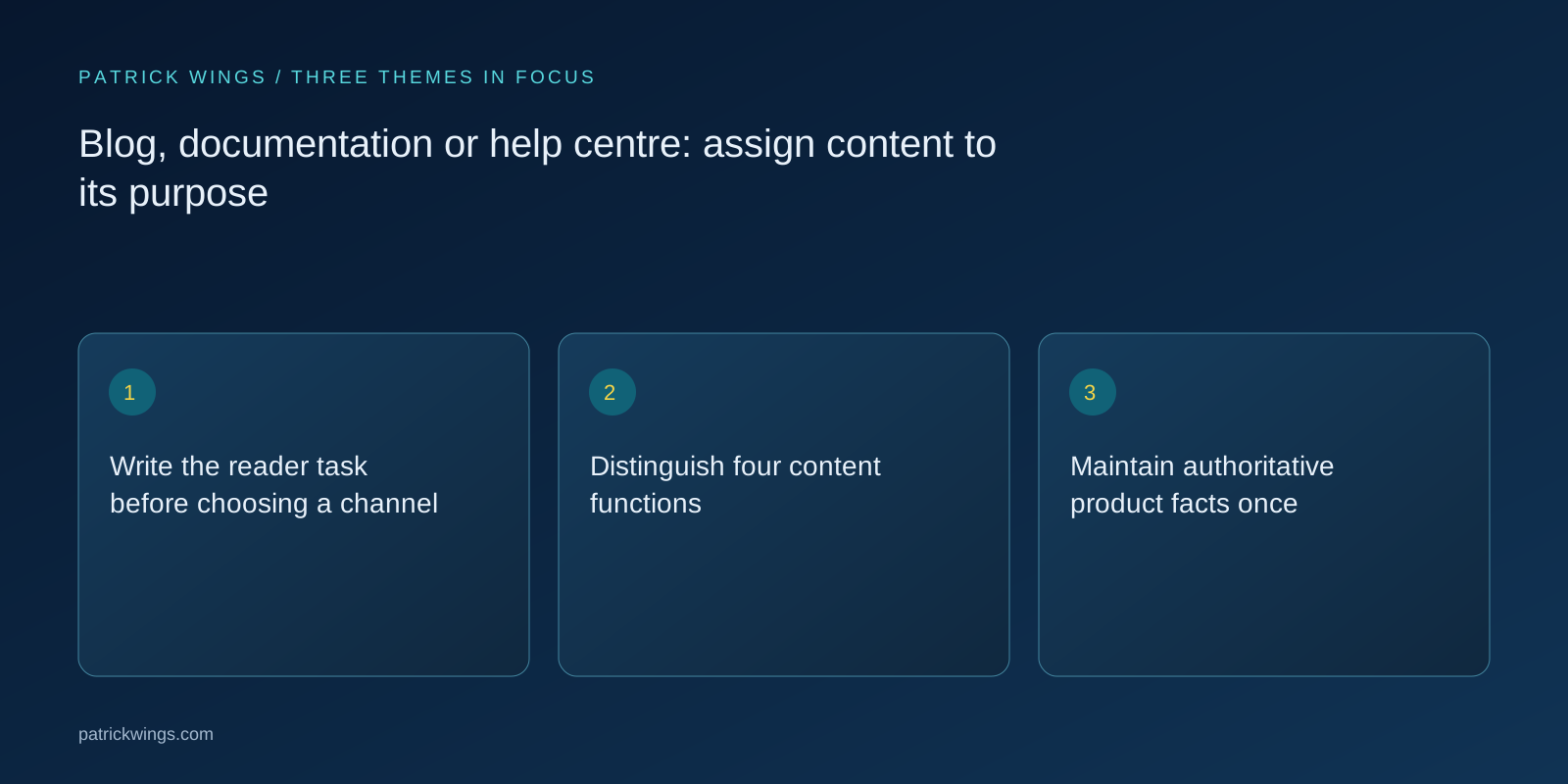
Maintain authoritative product facts once
Decide where current prerequisites, supported versions, limits and technical parameters are maintained authoritatively. Editorial articles can interpret these facts without creating a second neglected reference. Link to the specific relevant section and include conditions essential to understanding the explanation itself. A link must not become a place to hide a limitation that materially changes what a reader may reasonably expect.
Agree with product and support which changes trigger editorial review. A modified configuration step may affect blog posts, videos and onboarding emails. Keep a modest dependency register for important claims. It need not capture every incidental mention, but it should identify statements that people rely on when acting. If the authoritative source is missing or contradictory, pause the apparently simple publication and resolve the underlying product fact first. Explore this further in the guide Content costing: include research, review and maintenance.
| Review field | Evidence or observation | Next decision |
|---|---|---|
| Learning | Actual user task and expected outcome | Choose suitable format and ownership |
| task guidance | Actual user task and expected outcome | Choose suitable format and ownership |
| reference | Actual user task and expected outcome | Choose suitable format and ownership |
Build transitions around the next useful step
Do not indiscriminately connect every format to every other format. A decision explanation may lead to a preparation checklist; a configuration guide may lead to its exact reference. State the question answered by the destination in the link text. Generic “learn more” language makes readers guess whether they will receive context, instructions or a sales invitation. Technical transitions should make any prerequisite visible.
Inspect the destination from the particular role's perspective. A buyer without a product account gains little from an inaccessible internal support article. Provide a public, technically reviewed summary of relevant prerequisites where appropriate. Existing customers likewise should not need to complete another lead form before obtaining ordinary help. Connections between content types should reduce task friction instead of merely generating additional page views or collecting another contact record.

Fictional example: a SaaS SSO topic
In the invented example, Teambrücke offers B2B software with a particular SSO option. Marketing receives procurement and introduction questions, whereas support receives configuration questions. The team first publishes an explanation of roles, prerequisites and implementation considerations. Technical documentation contains the genuinely supported configuration procedure, while help content covers known failure situations. This is an entirely fictional scenario, not a description of any actual product or customer result.
All three resources point to the same accountable product source. The blog leads to introduction preparation, the procedure to the relevant reference, and troubleshooting back to a verified starting state. If a prerequisite later changes, the team updates the authoritative material first and then inspects dependent communications. Rather than inventing a success percentage, it tests whether people can perform their distinct tasks through the intended transitions.
Check the draft against its task boundary
Ask a knowledgeable person to use the draft for a concrete task. They should explain what the content now enables and which information remains absent.
Use H2 and H3 questions to make individual sections retrievable. A short direct answer at the beginning supports purposeful lookup without requiring another complete introduction. Put prerequisites beside action-sensitive steps. These choices can improve understandable discovery; they do not guarantee search rankings or citations in answer systems. Factual correctness and usefulness remain the team's acceptance conditions regardless of how the material is later found.
Can the draft support the task?
If they expected a procedure but received arguments, the title and substance are misaligned. If an explanation assumes a configured account despite targeting prospective buyers, the draft crosses a different boundary. Diagnose the mismatch rather than simply adding more paragraphs.
Assign responsibility across departments
Identify an editorial publisher, a factual authority and the operating area responsible for ongoing use. Marketing may own a decision explanation, product the technical facts, and support a fault diagnosis. Agree who announces changes and who examines their effect on connected material. Sharing a content platform does not by itself settle these ownership questions or prevent contradictory updates.
Separate routine maintenance from urgent factual corrections. An outdated screenshot with no change in meaning may wait for a planned review; a wrong instruction requires a faster specialist decision. Record the actual consequence instead of using broad urgency labels to create pressure. When responsibility is unclear, assign a named person to resolve it rather than repeatedly passing the request between teams. Keep the reader's purpose visible while several contributors negotiate the necessary work.
Test a small connected topic
Choose a subject that repeatedly generates questions from different roles. List explanation, preparation, execution and likely troubleshooting needs. For every question, decide which existing material already works and which actual gap requires new writing. Do not add another format solely because a generic publishing plan says one should exist. A clearer transition can be more valuable than another similar page that creates maintenance work.
After release inspect wrong entry points, unnecessary support contacts and repeated questions at the same stage. Combine those observations with small usability tests. Lower traffic to an old page may mean that a more direct route now exists; it is not automatically a loss. Evaluate the connected set through completed tasks and maintainable factual authority, then record which boundary needs adjustment and who will implement that change.
INTERACTIVE / FROM READING TO ACTION
Three checkpoints for your implementation
Choose a checkpoint and track your reading progress. Checks are neither saved nor sent and do not score your business.
CHECKPOINT 01
Maintain authoritative product facts once
Decide where current prerequisites, supported versions, limits and technical parameters are maintained authoritatively.
Explore in the article ↗CHECKPOINT 02
Build transitions around the next useful step
Do not indiscriminately connect every format to every other format.
Explore in the article ↗CHECKPOINT 03
Fictional example: a SaaS SSO topic
In the invented example, Teambrücke offers B2B software with a particular SSO option.
Explore in the article ↗Frequently asked questions
Should one topic use one page or several?
Separate clearly different user tasks. Shared terminology justifies neither one overloaded page nor unlimited near-duplicate articles.
Does a blog always mean explanatory content?
No. Blog describes the publishing format. Explicitly decide whether the piece supports understanding, decision making, execution or another task.
Where should technical parameters be maintained?
In an identified source with accountable subject ownership. Editorial explanations can interpret and link to it without creating an independently neglected reference.
Must public articles link to the help centre?
Only where the destination is accessible and useful for the relevant role. Check access, prerequisites and the actual next question answered.
How should a connected topic be evaluated?
Observe usability, completed tasks and recurring questions. Page views provide context but do not by themselves demonstrate effective navigation.
Does the structure automatically improve GEO and AEO?
Clear questions, direct answers and verifiable sources support understandable lookup. They do not guarantee selection or citation by search and answer systems.