
THE SHORT ANSWER
Choose bidding goals through signal quality and availability rather than the largest possible conversion count.
For the broader picture of how target customers, channels and sales handoffs work together, read the pillar guide B2B demand generation: from attention to qualified pipeline.
Choose the business signal
Choose bidding goals through signal quality and availability rather than the largest possible conversion count. A consistently qualified enquiry can be a more useful working signal than an infrequent contract. A download cannot substitute for qualification when its later commercial relevance remains unknown. Explore this further in the guide B2B conversion goals: organise meaningful business signals.
Begin by asking what decision a poor signal would encourage. If the system finds inexpensive content requests while sales needs implementation projects, rising conversion volume is insufficient evidence of improved acquisition or commercially suitable additional demand.
Describe signal quality
For each event, document its definition, frequency, delay, duplication risk and CRM coverage. Primary and secondary conversion actions serve different purposes in Google Ads. Also inspect the campaign goals actually selected and any custom goals; an action label alone does not fully explain bidding behaviour. Explore this further in the guide Offline conversions: return qualified CRM events to advertising.
Add the unsuitable-contact share and time until final assessment. A status interpreted differently by each team is not a common definition. Ask several reviewers to classify the same examples and resolve disagreements before presenting the field as a dependable business signal.
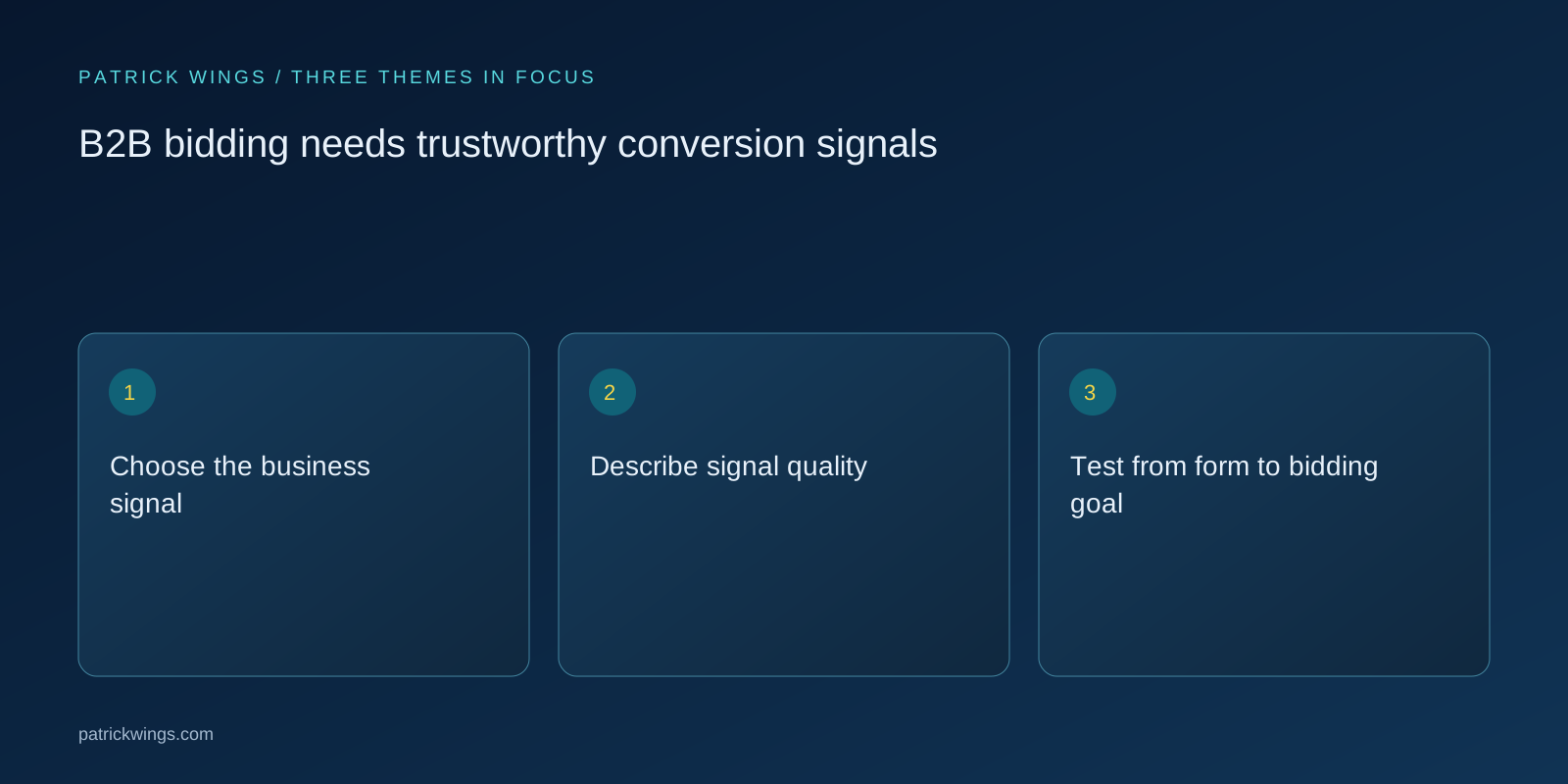
Test from form to bidding goal
Validate collection using individual real cases first. Reconcile the form, CRM status and returned event. Then provide a consistent goal without simultaneously changing its definition, bidding logic, budget and offer. Otherwise a later performance change cannot be associated with a specific intervention.
Give a test case a known identifier, confirmed CRM status and logged delivery time. Verify that exactly one event arrives and affects the expected campaign goal. Repeat the check after correcting the status and after a technical retry to expose duplication.
Twenty qualified versus eighty raw enquiries
A hypothetical team receives 80 enquiries each month, with 20 meeting explicit suitability criteria; contracts arrive months later. If those 20 qualifications are returned consistently, they are a testable candidate signal. If only selected sales teams report them, the signal instead reflects reporting practice rather than demand quality.
Calculate coverage too: if only twelve of twenty confirmed qualifications are transferred, eight signals are absent. Determine whether missingness is random or concentrated in particular sources. That distinction reveals whether bidding receives a systematically distorted picture of the intended audience.

Separate volume and commercial meaning
A large event volume is unhelpful when it includes spam, tests or duplicate uploads. Delayed qualification can also distort assessment. Do not assign invented monetary values to micro-actions merely to make value optimisation look commercially grounded. Values require a defensible relationship with the actual business outcome.
A value model needs a defensible basis, such as mature historical groups with similar offers. Distinguish expected value from realised revenue. When evidence is sparse, use transparent scenarios rather than changing monetary values after every individual contract win.
Check coverage alongside outcomes
Review goal performance alongside import completeness, reporting delay and suitable-conversation rate. Examine differences by sales team and source. If a goal change improves the platform metric while CRM cases deteriorate, revisit the measurement definition before increasing spend or concluding that the bidding approach succeeded.
Build a control sheet with CRM qualifications, sent events, accepted events and delay. A sudden gap between these series triggers a data investigation. Only after the chain is verified should market conditions or bidding strategy be treated as the leading explanation.
Control signal changes
Give every conversion definition a business owner. Marketing manages campaign usage, revenue operations maintains delivery and sales owns qualification criteria. Agree how changes are approved and communicated so a new CRM stage cannot silently redefine the optimisation target across multiple campaigns.
Before switching, sales validates real examples, operations checks completeness and marketing confirms campaign mapping. Record the last stable configuration. If the new signal starts incompletely, the team needs a prepared recovery path rather than further spontaneous changes across the account.
INTERACTIVE / FROM READING TO ACTION
Three checkpoints for your implementation
Choose a checkpoint and track your reading progress. Checks are neither saved nor sent and do not score your business.
CHECKPOINT 01
Test from form to bidding goal
Validate collection using individual real cases first.
Explore in the article ↗CHECKPOINT 02
Twenty qualified versus eighty raw enquiries
A hypothetical team receives 80 enquiries each month, with 20 meeting explicit suitability criteria; contracts arrive months later.
Explore in the article ↗CHECKPOINT 03
Separate volume and commercial meaning
A large event volume is unhelpful when it includes spam, tests or duplicate uploads.
Explore in the article ↗Frequently asked questions
Must we bid toward contracts?
Not necessarily. Assess availability, delay and quality of an earlier business signal.
Are downloads always unsuitable?
No, but their relationship with suitable demand must be understood.
When should we change the goal?
When a more reliable definition has passed technical and business validation.
How can I put “Choose the business signal” into practice?
Choose bidding goals through signal quality and availability rather than the largest possible conversion count. A consistently qualified enquiry can be a more useful working signal than an infrequent contract. A download cannot substitute for qualification when its later commercial relevance remains unknown.
What matters when working on “Describe signal quality”?
For each event, document its definition, frequency, delay, duplication risk and CRM coverage. Primary and secondary conversion actions serve different purposes in Google Ads. Also inspect the campaign goals actually selected and any custom goals; an action label alone does not fully explain bidding behaviour.