
THE SHORT ANSWER
Develop demand for buying committees by serving different decision tasks.
For the broader picture of how target customers, channels and sales handoffs work together, read the pillar guide B2B demand generation: from attention to qualified pipeline.
Develop demand across relevant roles
Develop demand for buying committees by serving different decision tasks. One engaged contact does not automatically represent the whole company. Users, IT, procurement and economic sponsors may examine different conditions and need relevant evidence that they can share internally without requiring another general sales presentation. Explore this further in the guide Understand enterprise buying groups.
Limit this model to reach and usable information: which relevant role has access to suitable material, and which question remains unserved? The full approval sequence belongs in the specific sales plan. Marketing first needs resources that answer important questions and can be usefully shared internally by the established contact without requiring a separate pitch.
Map contact coverage by task
Build a role map covering likely task, unresolved objection and available evidence. Distinguish confirmed participants from assumed roles. A job title does not establish decision authority. Record unknown involvement rather than interpreting missing contacts as agreement or proof that a particular approval is unnecessary.
The coverage sheet contains account ID, confirmed role, known contact, unresolved specialist question, appropriate resource and communication preference. Do not invent a name for an assumed role. Several contacts in one function may be addressing the same question. Mark information gaps separately from missing contact details so the team does more than increase the number of people stored.
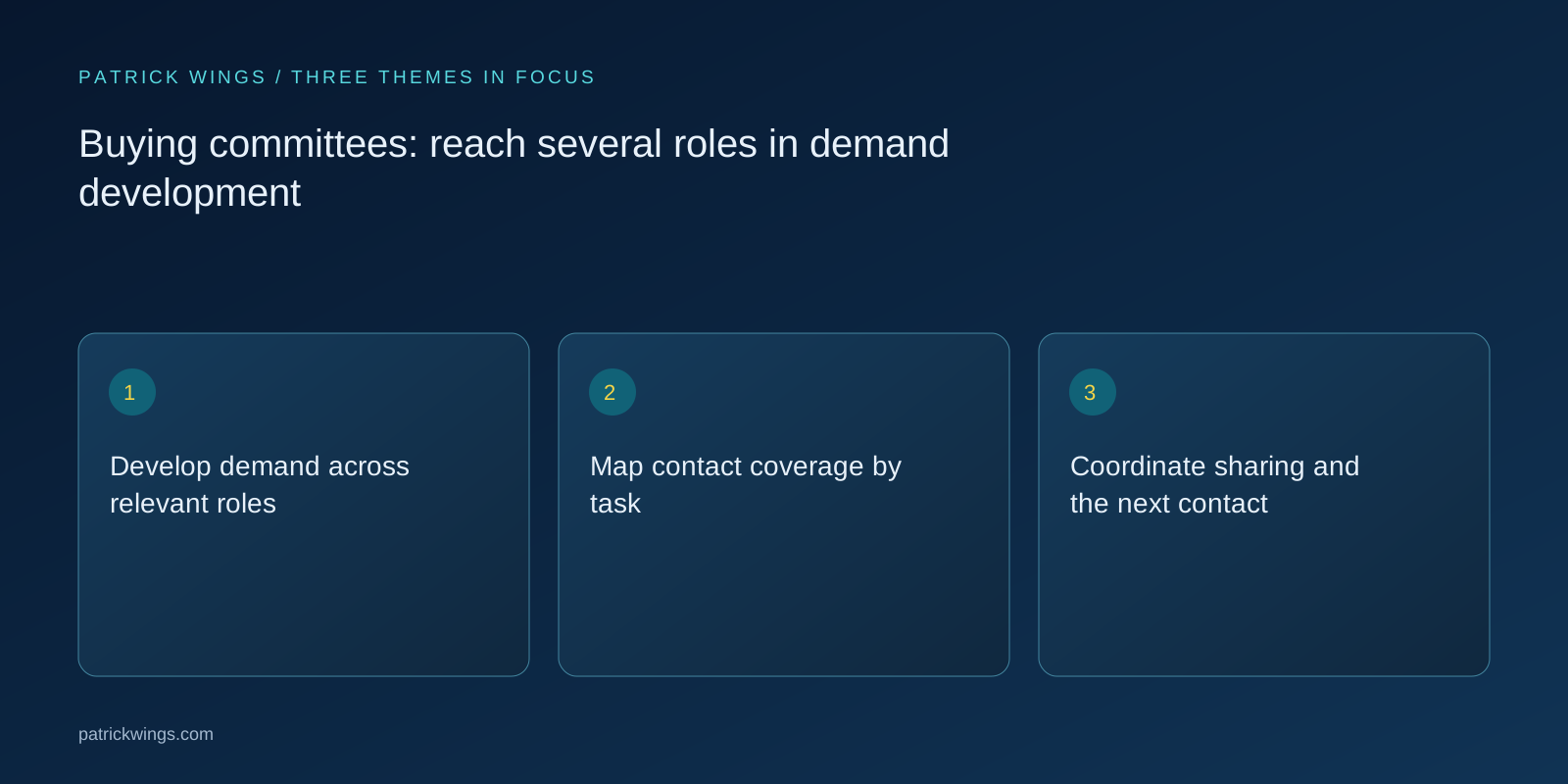
Coordinate sharing and the next contact
Ask the existing contact which internal reviews remain and what materials would help. Prepare resources understandable without your narration. Associate contacts transparently with account and opportunity. Avoid uncoordinated parallel outreach that bypasses the established contact or creates inconsistent expectations among colleagues participating in one purchase.
Agree with the contact whether they want to share materials themselves or arrange a joint discussion. Internally shareable content states the task, conditions, evidence and next contact without requiring another sales explanation. Direct outreach to additional people needs an appropriate reason and coordinated routing. A researched name alone does not constitute an agreed contact strategy for the account.
Close information gaps in an example
A hypothetical provider gains the interest of an operations manager. Security validation and budget approval remain outstanding. Three more contacts at the company increase account activity but do not create three new opportunities. A security dossier and defensible business case that the manager can share internally would be more useful.
The invented operations manager could share a security dossier with IT and a transparent value worksheet with the economic sponsor. Marketing checks whether both resources make sense without her personal narration. Sales asks which questions remain. This closes specific information gaps, whereas three additional general contacts establish neither answered questions nor actual internal sharing of the material.

Do not confuse contact count with support
More recorded contacts do not automatically mean broader support. People may be critically evaluating, gathering information or unrelated to the project. Important decision-makers may remain invisible too. Treat account engagement as activity evidence and supplement it with confirmed roles and unresolved purchasing tasks.
Add the purpose of an interaction to account reporting. A technical documentation visitor may be a customer, integration partner or project evaluator. Confirmed context enables appropriate classification. Somebody asking critical questions is not automatically an advocate. Campaign coverage should expose those distinctions rather than infer support merely because another person at the company has become reachable.
Review roles reached and questions resolved
Check whether necessary questions are resolved and the contact can explain the next internal steps. Evaluate substantive coverage rather than contact count. If a project stalls despite many interactions, a missing role or unanswered financial objection may matter more than another round of general awareness advertising.
For each relevant role, check whether usable evidence exists, whether it was offered or actually requested and what question remains. Silence proves neither internal rejection nor successful sharing. A voluntary clarification with the established contact may be more appropriate than additional parallel messages to unknown colleagues. The next action should address the identified information gap rather than pursue contact-count growth.
Maintain resources and contact routing together
Maintain the role map jointly with sales and update it when changes are confirmed. Marketing owns usable materials while specialists own their accuracy. Record which roles remain unknown so the next review works from actual decision requirements rather than assuming a contact list demonstrates complete stakeholder coverage.
Marketing maintains current resources and understandable sharing links; specialists verify claims; sales records the agreed contact route. For new contacts, routing first checks existing account and opportunity ownership. Another person then receives useful context without triggering a second uncoordinated conversation. Review closed information-coverage gaps rather than the growth of an apparently complete contact list whose relevance has not been confirmed. Explore this further in the guide Account-based marketing: develop target accounts together.
INTERACTIVE / FROM READING TO ACTION
Three checkpoints for your implementation
Choose a checkpoint and track your reading progress. Checks are neither saved nor sent and do not score your business.
CHECKPOINT 01
Coordinate sharing and the next contact
Ask the existing contact which internal reviews remain and what materials would help.
Explore in the article ↗CHECKPOINT 02
Close information gaps in an example
A hypothetical provider gains the interest of an operations manager.
Explore in the article ↗CHECKPOINT 03
Do not confuse contact count with support
More recorded contacts do not automatically mean broader support.
Explore in the article ↗Frequently asked questions
How many contacts do we need?
Enough relevant roles for the decision; there is no useful universal count.
Should every role be approached directly?
Only through coordinated outreach with an appropriate reason.
What does contact growth show?
More observed people, not confirmed support or project coverage.
How can I put “Develop demand across relevant roles” into practice?
Develop demand for buying committees by serving different decision tasks. One engaged contact does not automatically represent the whole company. Users, IT, procurement and economic sponsors may examine different conditions and need relevant evidence that they can share internally without requiring another general sales presentation.
What matters when working on “Map contact coverage by task”?
Build a role map covering likely task, unresolved objection and available evidence. Distinguish confirmed participants from assumed roles. A job title does not establish decision authority.