
THE SHORT ANSWER
Separate similar articles by the decision each helps a reader make, not merely by swapping keywords in their titles. Compare actual queries, page content and reader tasks before diagnosing harmful overlap. Keep distinct answers when the distinction is useful; consolidate when multiple pages compete to fulfil essentially the same promise without adding meaningful value.
For the broader picture of technical foundations, useful content and visibility measurement, read the pillar guide SEO, GEO and AEO for SaaS: visibility that supports buying decisions.
Write a one-sentence promise for each page
State who the article serves, what question it answers and what the reader should be able to do afterwards. Avoid broad labels such as strategy or best practices without a concrete outcome. Two pages about migrations can legitimately differ if one produces a URL inventory and another defines post-launch monitoring. If their promises remain interchangeable after removing the titles, investigate whether the distinction is real. Include existing established pages in this exercise so new articles do not quietly duplicate an answer that already serves readers well.
Compare observed queries with actual content
Review query-to-page patterns from available search data, noting coverage limits and periods. Multiple pages appearing for a related query does not by itself prove a problem. Inspect which answer each page provides and whether the search need is ambiguous. Read headings, examples, calls to action and evidence, not just title tags. A page may attract an unexpected query because it contains one useful section; the remedy could be clarifying that section’s role rather than rewriting the entire article around a new assumed intent. Explore this further in the guide Finding unanswered buyer questions in search data.
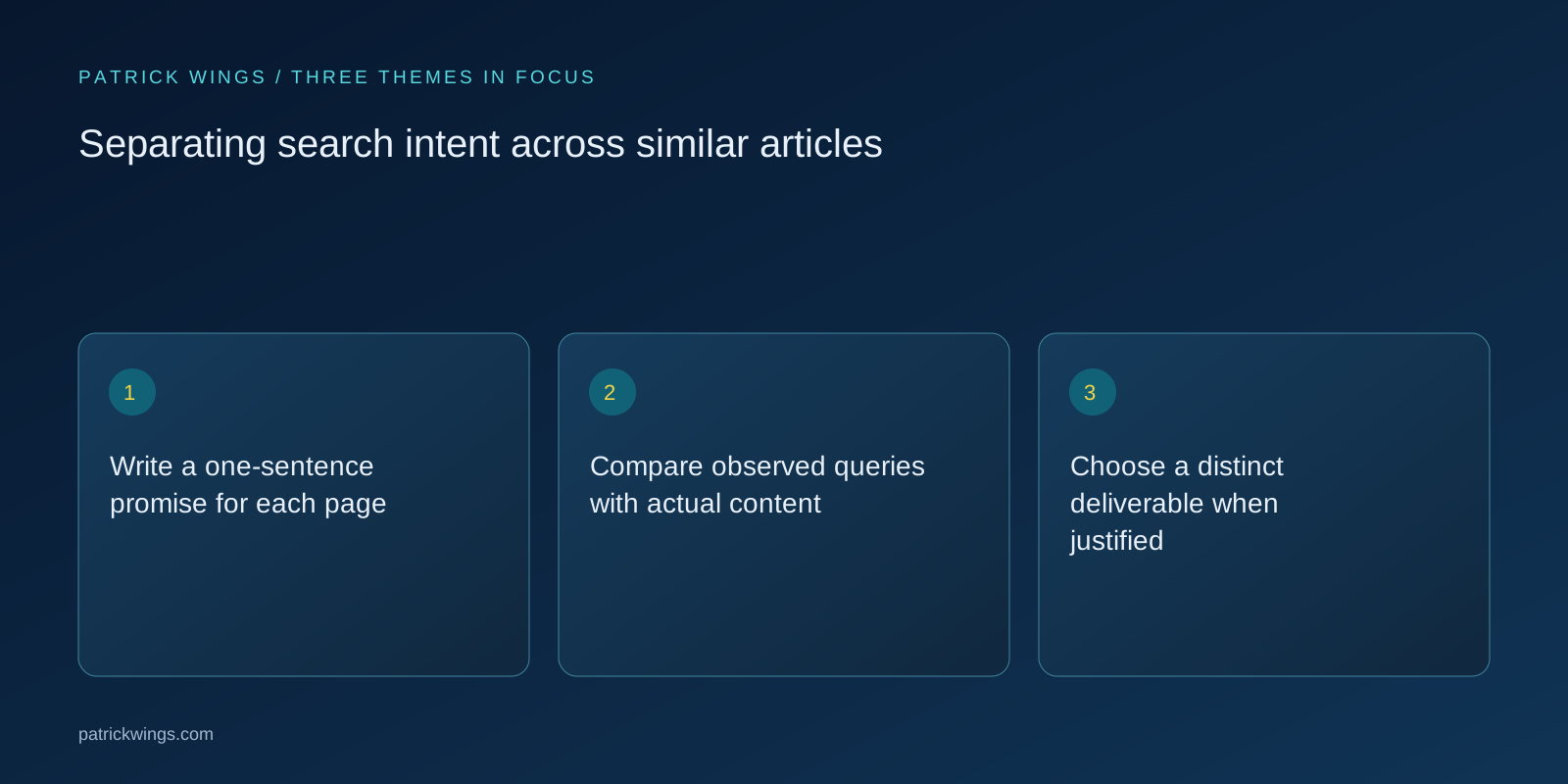
Choose a distinct deliverable when justified
Give each retained article a concrete output: a diagnostic table, implementation process, decision checklist or worked comparison. Make the distinction visible early in the introduction and sustain it through the sections. Reference the broader foundational guide instead of repeating its definitions at length. Bound the scope by naming what the reader must already know and which adjacent task follows. Distinct deliverables should reflect real differences in reader work, not artificial fragmentation designed to create more addresses for closely related search phrases.
Consolidate when the promises converge
If pages genuinely duplicate the same answer, compare evidence, usefulness, inbound links, language versions and maintenance obligations before selecting a durable destination. Preserve unique valuable sections during consolidation. Plan redirects and update internal references where appropriate; do not delete first and investigate later. Avoid assuming that the page with the highest historical traffic is automatically the best future answer. The selected destination should serve the complete current task. Record why other pages were retained or merged so the same duplicate brief does not return in the next editorial cycle. Explore this further in the guide Consolidating similar content without losing useful answers.

Illustrative example: two migration guides
Imagine an illustrative pair titled migration checklist and migration planning guide. Their bodies both list the same preparatory tasks, so cosmetic keyword changes would not create a useful distinction. The team turns one into a specific inventory-building procedure and retains the established guide as the broader planning overview, with contextual links between them. If the inventory content cannot support an independent useful procedure, it would instead merge that material. This example shows an editorial decision, not a guaranteed resolution of ranking volatility or a universal rule to split articles.
Review after revision with realistic evidence
Check whether introductions, examples and navigation now express the chosen scope. Observe query and landing-page patterns over suitable comparable periods, while accounting for demand and wider site changes. Do not promise that one page must exclusively rank for one keyword; search systems can match multiple useful pages to different interpretations. Success means a clearer architecture and fewer redundant maintenance obligations. Reopen the decision if users still encounter interchangeable answers, essential context is missing or a narrow article cannot remain useful independently. Rankings are supporting evidence rather than the sole editorial acceptance criterion.
INTERACTIVE / FROM READING TO ACTION
Three checkpoints for your implementation
Choose a checkpoint and track your reading progress. Checks are neither saved nor sent and do not score your business.
CHECKPOINT 01
Choose a distinct deliverable when justified
Give each retained article a concrete output: a diagnostic table, implementation process, decision checklist or worked comparison.
Explore in the article ↗CHECKPOINT 02
Consolidate when the promises converge
If pages genuinely duplicate the same answer, compare evidence, usefulness, inbound links, language versions and maintenance obligations before selecting a durable destination.
Explore in the article ↗CHECKPOINT 03
Illustrative example: two migration guides
Imagine an illustrative pair titled migration checklist and migration planning guide.
Explore in the article ↗Frequently asked questions
Are two pages ranking for one query always a problem?
No. Check whether they serve different useful interpretations and whether readers receive distinct answers.
Can a title change resolve overlap?
Only if it reflects a real change in scope. Cosmetic wording does not create a distinct reader task.
When should pages merge?
When their promises and useful answers substantially duplicate each other and an independent distinction cannot be sustained.
How can I put “Write a one-sentence promise for each page” into practice?
State who the article serves, what question it answers and what the reader should be able to do afterwards. Avoid broad labels such as strategy or best practices without a concrete outcome. Two pages about migrations can legitimately differ if one produces a URL inventory and another defines post-launch monitoring.
What matters when working on “Compare observed queries with actual content”?
Review query-to-page patterns from available search data, noting coverage limits and periods. Multiple pages appearing for a related query does not by itself prove a problem. Inspect which answer each page provides and whether the search need is ambiguous.