
THE SHORT ANSWER
Consolidate similar pages by first designing the complete answer you want to preserve, then selecting a durable destination and mapping the technical changes. Compare unique evidence, reader tasks and incoming links before merging. Fewer URLs are not automatically better; consolidation is justified when it produces a clearer useful answer and manageable ongoing ownership.
For the broader picture of technical foundations, useful content and visibility measurement, read the pillar guide SEO, GEO and AEO for SaaS: visibility that supports buying decisions.
Establish why a merge is needed
Identify the specific problem: interchangeable answers, fragmented evidence, contradictory guidance or duplicated maintenance. Read the candidates together and write their promised outcomes. Separate legitimate differences in audience, language or implementation depth from superficial variations in titles. Review current query patterns and reader feedback as supporting evidence. Do not merge merely because a tool reports similar wording. A shared technical definition can be necessary across distinct tasks, while two differently titled articles may still repeat the same process without providing independent value to the intended reader. Explore this further in the guide Separating search intent across similar articles.
Create a preservation matrix
List the useful elements of every candidate: questions answered, examples, source references, diagrams, limitations and commercially relevant next steps. Mark which elements are current, redundant, contradictory or unsupported. Choose where each retained element belongs in the new outline. Include unique objections and implementation details that might be lost during a simple copy-and-paste merge. Assign subject-matter review to disputed claims. This matrix becomes the acceptance record: editors can verify that consolidation removed repetition without deleting the most useful material or silently broadening a claim beyond its evidence.
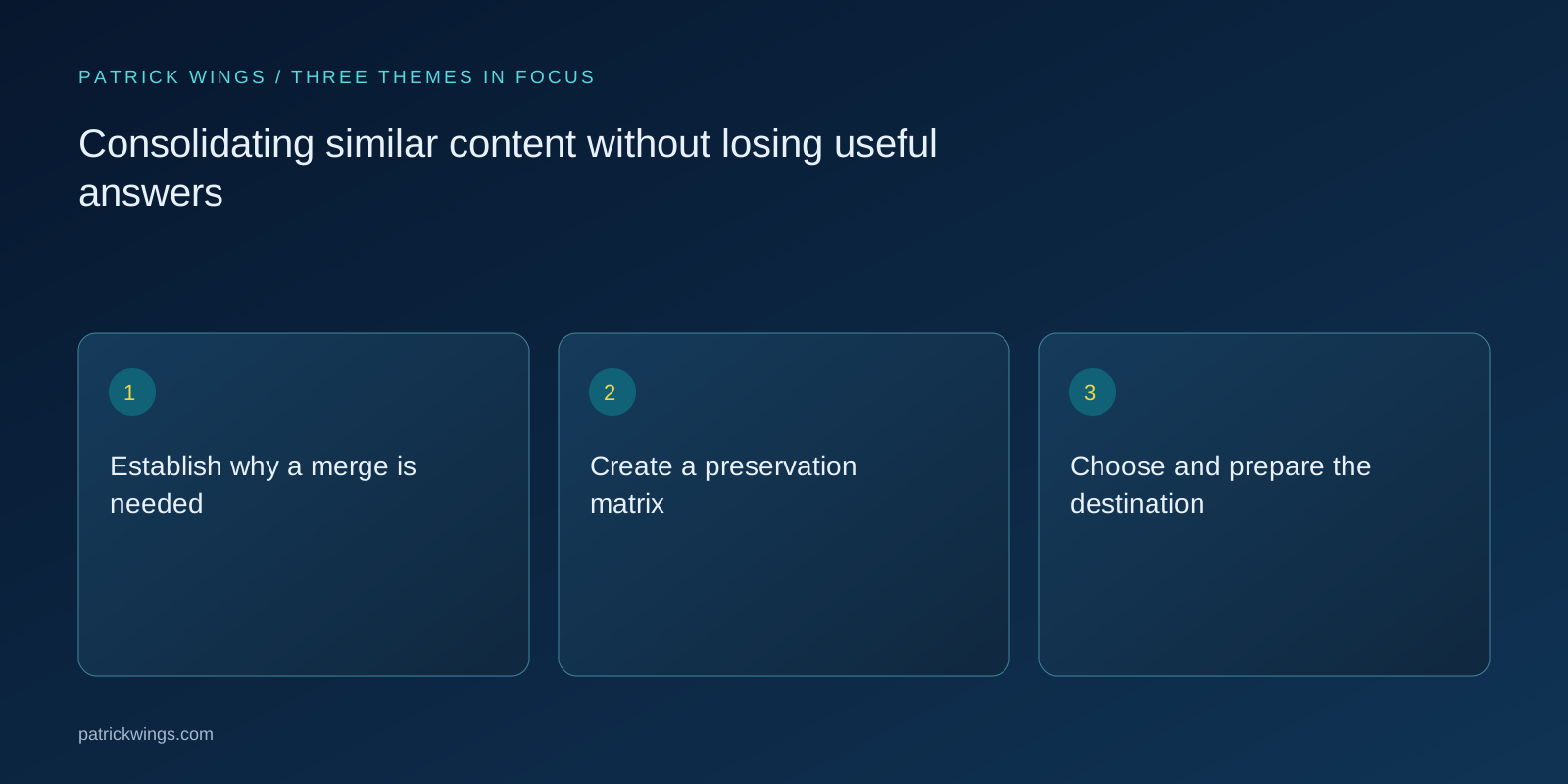
Choose and prepare the destination
Select a stable URL that fits the combined answer and the surrounding information architecture. Consider existing external references and historical usefulness, but do not let traffic alone choose an unsuitable page. Rewrite the structure around the complete task instead of stacking old introductions. Make the page title and description reflect the final scope. Check language equivalents and update related-resource recommendations. The destination should be ready before old pages change, with current evidence and an owner able to maintain the expanded answer after the consolidation project ends.
Map technical changes by meaning
For each retired URL, decide whether the combined destination genuinely fulfils its promise. Use appropriate redirects for equivalent replacements, update controlled internal links and remove obsolete sitemap entries. Recheck canonical and language annotations after the change. Where an old page serves a distinct task that the new page does not cover, reconsider the merge or provide a suitable separate destination. Test direct requests and redirect chains. Avoid a blanket category redirect that conceals the loss of specific answers simply because it is easier to implement across many pages. Explore this further in the guide Mapping migration redirects by meaning.

Illustrative example: fragmented integration guidance
Imagine an illustrative library with three short articles covering preparation, common mistakes and a duplicated checklist for the same integration task. The team creates one coherent implementation guide, preserves a unique troubleshooting example and removes conflicting outdated instructions after expert review. It maps equivalent old URLs to the completed guide and updates incoming internal links. A separate architecture comparison remains independent because it supports a different decision. This example explains preservation and scope; it does not promise a particular traffic increase or imply that every series should become one long page.
Verify the result and keep a recovery record
After release, test retired addresses, important incoming paths and the final page’s content. Monitor delivery errors and search observations alongside a dated change record. Keep the original material and mapping available internally in case a useful answer was missed. Interpret traffic movements cautiously because demand, seasonality and concurrent releases can affect the result. Success means preserved useful coverage, truthful transitions and simpler maintenance. Revisit the decision if readers cannot find an old task or if the combined guide becomes too diffuse to serve its intended audience clearly.
INTERACTIVE / FROM READING TO ACTION
Three checkpoints for your implementation
Choose a checkpoint and track your reading progress. Checks are neither saved nor sent and do not score your business.
CHECKPOINT 01
Choose and prepare the destination
Select a stable URL that fits the combined answer and the surrounding information architecture.
Explore in the article ↗CHECKPOINT 02
Map technical changes by meaning
For each retired URL, decide whether the combined destination genuinely fulfils its promise.
Explore in the article ↗CHECKPOINT 03
Illustrative example: fragmented integration guidance
Imagine an illustrative library with three short articles covering preparation, common mistakes and a duplicated checklist for the same integration task.
Explore in the article ↗Frequently asked questions
Should the highest-traffic page always survive?
No. Consider fit, evidence, stability and incoming references alongside traffic.
Must every retired URL redirect?
Only when there is an appropriate replacement. Do not force unrelated pages into an unsuitable destination.
How do we avoid losing useful sections?
Create a preservation matrix and compare the completed destination against every retained task and evidence item.
How can I put “Establish why a merge is needed” into practice?
Identify the specific problem: interchangeable answers, fragmented evidence, contradictory guidance or duplicated maintenance. Read the candidates together and write their promised outcomes. Separate legitimate differences in audience, language or implementation depth from superficial variations in titles.
What matters when working on “Create a preservation matrix”?
List the useful elements of every candidate: questions answered, examples, source references, diagrams, limitations and commercially relevant next steps. Mark which elements are current, redundant, contradictory or unsupported. Choose where each retained element belongs in the new outline.