
THE SHORT ANSWER
A value proposition explains why a particular audience should consider your offer. Your website needs to make that answer easy to understand. Broad words such as smarter, efficient or future-ready are insufficient on their own. This guide shows how to make the benefit concrete and connect it with evidence a buyer can evaluate.
To see how this step fits into your content strategy, read the pillar guide B2B content marketing: From useful expertise to qualified demand.
1. Define the audience and starting problem
A persuasive statement begins with the situation in which your solution becomes relevant. Describe the company type, task and trigger as concretely as possible. “For every business” gives prospects little help. “For SaaS teams organising the handover from self-service to sales-assisted conversations” describes a recognisable task. The wording must reflect your actual customer focus rather than simply naming a commercially attractive segment.
Check language against real conversations. Which words do customers use for the problem? Which parts of your internal product vocabulary create follow-up questions? A website does not need to remove every specialist term, but its important statements should make sense without prior knowledge of the categories your own team has created.
2. Connect the outcome to a credible mechanism
A desired result becomes more believable when you explain how your offer contributes. “Better planning” is abstract. Explaining shared capacity views, visible bottlenecks and defined approvals gives the reader more to assess. Only describe mechanisms the offer actually covers. Keep product capabilities, organisational prerequisites and expected benefits distinct instead of merging them into one broad promise without explaining the dependencies. Explore this further in the guide Writing B2B case studies: Show evidence, decisions and limitations.
Illustrative example: a platform might help teams sort support requests by priority and ownership. That does not automatically support a claim that every organisation will halve waiting times. Describe the specific contribution, and include measured outcomes only where approved data and understandable conditions are available. This lets a serious buyer assess whether their own circumstances are comparable.
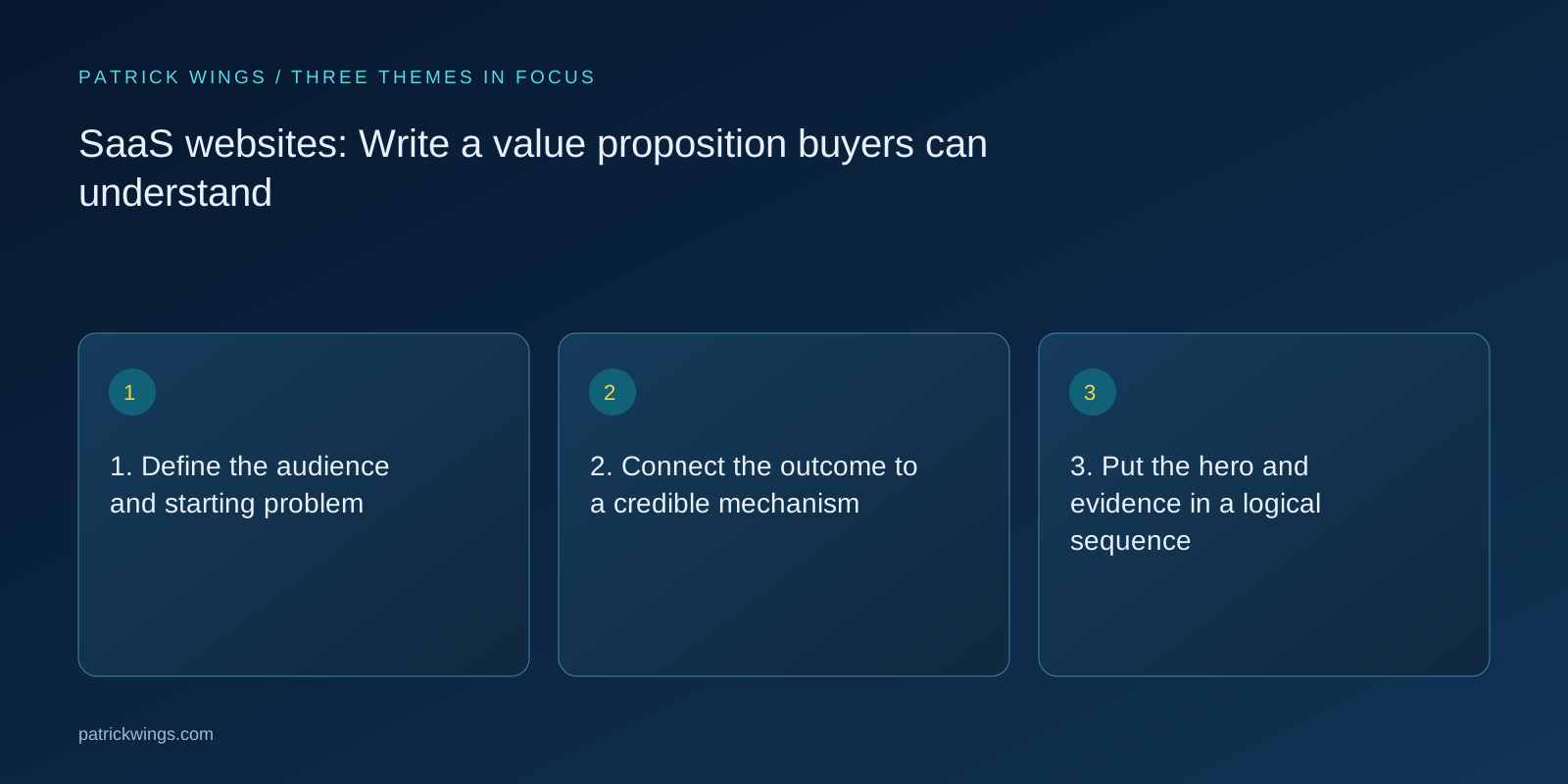
3. Put the hero and evidence in a logical sequence
The opening should communicate the main task. A short supporting explanation can identify the audience and approach. The next step must fit: a demo, an orientation call and a product signup are different offers. Follow with evidence addressing the strongest uncertainty. That might be a real product view, a clear delivery method or an approved case study showing what the work involved. Explore this further in the guide Demo and signup forms: Set the right B2B entry barrier.
Customer logos demonstrate an association but do not automatically explain it. Clarify whether they represent customer relationships, project experience or earlier employment where that distinction matters. A logo strip should not imply a broader engagement than actually took place. Relevant context builds more dependable trust than an impressive-looking collection of familiar names whose relationship with the business remains unclear.
4. Use deeper pages for different buying questions
A homepage cannot answer every technical, commercial and organisational question at once. Use supporting pages for specific services, use cases and objections. Keep the central benefit consistent while adding detail for different roles. An IT page can discuss integration and operation; an evaluation page can explain rollout and responsibilities. Both should describe the same underlying offer without making conflicting assumptions about its scope.
Avoid creating pages that merely rephrase each other. Ask which question each page answers better than the homepage. Internal links should announce that additional value. The result is a website where prospects can investigate their requirements instead of repeatedly encountering the same general promotional paragraph under a different heading.

5. Test understanding before polishing style
Show the opening to people matching your audience and ask open questions: who is this for, which problem is addressed, roughly how does the approach work, and what would you expect next? Avoid asking only whether they like the headline. Personal taste is a different signal from comprehension or perceived relevance, and can send a team towards fashionable language that communicates less.
If several people misunderstand the same point, fix that issue first. Record the hypothesis before publishing a variant. Afterwards, examine relevant enquiries and conversation feedback alongside click-through rates. A clearer message can produce fewer unsuitable enquiries while becoming more valuable commercially. The objective is appropriate demand and useful expectations, not universal approval of the wording.
INTERACTIVE / FROM READING TO ACTION
Three checkpoints for your implementation
Choose a checkpoint and track your reading progress. Checks are neither saved nor sent and do not score your business.
CHECKPOINT 01
3. Put the hero and evidence in a logical sequence
The opening should communicate the main task.
Explore in the article ↗CHECKPOINT 02
4. Use deeper pages for different buying questions
A homepage cannot answer every technical, commercial and organisational question at once.
Explore in the article ↗CHECKPOINT 03
5. Test understanding before polishing style
Show the opening to people matching your audience and ask open questions: who is this for, which problem is addressed, roughly how does the approach work, and what would you expect next?
Explore in the article ↗Frequently asked questions
What belongs in a value proposition?
The audience, relevant problem, concrete benefit and a credible explanation of your contribution. Suitable evidence supports the claim.
Must the entire explanation fit in the H1?
No. The main heading carries the central idea. Supporting text, evidence and a clear next step can provide the detail.
How can I test positioning?
Ask suitable people to explain the offer in their own words. Assess understanding, relevance and enquiry quality rather than preference alone.
How can I put “1. Define the audience and starting problem” into practice?
A persuasive statement begins with the situation in which your solution becomes relevant. Describe the company type, task and trigger as concretely as possible. “For every business” gives prospects little help.
What matters when working on “2. Connect the outcome to a credible mechanism”?
A desired result becomes more believable when you explain how your offer contributes. “Better planning” is abstract. Explaining shared capacity views, visible bottlenecks and defined approvals gives the reader more to assess.