
THE SHORT ANSWER
Conversion optimisation improves the path from relevant interest to a useful action. In B2B, that action is not always an immediate purchase. It may be a suitable demo meeting, a qualified enquiry or a successful product start. Before changing buttons, define the goal clearly and develop an evidence-based view of the obstacle.
To see how this step fits into your content strategy, read the pillar guide B2B content marketing: From useful expertise to qualified demand.
1. Define a conversion that fits the business
A submitted enquiry is easy to count but says little about its value. Agree with sales or product colleagues what makes an action useful. For a consultative IT offer, fit between company and problem may be central. For self-service SaaS, completing the first meaningful product task can be closer to value than simply creating an account that is never subsequently used. Explore this further in the guide SaaS websites: Write a value proposition buyers can understand.
Map the relevant steps from entry to that goal. Record which events are captured reliably and where information is missing. If confirmation pages, forms and CRM records count different things, the initial analysis can already mislead the team. Establish data quality before interpreting individual metrics or deciding that a particular page needs a new design.
2. Examine meaningful differences between segments
Review important pages by entry source, device and identifiable intent. A person arriving from an informational search has different expectations from someone clicking a specific demo advertisement. Sending both groups to a general page can produce a message that helps one group but remains too vague for the other. Segmentation should reflect plausible differences in need rather than arbitrary dashboard categories.
Check obvious breaks first: does the form work, does the mobile layout behave properly, and does the landing page fulfil the advertisement's promise? Observed technical failures do not require an elaborate experiment. Fix them and record the change. Evaluate finer variants once the basic journey functions as intended and prospective customers can complete the task without avoidable errors.
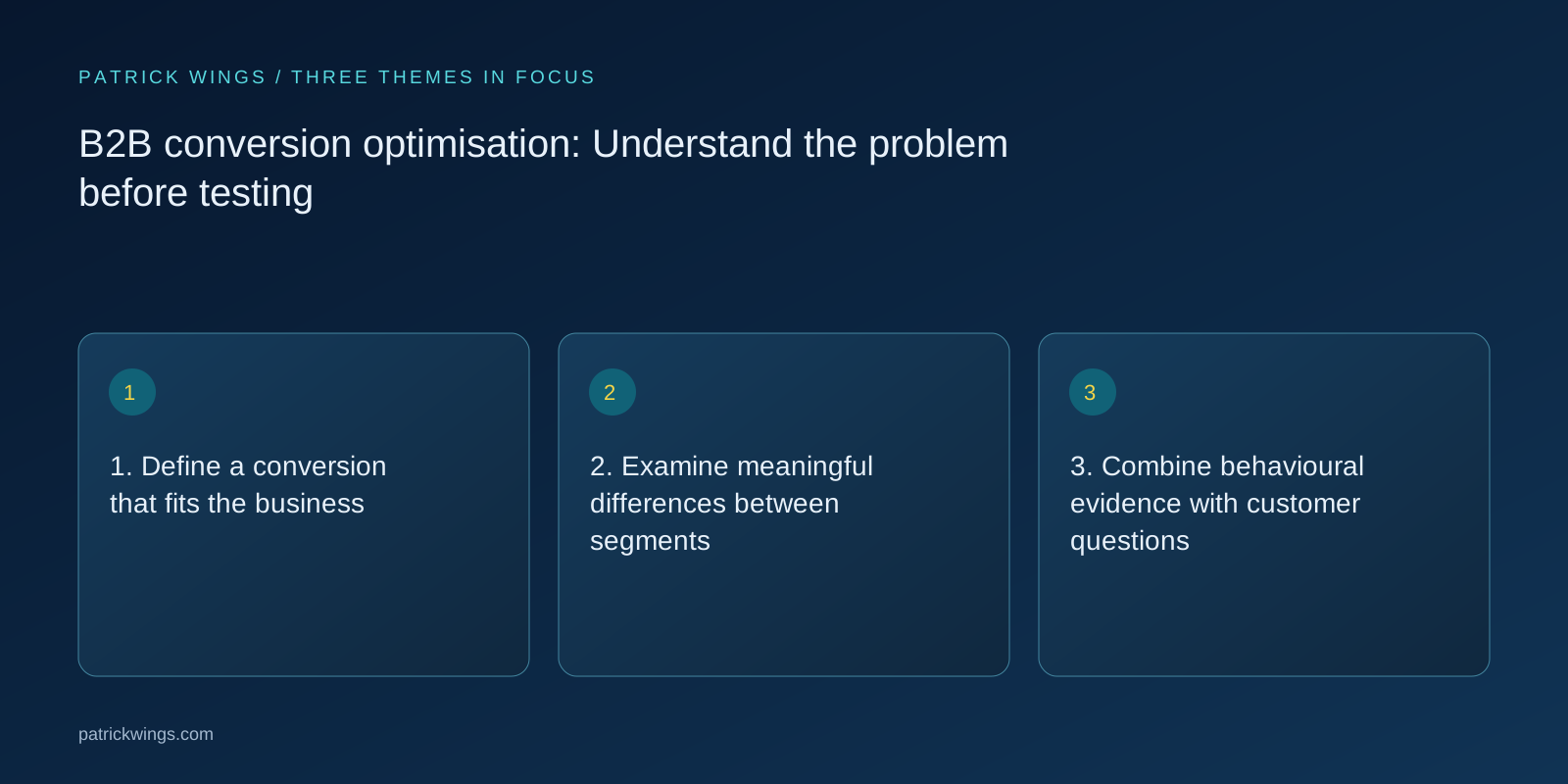
3. Combine behavioural evidence with customer questions
Heatmaps and session recordings can reveal clicks, scrolling and interaction difficulties. They do not automatically explain motivation. Microsoft describes Clarity recordings as a visual way to inspect interactions. Use those observations to generate questions, then add conversations, form feedback or specific information from sales. The combination is stronger than treating every visual pattern as proof of a particular reason for leaving.
Illustrative example: several visitors click a static pricing comparison. This initially suggests they expect an interaction there. Perhaps they need explanations; perhaps the design resembles a button. A recording does not prove that the price is too high. Develop alternative explanations before choosing a change, and identify what additional evidence would distinguish between those explanations.
4. Prioritise hypotheses you can explain
Write each idea as a testable proposition: because a particular uncertainty was observed, add a specific piece of information and expect a more appropriate action. Assess evidence, potential impact and effort. Explaining the demo process may matter more than changing button colour if customer conversations repeatedly reveal uncertainty about what happens after booking or whether the call will be relevant. Explore this further in the guide Writing B2B case studies: Show evidence, decisions and limitations.
Specify the primary metric and useful countermeasures in advance. More submissions are not necessarily an improvement if many additional contacts are unsuitable. Record variants, dates and concurrent changes. Otherwise, a difference can be difficult to separate from campaign changes, seasonality or a shift in the audience arriving at the website during the same period.

5. Match evaluation to the available evidence
An A/B test needs enough relevant observations and a predefined analysis approach. For a small B2B website, a well-run comprehension test or qualitative review can be more useful than an experiment unlikely to support a reliable decision. That makes qualitative insight valuable, but not statistically conclusive. State the distinction when communicating what has been learned and what remains uncertain.
Maintain a change log and review suitable enquiries and actual conversations after an appropriate observation period. If the result is unclear, keep the hypothesis open. Good conversion work also records explanations that were not confirmed. Over time, this builds better knowledge about prospective customers instead of accumulating disconnected design decisions that nobody can explain or assess later.
INTERACTIVE / FROM READING TO ACTION
Three checkpoints for your implementation
Choose a checkpoint and track your reading progress. Checks are neither saved nor sent and do not score your business.
CHECKPOINT 01
3. Combine behavioural evidence with customer questions
Heatmaps and session recordings can reveal clicks, scrolling and interaction difficulties.
Explore in the article ↗CHECKPOINT 02
4. Prioritise hypotheses you can explain
Write each idea as a testable proposition: because a particular uncertainty was observed, add a specific piece of information and expect a more appropriate action.
Explore in the article ↗CHECKPOINT 03
5. Match evaluation to the available evidence
An A/B test needs enough relevant observations and a predefined analysis approach.
Explore in the article ↗Frequently asked questions
Is a higher conversion rate always better?
Only relative to the defined objective. More unsuitable enquiries can increase the rate while creating additional sales work.
What can heatmaps show?
They show aggregated interaction patterns such as clicks or scrolling. Additional research is needed to understand the reasons.
Can CRO help a low-traffic website?
Yes, through error correction, comprehension testing and qualitative research. Limited data restricts what statistical experiments can establish.
How can I put “1. Define a conversion that fits the business” into practice?
A submitted enquiry is easy to count but says little about its value. Agree with sales or product colleagues what makes an action useful. For a consultative IT offer, fit between company and problem may be central.
What matters when working on “2. Examine meaningful differences between segments”?
Review important pages by entry source, device and identifiable intent. A person arriving from an informational search has different expectations from someone clicking a specific demo advertisement. Sending both groups to a general page can produce a message that helps one group but remains too vague for the other.