
THE SHORT ANSWER
An ideal customer profile describes businesses where your solution is a useful and commercially viable fit. It supports decisions across marketing, sales and product. A useful ICP explains not only whom you want to reach, but why a meaningful need could exist there.
For the broader picture of how target customers, channels and sales handoffs work together, read the pillar guide B2B demand generation: from attention to qualified pipeline.
Begin with patterns in real customers
Build a manageable list of successful customers, lost opportunities and difficult implementations. Success means more than a signed agreement: consider usage, support needs, retention and the economics of working together. Record industry, process maturity, existing systems, the underlying problem and the purchase trigger for each case. A company can look ideal on paper while requiring disproportionate support. Look for recurring reasons for both suitability and friction. If customer evidence is limited, label assumptions explicitly and supplement them with conversations with plausible target businesses rather than creating elaborate fictional personas that cannot be checked against reality. Explore this further in the guide Account-based marketing: develop target accounts together.
Rank attributes by their relevance
Separate convenient targeting filters from evidence of an actual need. Company size and location help with outreach but only partly explain demand. A particular workflow, system change or recurring bottleneck may be more informative. For an illustrative recruitment platform, repeatedly hiring hard-to-find specialists may be more relevant than an arbitrary employee threshold. Define what observation supports each attribute and where the information comes from. Avoid precise-looking thresholds when you have not tested their relationship with successful product use. The aim is a useful explanation of customer suitability, not a spreadsheet that appears rigorous because it contains many numbers.
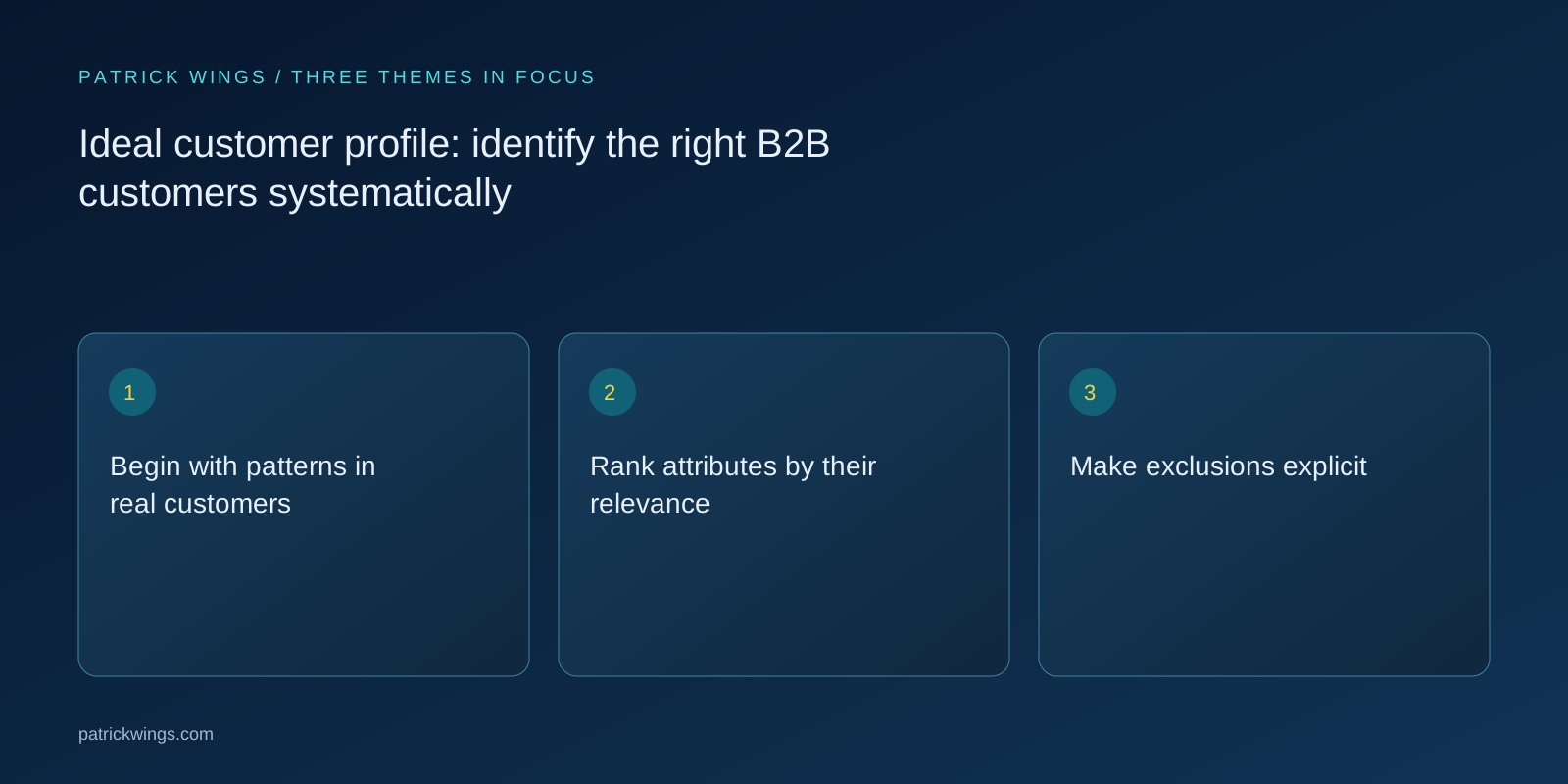
Make exclusions explicit
An ICP becomes more useful when it identifies unsuitable situations. Define technical, organisational and commercial exclusions. These might include a mandatory integration you cannot provide or a fundamentally different application. Distinguish genuine exclusions from unanswered questions. An unknown budget is not the same as confirmed inability to buy. Write a brief reason and a possible discovery question for every exclusion. This helps sales qualify consistently and reduces the pressure on marketing to prevent every unsuitable enquiry through imperfect targeting filters. Revisit the exclusions as your product and service capabilities develop, so yesterday's limitation does not become a permanent rule by accident.
Separate companies from buying roles
The ICP describes an organisation; buying committee roles describe the people involved. Record who experiences the problem, investigates solutions, assesses technical risk and makes the commercial decision. One person may perform several roles. A department manager may care about workflows, IT about data movement and procurement about contractual terms. Turn those questions into suitable content and conversation starters. This produces a practical communication aid rather than a fictional biography with hobbies and an invented name. Advertising audiences are then the best available representation of this business model, rather than the original definition of the customer you want to serve. Explore this further in the guide B2B lead qualification: separate fit, interest and buying readiness.

Translate the profile into working rules
Summarise the key criteria on one page and add examples of clearly suitable, uncertain and unsuitable organisations. Represent important attributes as understandable CRM fields where you can collect them reliably. A fit score can help organise information, but it does not replace assessment of a genuine application. Define how unknown information should be handled. Missing data should not create an arbitrary rejection. Use the profile to shape campaign arguments, research questions and content requirements. A profile that lives only in a strategy presentation will have little influence on daily acquisition decisions, however polished the presentation may look.
Update assumptions against outcomes
Review which segments lead to useful conversations, practical implementations and sustained usage. Compare similar levels of maturity and time periods where possible. A new market may appear weaker because messaging and selling are not yet established, rather than because every business in it is unsuitable. Investigate alternative explanations before narrowing the profile. Document changes together with their trigger and expected effect. The ICP then becomes a learning instrument rather than a fixed opinion. Often the most useful adjustment is a more precise need signal, not a smaller and smaller company list that excludes potential customers without a defensible reason.
INTERACTIVE / FROM READING TO ACTION
Three checkpoints for your implementation
Choose a checkpoint and track your reading progress. Checks are neither saved nor sent and do not score your business.
CHECKPOINT 01
Make exclusions explicit
An ICP becomes more useful when it identifies unsuitable situations.
Explore in the article ↗CHECKPOINT 02
Separate companies from buying roles
The ICP describes an organisation; buying committee roles describe the people involved.
Explore in the article ↗CHECKPOINT 03
Translate the profile into working rules
Summarise the key criteria on one page and add examples of clearly suitable, uncertain and unsuitable organisations.
Explore in the article ↗Frequently asked questions
Is an ICP the same as a persona?
No. An ICP describes suitable organisations. Personas or role descriptions focus on people, their responsibilities and their buying questions.
How many target segments should we use?
Use as many as you can meaningfully address and evaluate with distinct messages and processes. A clear focus is often more useful for a pilot.
What if we have little customer data?
Use clearly labelled assumptions, interviews and limited tests. Update the profile when reliable observations become available.
How can I put “Begin with patterns in real customers” into practice?
Build a manageable list of successful customers, lost opportunities and difficult implementations. Success means more than a signed agreement: consider usage, support needs, retention and the economics of working together. Record industry, process maturity, existing systems, the underlying problem and the purchase trigger for each case.
What matters when working on “Rank attributes by their relevance”?
Separate convenient targeting filters from evidence of an actual need. Company size and location help with outreach but only partly explain demand. A particular workflow, system change or recurring bottleneck may be more informative.