
THE SHORT ANSWER
Add an open buyer question to observed source data.
For the broader picture of how target customers, channels and sales handoffs work together, read the pillar guide B2B demand generation: from attention to qualified pipeline.
Buyer reports as another perspective
Add an open buyer question to observed source data. Self-reporting can reveal recommendations, communities and internal sharing that technical tracking misses. It is another perspective with memory limitations, not a replacement for every other source field or an automatically authoritative explanation of the entire journey. Explore this further in the guide Buying committees: reach several roles in demand development.
Source questions are particularly useful when referrals and internally shared resources matter. Those routes often leave a technical touch only later. Buyer reports add earlier context and can explain why an apparently isolated branded-search click occurred after substantial unobserved discussion.
Separate discovery and current trigger
Separate discovery from the immediate trigger. How did you first hear about us? asks something different from What prompted your enquiry today? Preserve the original answer and add a transparent category rather than immediately forcing a free-text response into one supposedly definitive channel.
If only one field is available, choose wording for the intended decision. Discovery may matter for awareness investment while the current trigger informs offer design. Preserve the question wording so later reports do not unknowingly combine answers to different questions. Explore this further in the guide B2B buyer research: use customer interviews to make better market decisions.
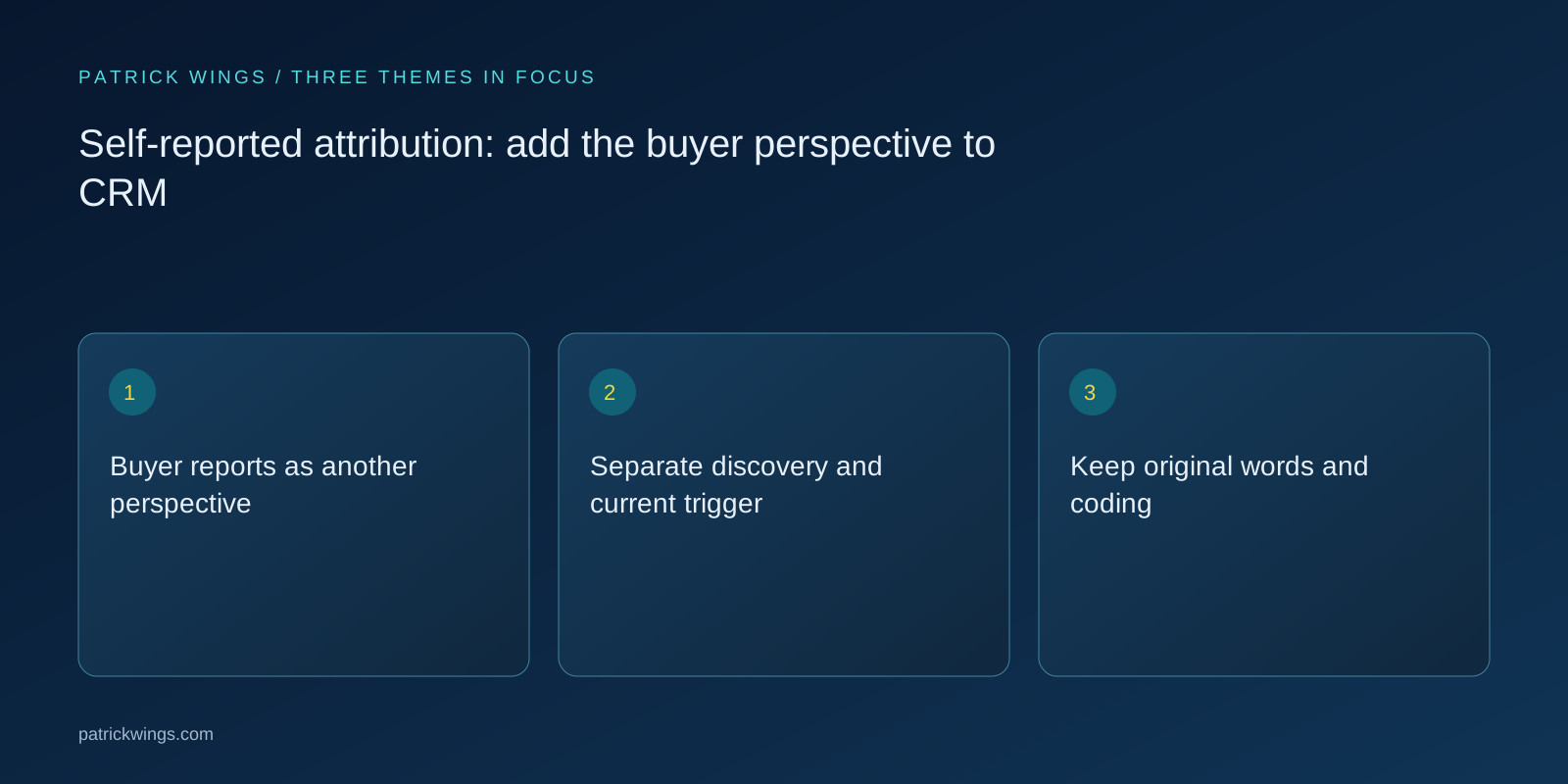
Keep original words and coding
Ask at a suitable moment without leading options. An optional form field or brief conversation question may work. Agree categories for partners, personal recommendations, search, content and unknown. Retain multiple mentions and keep the coding separate from the words the buyer actually used.
Avoid options limited to paid channels. Buyers should be able to name colleagues, communities, partners or forgotten origins. Free-text answers may receive multiple codes under transparent rules while the original wording remains available for checking and interpretation.
Why a colleague and paid search can agree
A hypothetical buyer writes: A colleague sent your presentation; today I searched your name. The CRM records paid search as the latest source. The answer adds internal sharing and a presentation as discovery context. It does not invalidate the click; it explains why that person searched for the brand.
The case might be coded as internal recommendation plus presentation, while paid search remains the technical source. A note explains the combination. This is clearer than removing search advertising retrospectively or declaring the presentation the only unquestionably causal contribution.

Memory and interviewing effects
Memory is selective, and buyers may combine several experiences. Salespeople may interpret responses differently or unintentionally steer them. Unknown must remain a valid category. Requiring a source value creates visual completeness but does not necessarily produce more reliable knowledge of how the purchase developed.
A required form question can encourage quick approximations. In conversation, seller examples may influence recall. Ask openly first and accept not remembered. Such responses describe knowledge limits; they should not be replaced later with a channel that merely sounds plausible to the analyst.
Review response coverage and disagreements
Examine response rate, multiple mentions and differences from technical sources. Use selected cases to understand content or partner contributions. A small responding subset does not justify precise extrapolation to every customer. Show the evidence base whenever reporting a conclusion drawn from the answers.
Report response coverage and whether respondents differ from others. If mainly won customers are interviewed, the perspective initially applies to that group. It does not automatically explain how unsuitable enquiries or lost opportunities originally encountered the provider.
Maintain categories from real answers
Assign category maintenance and periodically check whether colleagues code the same answer similarly. Collect new patterns before creating additional categories. Only recurring, understandable themes should receive dedicated values so the field does not grow into an unreadable catalogue of individual phrases that cannot be compared meaningfully.
Keep a small shared coding guide. An answer such as through a presentation should not be assigned to a specific platform without more evidence. Review disputed cases together and add categories only when recurring patterns have a clear substantive boundary.
INTERACTIVE / FROM READING TO ACTION
Three checkpoints for your implementation
Choose a checkpoint and track your reading progress. Checks are neither saved nor sent and do not score your business.
CHECKPOINT 01
Keep original words and coding
Ask at a suitable moment without leading options.
Explore in the article ↗CHECKPOINT 02
Why a colleague and paid search can agree
A hypothetical buyer writes: A colleague sent your presentation; today I searched your name.
Explore in the article ↗CHECKPOINT 03
Memory and interviewing effects
Memory is selective, and buyers may combine several experiences.
Explore in the article ↗Frequently asked questions
Do self-reports replace UTMs?
No. They describe different observations and should remain separate.
Which question is better?
Discovery and the current trigger are different questions; choose deliberately.
Free text or dropdown?
Free text reveals unexpected answers; an additional controlled category supports analysis.
How can I put “Buyer reports as another perspective” into practice?
Add an open buyer question to observed source data. Self-reporting can reveal recommendations, communities and internal sharing that technical tracking misses. It is another perspective with memory limitations, not a replacement for every other source field or an automatically authoritative explanation of the entire journey.
What matters when working on “Separate discovery and current trigger”?
Separate discovery from the immediate trigger. How did you first hear about us? asks something different from What prompted your enquiry today?