
THE SHORT ANSWER
Maintain retargeting exclusions according to actual communication needs.
For the broader picture of how target customers, channels and sales handoffs work together, read the pillar guide B2B demand generation: from attention to qualified pipeline.
Derive exclusions from communication needs
Maintain retargeting exclusions according to actual communication needs. Customers, applicants and open opportunities require different next steps. A large audience provides no benefit when some people are already being served or were never potential buyers of the advertised offer.
For applicants, acquisition may end after a clearly identified careers interaction. For customers, the answer depends on the offer. A product update may be relevant while another invitation to evaluate the supplier for the first time is inappropriate, requiring campaign-specific rules for the same person.
A matrix rather than one blocked list
Create an exclusion matrix covering CRM status, affected campaign, duration and re-entry conditions. Customers need not disappear from all marketing; exclude the unsuitable acquisition message. Open opportunities may still need useful evidence, but should not automatically keep receiving the same request to submit another enquiry.
Include status source, last refresh and treatment of unknown identity in the matrix. Specify when missing data requires review. Automatically including every unknown person is no more inherently correct than excluding all visitors who cannot be identified confidently through the available systems.
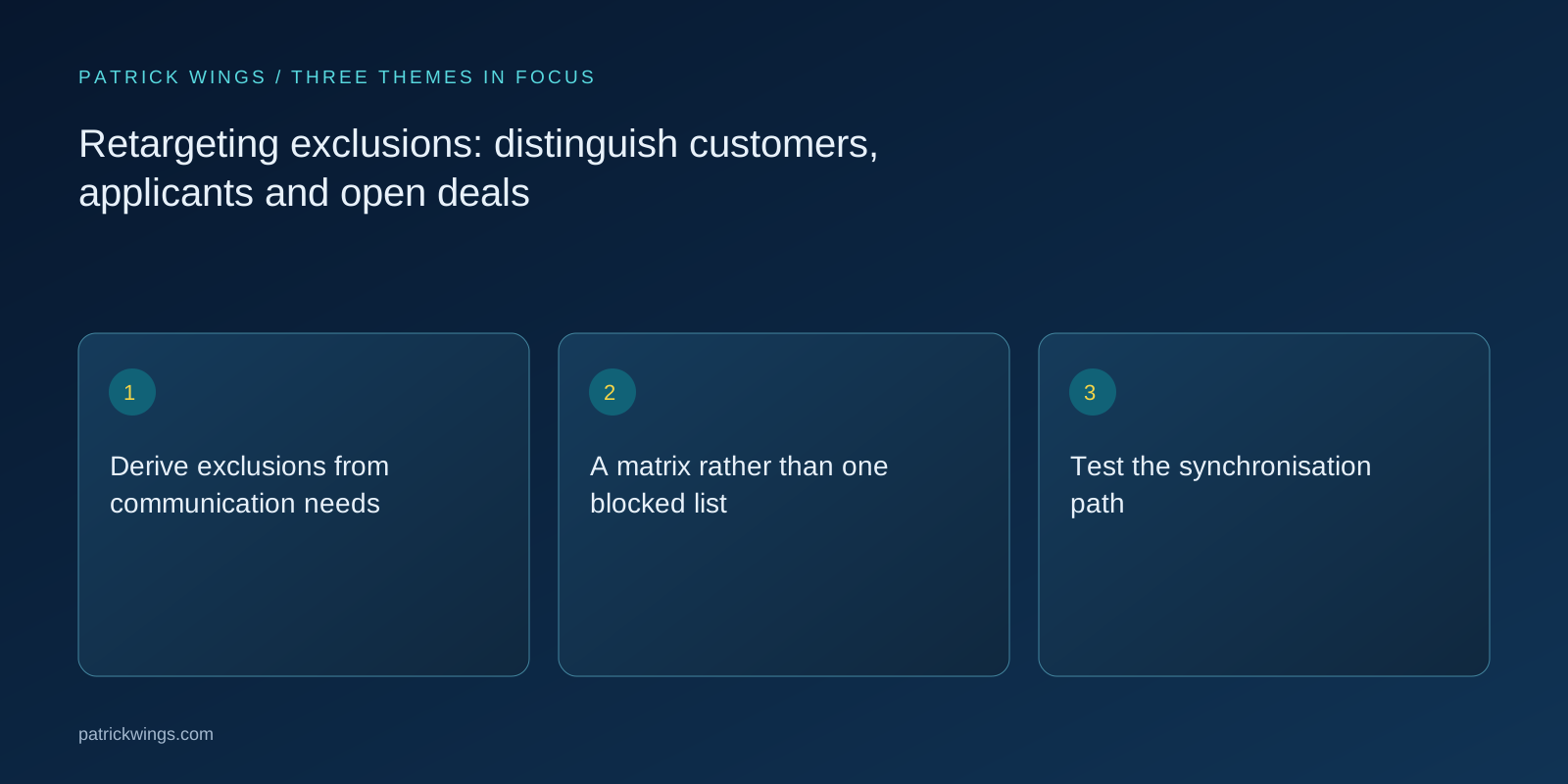
Test the synchronisation path
Check the full path from a status change to the audience actually updating. Account for sync delays, missing identifiers and technical eligibility requirements. Test with authorised sample records and compare list states. A configured workflow does not demonstrate that every advertising platform applies the intended exclusion promptly.
Trace a change through CRM update, export, platform acceptance and effective audience state using timestamps. This localises failure. A broken export needs a different repair from failed matching; rebuilding the entire platform setup may not address the part of the chain that actually failed. Explore this further in the guide Reducing AI context: share only the data a task needs.
Review five hundred visitors
Suppose an illustrative visitor list contains five hundred people, including eighty known customers and thirty applicants. A business review leaves at most 390 potential acquisition contacts. The platform’s reachable audience may be smaller still. That reduction is not lost success; it reflects a more deliberately defined communication task.
The 390 remaining contacts represent a business-defined ceiling, not guaranteed reach. Check overlap between customer and applicant groups before subtracting. Otherwise one person may be removed twice and the expected remainder becomes arithmetically wrong before platform matching is even considered.

Distinguish contact and account scope
Company-domain exclusions can block unrelated business units. A contact-only match can leave other members of an active buying committee in acquisition audiences. Choose deliberately between contact and account scope, and inspect identity-resolution limits before describing the exclusion list as complete or assuming every colleague is represented. Explore this further in the guide Buying committees: reach several roles in demand development.
A large customer with independent divisions illustrates domain-exclusion limits. Consider company structure and contract scope. Another branch may be a suitable new purchase while a second colleague in the same active project specifically does not need another generic acquisition message.
Test both included and excluded cases
Review samples of excluded and still-included cases regularly. Focus on status changes, duplicates and companies incorrectly merged together. A low list count is not the goal; the question is whether suitable people receive appropriate communication while unsuitable cases consistently leave the acquisition audience.
Use two samples: people who should leave and people who should remain. The first detects missing exclusions; the second detects unintended blocks. Both are economically relevant. Checking removal alone can silently eliminate suitable demand while making the exclusion process appear successful.
Business and technical ownership
Assign a business owner to each exclusion and a technical owner to synchronisation. Record who resolves conflicting CRM statuses. Reviewing complaints, sales feedback and stale lists turns exclusion management into an operating process rather than a one-time configuration whose assumptions eventually become invisible.
An automated import should not arbitrarily win when statuses conflict. Define a trusted source and resolution rule. The technical operator reports failures while the business owner decides which communication may appropriately continue until the inconsistency is resolved.
INTERACTIVE / FROM READING TO ACTION
Three checkpoints for your implementation
Choose a checkpoint and track your reading progress. Checks are neither saved nor sent and do not score your business.
CHECKPOINT 01
Test the synchronisation path
Check the full path from a status change to the audience actually updating.
Explore in the article ↗CHECKPOINT 02
Review five hundred visitors
Suppose an illustrative visitor list contains five hundred people, including eighty known customers and thirty applicants.
Explore in the article ↗CHECKPOINT 03
Distinguish contact and account scope
Company-domain exclusions can block unrelated business units.
Explore in the article ↗Frequently asked questions
Exclude all customers?
From unsuitable acquisition messages; relevant expansion offers need their own logic.
Is an email list sufficient?
Not always. Identity gaps and other contacts at the same account remain limitations.
How do we test synchronisation?
Compare timestamped CRM samples with the audience state actually applied.
How can I put “Derive exclusions from communication needs” into practice?
Maintain retargeting exclusions according to actual communication needs. Customers, applicants and open opportunities require different next steps. A large audience provides no benefit when some people are already being served or were never potential buyers of the advertised offer.
What matters when working on “A matrix rather than one blocked list”?
Create an exclusion matrix covering CRM status, affected campaign, duration and re-entry conditions. Customers need not disappear from all marketing; exclude the unsuitable acquisition message. Open opportunities may still need useful evidence, but should not automatically keep receiving the same request to submit another enquiry.