
THE SHORT ANSWER
A tracking acceptance contract states which action should count as which event, under what conditions and how that statement can be checked. It connects business meaning, technical implementation and accountable acceptance. The term denotes an original working template here, not a legal contract or specific platform feature. Start with a few relevant signals and controlled cases. A fired tag alone establishes neither correct business meaning nor complete capture of later customers. Resolve permitted data use with the accountable specialists rather than treating technical capability as sufficient authorisation.
For the broader connection between paid channels, measurement and economics, read the pillar guide Performance marketing for B2B SaaS: manage channels, measurement and budgets.
Define the business outcome before the tag
Write the action so that marketing and sales recognise the same entry condition. A button click, accepted enquiry and confirmed opportunity are different events. Give every signal a purpose: observation, technical checking or support for a campaign decision. Platform labels assist configuration but do not replace a business definition. Also record exclusions such as internal tests or repeated handling of one transaction. Resolve ambiguous meaning before implementation rather than apparently correcting it afterward through adjusted totals. A shared event name is useful only when the people using it understand the same underlying action. Explore this further in the guide Reconciling conversion figures across Google Ads, GA4 and CRM.
Record ownership and data scope
For each signal name the business owner, technical owner and reviewer. Describe required fields, permitted identifiers, timestamps and intended recipient. Include only the scope needed for the agreed purpose. Privacy, retention and access require review by the responsible specialists; a marketing guide does not replace that assessment. Keep documented restrictions beside the event. A technically possible transfer is not automatically a permitted use. Acceptance should preserve the boundary so that later campaign changes do not silently expand it. Record who can approve a changed purpose and what must remain paused until that review is complete.
How is a boundary recorded?
Describe which inputs or cases fall outside the agreed purpose. Explain the boundary and its review trigger. Do not compensate for missing coverage by silently broadening the interpretation of the signal that is available.
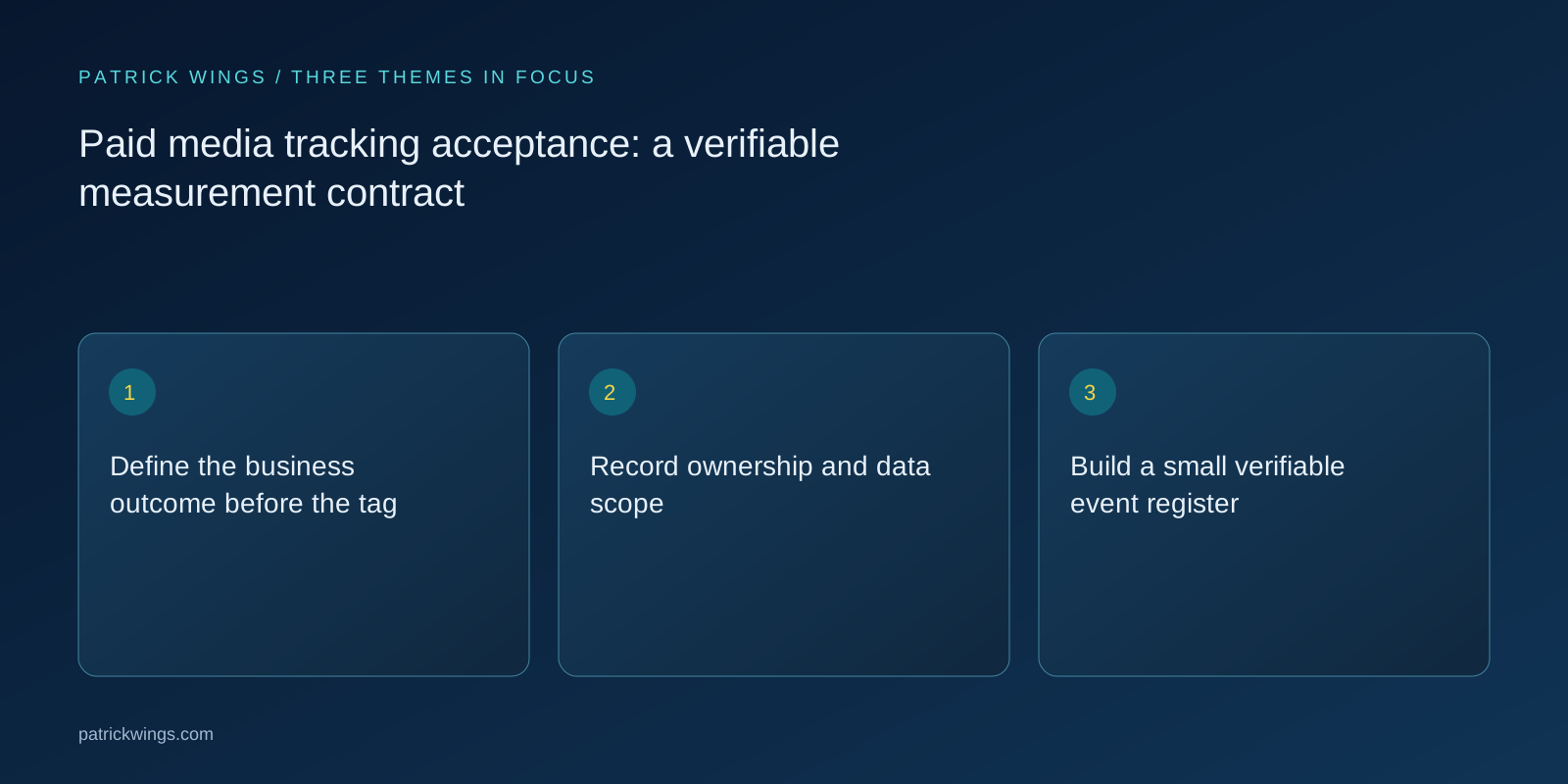
Build a small verifiable event register
Connect event name, trigger, counted object, deduplication rule and expected destination status. Add the system and version using the signal. Google distinguishes primary and secondary conversion actions; actual campaign use still needs checking against current configuration. Do not infer usage solely from an event label. The register is an original working structure, intended to create an inspectable shared statement rather than imitate a platform report that supposedly covers every exception. Where the implementation cannot satisfy a requested definition, narrow the accepted scope or leave the item unresolved instead of disguising the gap with a familiar label. Explore this further in the guide CRM campaign feedback: build an actionable error log.
| Case | Expected result | Acceptance |
|---|---|---|
| Successful enquiry | Defined action recorded | Business and technical |
| Failed submission | No false success signal | Technical owner |
| Repeat | Agreed counting rule applied | Sales operations and technical |
Prepare positive and negative cases
A useful plan covers the expected normal route and relevant cases that must not count as success. Test successful processing separately from a click on a failed submission, for example. Consider a repeated action and an appropriately prepared abandonment. State expected observations before running each case. Use approved inputs and suitable testing procedures. A retrospectively selected screenshot can illustrate the route but cannot replace acceptance of the agreed cases. Keep deviations visible even when part of the journey behaves as intended. A passed normal case does not establish that failure and repetition are handled correctly.

Handle duplicates and repeats through business rules
Several technical transmissions may concern one business event. Conversely, the same account may later begin a genuinely new evaluation. The right rule depends on the counted object. Define when a repeated signal is ignored, updates an existing event or counts again. Sales operations confirms relationships with CRM records; technical owners check implementation. Do not choose an arbitrary time window merely because it appears in an example. Record why the boundary was selected and which cases remain deliberately ambiguous. Test those boundaries so the business can interpret both the known cases and the limits of the resulting totals.
Verify CRM handoff and delay
Define which later business stage should be returned and which timestamp carries its meaning. A status may be entered late or corrected, so the process needs an explicit treatment. Check transmission and receipt separately from qualification. Google describes measurement mechanisms and richer signals, but your process still needs to verify a permitted and useful implementation. Missing assignment remains a data gap. Do not automatically interpret it as a lost customer or successful enquiry. Keep business delay, data-handling delay and failed transfer separate because they call for different corrective actions and different reporting explanations.
What should campaign owners receive?
They need business status, last verification date and known restrictions. Technical success alone is insufficient when a new CRM stage is maintained inconsistently or its meaning has just changed within the sales process.
Fictional example: accept a demo signal
An explicitly fictional team wants to measure confirmed demo requests. One controlled case is processed correctly; another ends in a validation error. The contract expects the confirmed event only in the first case. Reloading the confirmation page is checked separately. This illustrative observation is not a real implementation or proof of a particular platform feature. If the error case still reports success, the team corrects the trigger and repeats that exact test. Only afterward does it give bounded acceptance for the documented use case and conditions. Unrelated devices, integrations and future website changes remain outside that narrow evidence.
Connect changes to renewed acceptance
Link changes in forms, website, CRM stages and campaign goals to the event register. Identify the trigger for renewed verification and the accountable person. A new interface can alter a trigger while the visible form purpose stays the same. A new sales definition can change meaning while the technology remains untouched. Mark these breaks in reporting. One successful test does not establish continuing correctness for every later edition. The acceptance contract remains a maintained working agreement connecting observations with their permitted interpretation. Preserve earlier versions so later reviewers can explain a discontinuity without inventing a change in market demand.
INTERACTIVE / FROM READING TO ACTION
Three checkpoints for your implementation
Choose a checkpoint and track your reading progress. Checks are neither saved nor sent and do not score your business.
CHECKPOINT 01
Build a small verifiable event register
Connect event name, trigger, counted object, deduplication rule and expected destination status.
Explore in the article ↗CHECKPOINT 02
Prepare positive and negative cases
A useful plan covers the expected normal route and relevant cases that must not count as success.
Explore in the article ↗CHECKPOINT 03
Handle duplicates and repeats through business rules
Several technical transmissions may concern one business event.
Explore in the article ↗Frequently asked questions
Is the acceptance contract a legal document?
Here it is an operating template for shared definition and verification. Legal and privacy requirements are reviewed separately by accountable specialists. The template replaces neither that assessment nor an actual contractual agreement.
What belongs in an event definition?
Action, trigger, counted object, timestamp, ownership and relevant exclusions. Add technical implementation and permitted data use. The label alone cannot explain what a later count means or how it may be used.
Is a fired tag sufficient evidence?
It establishes at most a technical observation under tested conditions. Check meaning, receipt, repetition and relevant failure cases. A positive signal is not automatically a qualified enquiry or a new customer.
Who accepts tracking?
Business owners accept meaning, technical owners accept the evidenced route, and responsible specialists review permitted use. Small teams may combine these roles, but the distinct questions still need an inspectable record.
How should duplicates be handled?
Follow the agreed business counting rule. Separate repeated transmission from genuinely new commercial events. Removing every similar record through a blanket technical rule could otherwise erase real new evaluations from the analysis.
When is retesting needed?
After material changes to triggers, forms, goals, data routes or business definitions. Define review triggers and mark changes in reporting. An old test record cannot establish correctness of a subsequently changed implementation.