
THE SHORT ANSWER
Different conversion counts in Google Ads, GA4 and CRM are initially a comparison question, not automatically a tracking defect. First establish whether the figures describe the same action, period and assignment rule. Then inspect the technical route. This article proposes an original reconciliation method for B2B campaigns. The aim is an explained difference with an appropriate next action, not forced equality across all reports. An unknown remainder must not be filled with invented conversions or interpreted as proof of additional demand that nobody actually observed.
For the broader connection between paid channels, measurement and economics, read the pillar guide Performance marketing for B2B SaaS: manage channels, measurement and budgets.
Name the compared events precisely
Record which action each figure represents. An analytics event, an event marked important and a conversion created for advertising may serve different purposes. CRM may count only a business-accepted enquiry. A report labelled “leads” does not explain those distinctions. Create a small dictionary covering trigger, counted object, source and status. Google documents differences between Analytics key events and advertising conversions; your business still needs to define and maintain the meaning of its own sales stages. Preserve the accepted definitions so that later analysts compare the same concepts rather than familiar-looking labels.
Align period and reporting clock
State date range, time zone, freshness and the event basis of each report. A person can click on one day, enquire later and be qualified in CRM later still. Reports may therefore place the same sequence in different periods. Compare an appropriately mature cohort alongside a calendar report. Record export dates and whether further events may arrive. A difference caused by reporting clocks is not repaired through a new tag configuration. It needs an understandable analysis rule and visible context in the report. Separate late arrival of data from genuine delay in buyer evaluation. Explore this further in the guide Conversion lag: manage B2B campaigns by signal maturity.
Which clock belongs to the decision?
A short-term operating check may ask about received events, while channel evaluation needs a mature acquisition cohort. Define the question before choosing a column rather than retrospectively declaring the most favourable view correct.
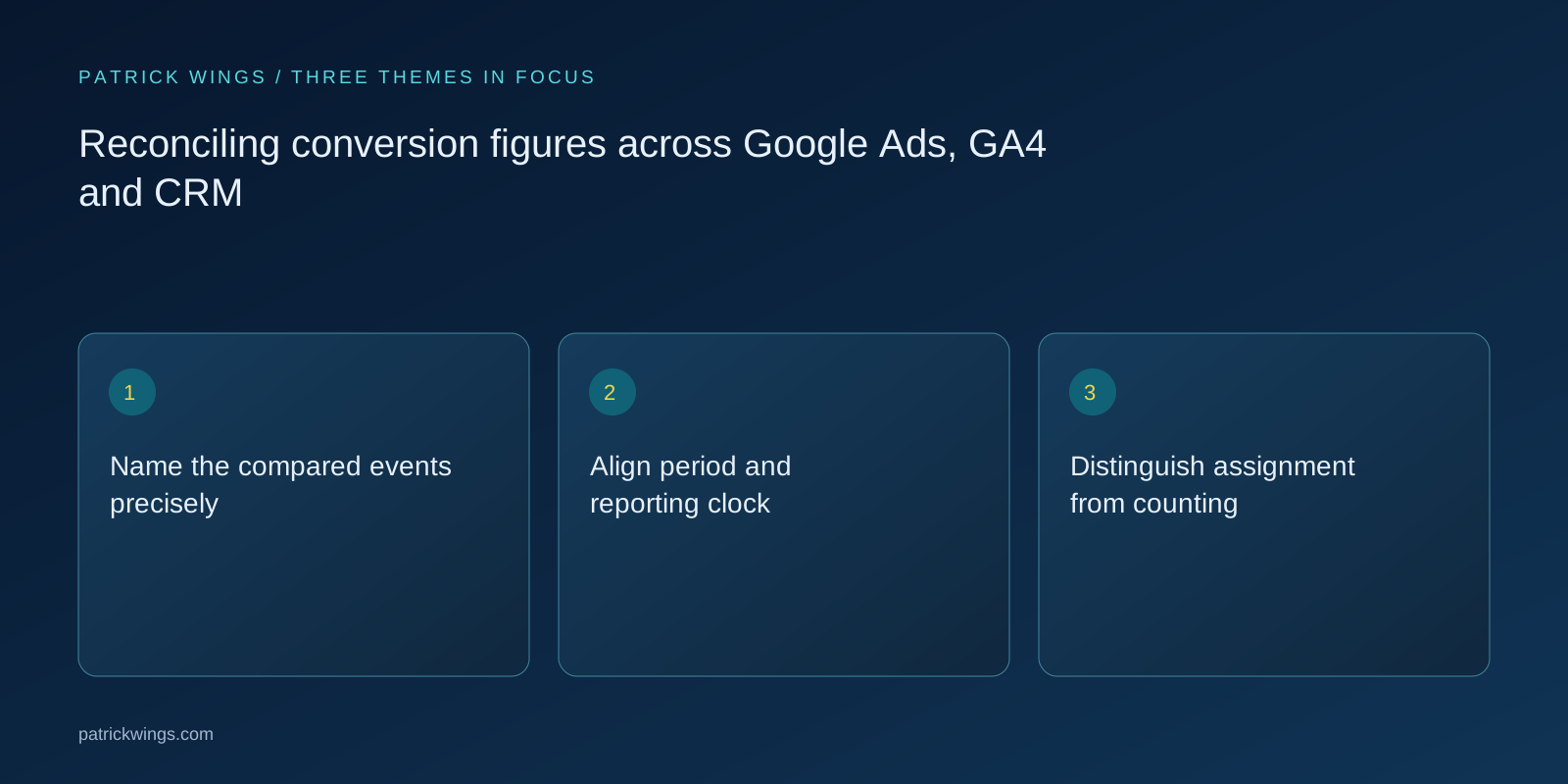
Distinguish assignment from counting
Check which contacts each system assigns to advertising and how repeated actions by the same person or company are counted. An account opportunity is not one website visit. Several members of a buying committee do not automatically represent several new sales opportunities. Record counting and deduplication rules before adding totals. Models may legitimately offer different perspectives. They do not justify reporting the largest available number as total performance. For a budget decision, state which observation and assignment rule support the conclusion, and disclose events that cannot be linked reliably under the approved measurement process.
| Difference | Check | Consequence |
|---|---|---|
| Different definition | Trigger and counted object | Label the metric clearly |
| Different clock | Interaction and event date | Explain comparison window |
| Technical fault | Controlled case | Repair and repeat acceptance |
Inspect the route with a controlled case
Choose an approved test case and record expected stages from website event through technical processing. Use suitable testing procedures and respect data and access rules. Check trigger, repeated transmission, processing status and actual goal configuration. A positive technical signal does not establish business-qualified demand. Conversely, absent assignment does not automatically mean that the person failed to perform the action. Record what was observed directly and which connection remains assumed. The issue then becomes actionable for an accountable specialist rather than a general complaint that the dashboard does not match another system.

Separate expected differences from defects
Classify findings as different definition, clock, assignment, coverage or a verified technical fault. Label a suspected cause as a hypothesis and state the additional check that could confirm it. Avoid turning every unexplained difference into the same blanket reimplementation project. Technical corrections need their own acceptance test. Changed reporting definitions need a version note. Disclose an unresolved remainder so that a later configuration change does not silently present it as improved campaign performance. A plausible explanation should remain open to challenge until the relevant observation supports it rather than merely sounding reasonable.
Publish a comprehensible reconciliation note
The shared report contains starting counts, their meanings, established differences and open investigation tasks. Assign an owner and identify the decision restricted pending each clarification. A dashboard should not imply greater precision than the reconciliation permits. Avoid one adjustment formula for causes that differ. Where reports answer legitimately different questions, retain them side by side. Marketing, analytics and sales operations should be able to understand the explanation without replaying the original analyst conversation every time. Preserve the evidence behind the classifications so that a future owner can reproduce the same bounded conclusion.
How is unknown origin retained?
Show the unknown group separately with its definition. Do not allocate it arbitrarily across known channels. Improved later assignment needs defensible permitted evidence and a documented change to the analysis rather than an unexplained balancing adjustment.
Fictional example: three figures with different jobs
An explicitly fictional team sees twelve form events, nine attributed ad conversions and four accepted CRM enquiries. These invented figures illustrate the method and are not benchmarks. Reconciliation establishes that the first counts technical actions, the second channel attribution and the third a business stage. The team also finds one duplicated form transmission. It repairs that defect without promising equality of the three figures afterward. It records remaining differences and revisits young contacts later. None of the totals independently establishes caused revenue or a complete buyer journey, even when their definitions and technical handling are correct.
Plan changes and repeat verification
Version event definitions, reporting scope and technical assignment together. A changed CRM stage or new conversion action can interrupt comparability. Repeat a controlled case after such changes and mark the transition in reporting. Monitor how well differences can be explained, not just their size. A coincidentally small discrepancy does not prove quality. A larger, understood difference may be correct. Useful measurement supports bounded accountable decisions and keeps uncertainty visible rather than forcing all platforms into one number after the fact. Review the reconciliation when assumptions change, not merely when a dashboard begins to look untidy. Explore this further in the guide Paid media tracking acceptance: a verifiable measurement contract.
INTERACTIVE / FROM READING TO ACTION
Three checkpoints for your implementation
Choose a checkpoint and track your reading progress. Checks are neither saved nor sent and do not score your business.
CHECKPOINT 01
Distinguish assignment from counting
Check which contacts each system assigns to advertising and how repeated actions by the same person or company are counted.
Explore in the article ↗CHECKPOINT 02
Inspect the route with a controlled case
Choose an approved test case and record expected stages from website event through technical processing.
Explore in the article ↗CHECKPOINT 03
Separate expected differences from defects
Classify findings as different definition, clock, assignment, coverage or a verified technical fault.
Explore in the article ↗Frequently asked questions
Must the figures be identical?
Only if definition, timing, assignment and coverage actually match. Verify those conditions. A deliberate difference in perspective is not a defect, but must not be compared as though it were the same metric.
Where should reconciliation begin?
With the business meaning of each figure and a clear reporting period, followed by technical investigation. Without that order, a functioning implementation may be changed unnecessarily and create a fresh comparison gap.
Is CRM always the truth?
It is the reference for the business events defined there, provided records are maintained correctly. Missing stages, duplicates and changed rules can limit CRM evidence too and need their own verification.
What does a test event establish?
It may confirm a defined technical route under specified conditions. It does not establish complete capture of every user or business quality of later contacts. Keep those limits beside the acceptance record.
Can attribution models be added?
Not without resolving overlap and a shared definition. Different systems may each attribute the same event. Adding their totals can therefore create double counting rather than reveal extra customers or additional revenue.
When is a difference sufficiently explained?
When meaning, established cause and remaining uncertainty are inspectable and the next decision can be responsibly bounded. An exact zero is not necessary when systems answer legitimately different questions.