
THE SHORT ANSWER
A CRM error log turns sales feedback into testable campaign improvements. Instead of merely labelling a lead as poor, it records the observed mismatch, supporting evidence and next accountable decision. This article covers diagnosis after handover. It does not replace a complete lead-scoring model or the technical setup of offline conversions. The aim is a small, consistently maintained loop between media owners and sales that distinguishes unsuitable demand from processing failures. It should preserve unknown causes rather than forcing every disappointing conversation into a convenient explanation that the available evidence cannot actually support.
For the broader connection between paid channels, measurement and economics, read the pillar guide Performance marketing for B2B SaaS: manage channels, measurement and budgets.
Start with a concrete diagnostic question
Begin with a recurring issue, such as enquiries expecting an integration the product does not offer. Specify the campaigns and entry cohort under examination. An unlimited collection of every possible rejection reason quickly becomes unusable. State the decision the log should enable: narrowing a claim, adding a qualification question or repairing a handover. Name the person responsible for each intervention. An entry without a decision consequence may still be useful customer context, but it does not automatically belong in the central campaign diagnosis. This keeps the working log small enough to be read regularly and used to change work rather than becoming another neglected reporting requirement.
Agree failure classes instead of assigning blame
Separate unsuitable customer context, misleading expectations, missing product prerequisites, processing problems and unknown causes. A seller should not automatically classify an unprepared contact as a media failure; marketing should not infer poor sales work from a missing CRM field. Define each class through an observable example and counterexample. Permit several causes when evidence supports them, identifying a primary working hypothesis where useful. Include an unresolved state so required fields do not manufacture diagnoses. The classification supports joint improvement. It should not become a ranking of departments or a disguised performance assessment of individual employees whose working circumstances the campaign team may not understand. Explore this further in the guide Long sales cycles: qualify intermediate bidding signals.
| Failure class | Concrete evidence | Possible correction |
|---|---|---|
| Wrong type of business | Documented requirement outside the ICP | Review message or qualification question |
| Unfulfillable promise | Advertised feature absent from the product | Repair ad and landing page |
| Handover failed | No accountable owner or next appointment | Repair routing and response process |
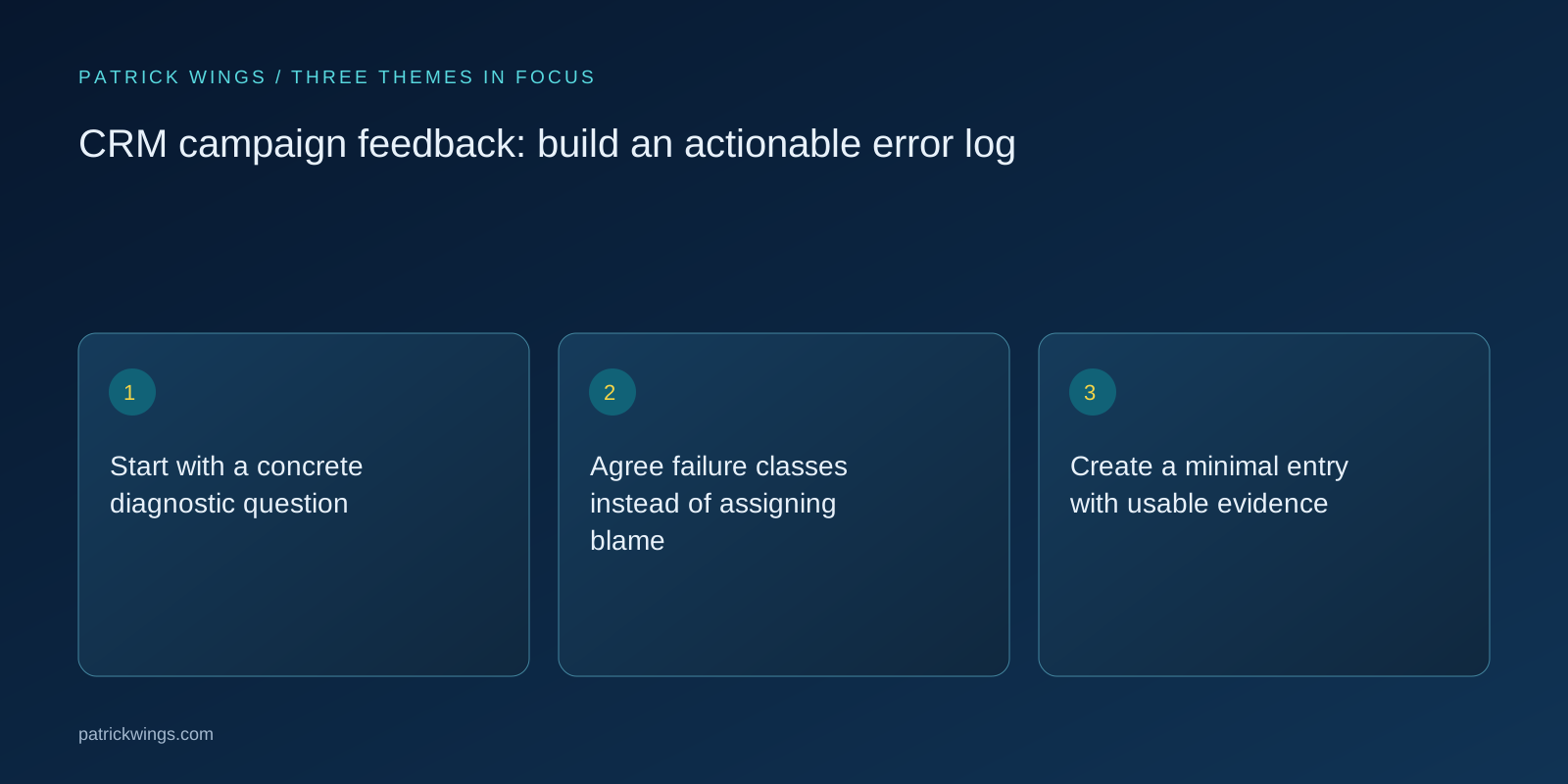
Create a minimal entry with usable evidence
A useful record contains a case identifier, entry cohort, campaign connection where known, processing state, observed mismatch and evidence reference. Add consequence, an owner and a review date. Do not copy entire conversation transcripts into a widely shared marketing export when a factual summary is sufficient. Handle sensitive information and usage rights through approved procedures. “Integration X was expected, while the product supports only Y” is usually more useful than a long unstructured quotation. Evidence should remain discoverable by authorised reviewers without needlessly reproducing personal information across additional spreadsheets, decks and tools. The log’s purpose is diagnosis, not unrestricted access to every detail collected during a sale.
Reconstruct campaign connections cautiously
When several people from one business use different entry points, origin is not always clear. Separate direct campaign attribution, supporting indications and unknown source. Google and LinkedIn document mechanisms for feeding conversion events back to advertising systems; those mechanisms do not replace an explanation of why an enquiry was unsuitable. Avoid counting one opportunity repeatedly across contacts and platforms. Ask whether a problem belongs to a particular message or is simply recorded more consistently there. A log can trigger an investigation without proving a channel comparison. Small subsets especially require case review rather than dramatic percentages that appear precise while resting on a handful of ambiguous observations.
When does a rejection become campaign evidence?
A reason becomes actionable when it plausibly changes reach, offer, expectations or handover. “Not interested” alone is too broad. Ask for the recorded trigger and the point where expectations stopped matching. Unknown remains an acceptable answer; forcing a reason manufactures precision that the seller did not actually observe and can send the campaign team towards an irrelevant intervention.

Inspect a fictional recurring pattern
The fictional SaaS company HafenDesk examines twelve enquiries from a bounded campaign period. In four invented cases, buyers expect real-time synchronisation while the product supports only scheduled exchange. Two cases can be linked to the same ad; the other entry points remain unresolved. These numbers are illustrative assumptions, not actual client outcomes. HafenDesk discovers an overly broad landing-page statement and clarifies it instead of immediately pausing the entire channel. It then checks the next cohort for recurrence of that expectation. Price rejection and delayed sales response remain separate classes because they call for different interventions and accountable owners rather than the same creative rewrite.
Connect each change to an expected observation
A correction needs a testable expectation: fewer conversations with a specific false integration assumption, without excluding suitable buyers unnecessarily. Record timing, scope and affected assets. A drop in reported errors is insufficient if sales simultaneously records fewer cases or campaign delivery collapses. Examine case volume, processing coverage and observed errors together. Do not change a campaign after every isolated remark. A demonstrably false promise may need immediate correction; an unconfirmed preference from one contact is more likely to justify research. This distinction reduces reactive management and makes the loop capable of learning from evidence instead of confusing a steady stream of edits with genuine improvement.
Prioritise by consequences during the review
Discuss failures that mislead buyers, violate agreed boundaries or systematically prevent valuable conversations first. Then consider frequent but less consequential friction. Frequency is not the sole criterion: a rare false security promise can matter more than several harmless comprehension questions. Assign each issue a decision: correct it, gather more evidence, route it to product or document an exception. Name a backup when the owner is unavailable. End the review with a few executable tasks and dates rather than a long list without delivery responsibility. Carry unresolved items forward until an accountable acceptance or a reasoned decision to close the investigation exists. Explore this further in the guide Paid media tracking acceptance: a verifiable measurement contract.
Test the proposed response against one concrete case before rolling it out widely. Can the accountable person identify the exact claim or handover that should change? If not, clarify the entry with its reporter. Adding another comment without changing work does not close the improvement loop. Link closure to a visible intervention, a verified decision or a reasoned explanation of why no correction is justified yet.
Audit the log for its own biases
Periodically check whether sellers interpret classes consistently and whether new colleagues classify the same examples similarly. Compare recording coverage across periods before interpreting differences as changing lead quality. Merge categories that no longer alter decisions; require a practical consequence before introducing new ones. Archive completed interventions with their outcomes so known issues are not rediscovered indefinitely. Keep access proportionate to the task, and delete or aggregate data under the applicable internal rules. A good error log depends on consistent observation, clear decisions and feedback to the people who reported the original cases, rather than collecting the largest possible volume of customer information without a usable purpose.
How do you avoid collecting only bad cases?
Include suitable and unresolved enquiries alongside rejected ones in a small recurring review. Otherwise, the team creates a complaint catalogue without a denominator. Record the source population and missing processing states. A rise in negative reports may reflect more consistent recording rather than worse campaign quality. Keep that measurement explanation visible when discussing whether media activity should change.
INTERACTIVE / FROM READING TO ACTION
Three checkpoints for your implementation
Choose a checkpoint and track your reading progress. Checks are neither saved nor sent and do not score your business.
CHECKPOINT 01
Create a minimal entry with usable evidence
A useful record contains a case identifier, entry cohort, campaign connection where known, processing state, observed mismatch and evidence reference.
Explore in the article ↗CHECKPOINT 02
Reconstruct campaign connections cautiously
When several people from one business use different entry points, origin is not always clear.
Explore in the article ↗CHECKPOINT 03
Inspect a fictional recurring pattern
The fictional SaaS company HafenDesk examines twelve enquiries from a bounded campaign period.
Explore in the article ↗Frequently asked questions
Does a rejection reason prove a cause?
No. It begins as an observation or interpretation. Examine evidence, competing explanations and suitable comparison cases before making a fundamental campaign change.
How many categories are needed?
Use as few as possible while preserving different decisions. Categories with identical ownership and consequences can often be merged without losing useful information.
Should marketing receive complete call recordings?
Not automatically. Use factual summaries and authorised evidence references when they answer the diagnostic question without unnecessary distribution of customer data.
Can one case have several causes?
Yes. Record evidenced causes separately and label any provisional primary hypothesis. Do not force a single explanation when the situation is genuinely mixed.
How is a correction evaluated?
Compare suitable subsequent cases, recording coverage and the specific mismatch. Fewer reports alone prove little when processing or campaign delivery also declines.
When can an issue be closed?
Close it after checking the intervention, recording the outcome and assigning any remaining monitoring responsibility. Unresolved uncertainty should stay visible in the record.