
THE SHORT ANSWER
A paid media handover is complete when the receiving owner can understand, inspect and continue operations with appropriate access. A directory of advertisement exports is insufficient. Agree account structure, decision ownership, measurement definitions, active commitments and learning history together. This article proposes an operating handover method, not a legal assessment of contractual or data rights. Platform roles and actual permissions need checking against current documentation and account settings. The aim is an inspectable operating transition rather than an apparent fresh start that discards the reasons behind the current configuration.
For the broader connection between paid channels, measurement and economics, read the pillar guide Performance marketing for B2B SaaS: manage channels, measurement and budgets.
Define scope and transition ownership
List affected ad accounts, data connections, pages, forms, creatives, reports and running experiments. Name current and future responsibility for each. Establish what transition is actually commissioned and which dependency another owner handles. An agency change does not automatically mean a new campaign strategy or business definition. Agree a transition point and a route for remaining questions. The inventory describes required operating capability rather than every imaginable file. Where scope or responsibility is disputed, preserve the open issue for the accountable parties instead of silently expanding the assignment or treating an assumption as an accepted obligation. Explore this further in the guide Paid media budget pacing: manage expenditure and learning needs.
Check accounts and roles in the actual system
Distinguish an existing link, administrative permission, billing responsibility and business ownership. Google documents differences between manager links and owner privileges; a visible connection alone does not grant every administrative capability. Review current settings with authorised people. Use suitable roles rather than relying on shared personal passwords. This guide performs no permission changes. Record which required action the new role can actually perform and what remains unverified before transition. Visibility and operating ability are different conditions. Do not infer a permission from a familiar role name when account relationships and actual configuration determine its effect.
Which role does ongoing operation need?
Derive it from required tasks and verify its effect in the actual account relationship. More privileges do not make the handover clearer. Missing ownership should not be replaced by broadly sharing a personal login.
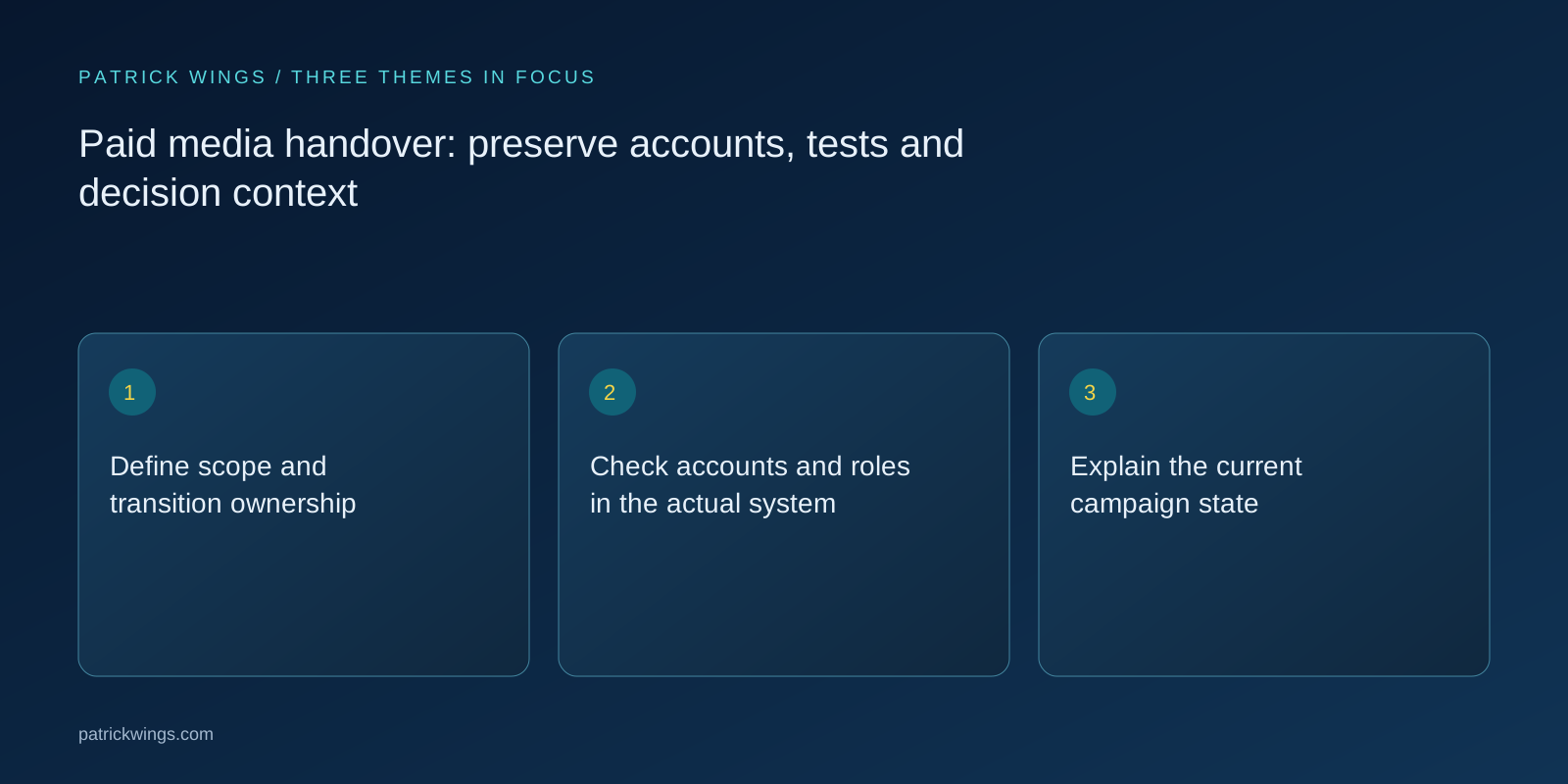
Explain the current campaign state
Transfer audience, offer, active targeting, budget boundaries and important justified exclusions. Explain why the structure exists. An unusual setting may be a deliberate response to a previous finding. It should neither be accepted blindly nor removed simply because it looks unfamiliar. Preserve actually deployed creatives and destination versions. An export shows settings but not their decision rationale. Add short references to observations and open assumptions. The next operator should distinguish changes requiring investigation from corrections to outdated documentation. The objective is usable context, not a presentation defending every historical choice against legitimate later review.
| Handover field | Required context | Verification |
|---|---|---|
| Accounts | Roles, links and billing | Required action possible |
| Measurement | Definition and data route | Metric traceable |
| Experiments | Hypothesis and observation state | Next decision defensible |
Transfer measurement definitions with data routes
Connect event labels to business meaning, technical source, counting rule and known limitations. Check whether the receiver can trace a reported metric to its definition. Include open data defects and recently changed CRM stages explicitly. An apparently tidy report must not lose uncertainty when a different person presents it. Transfer information only within the confirmed permitted scope. Access and outstanding legal obligations are reviewed separately by accountable specialists. A complete operating explanation does not automatically require copies of all personal raw data or every historic export. Prefer the evidence needed to understand and verify the agreed operating state. Explore this further in the guide Low-volume B2B advertising tests: define defensible evidence limits.

Preserve active tests and earlier decisions
For every running experiment record hypothesis, baseline, variants, analysis rule, observation window and next decision. Identify comparisons that immediate changes would invalidate. Give the new owner room for critical review without forcing automatic termination. Previously rejected approaches need a brief reason and historical context. A discontinued experiment was not necessarily a proven failure: capacity constraints or a changed product may explain the decision. Preserving the distinction prevents old uncertainty from becoming supposedly established channel knowledge. An honest record should show what was learned, what was not established and what evidence could justify reopening the question.
Conduct a controlled takeover exercise
Ask the receiver to explain a typical report, reconstruct a documented test and inspect an approved low-impact operating task within the authorised scope. The previous owner observes unclear points and supplies missing context. This checks the usability of the handover rather than judging the individuals’ competence. A successful account login alone does not establish usability. Classify blocked steps as access, documentation or process issues. Only then decide which corrective work enables transition and which is optional improvement. Preserve the receiver’s actual questions; they often reveal dependencies that a polished summary or nominally complete checklist failed to capture.
What stays stable pending clarification?
Identify changes that would disrupt an active comparison or material operating route. Agree accountable handling of those dependencies rather than treating every historical setting as permanently untouchable or requiring an unexamined restart.
Fictional example: an exclusion without its explanation
An explicitly fictional team inherits a search campaign with an unusual exclusion. The export contains only the rule. The learning log explains that earlier enquiries expected an unsupported product variant. The new owner checks whether that limit still applies before removing the exclusion. This invented case is not a customer reference and proves no economic benefit of a particular rule. It illustrates the value of decision context. If the product has changed, a new bounded experiment may be appropriate. Keep the original decision within its historical scope instead of retrospectively rewriting it as an error simply because circumstances differ today.
Accept the transition and agree follow-up
Acceptance records completed operating requirements, open boundaries, accountable people and the next review point. Distinguish necessary remaining work from a newly requested strategy. During agreed follow-up, check whether reporting, cost oversight and data routes remain understandable. Authorised owners manage roles appropriately; this method replaces neither security assessment nor contract review. A useful transition ends with clear state and responsibility, not the largest possible documentation bundle. Preserve evidence so later issues can be investigated against the actual accepted state without attributing every gap in memory to another party. Revisit the operating agreement when a genuine new dependency emerges.
INTERACTIVE / FROM READING TO ACTION
Three checkpoints for your implementation
Choose a checkpoint and track your reading progress. Checks are neither saved nor sent and do not score your business.
CHECKPOINT 01
Explain the current campaign state
Transfer audience, offer, active targeting, budget boundaries and important justified exclusions.
Explore in the article ↗CHECKPOINT 02
Transfer measurement definitions with data routes
Connect event labels to business meaning, technical source, counting rule and known limitations.
Explore in the article ↗CHECKPOINT 03
Preserve active tests and earlier decisions
For every running experiment record hypothesis, baseline, variants, analysis rule, observation window and next decision.
Explore in the article ↗Frequently asked questions
Is a campaign export sufficient?
No. It shows part of configuration without explaining hypotheses, business goals, access roles and unresolved limits. The receiving owner should understand state and rationale rather than rebuild settings without knowing why they exist.
Must every campaign restart?
Not automatically. Review current state, product scope and active comparisons. A responsibility change alone does not establish a need for a full restart. Justified changes need their own decision and a traceable baseline.
Who verifies access?
Authorised account owners use current platform rules and actual settings. A visible link does not confirm every needed action. This operating model performs no account intervention or substitute approval for a particular permission change.
What belongs in the learning log?
Question, deployed editions, observations, conditions, uncertainty and decision. An approach may have ended because capacity disappeared. Record the actual reason instead of treating every discontinued activity as a proven failure of the channel.
How is the handover checked?
Through typical tasks within the approved scope: explain a report, find a metric definition and reconstruct an experiment. Assign causes and ownership to blocked steps. A simple acknowledgement that files arrived is insufficient evidence of operational readiness.
When is transition complete?
When agreed operating requirements are met and remaining boundaries have documented ownership. Optional new strategy and later improvements remain separate tasks. Appropriate follow-up resolves questions genuinely related to the accepted handover rather than silently expanding it.