
THE SHORT ANSWER
Plan paid media spending as a bounded investment decision with a learning objective and follow-up capacity.
For the broader picture of how target customers, channels and sales handoffs work together, read the pillar guide B2B demand generation: from attention to qualified pipeline.
Learning before budget percentages
Plan paid media spending as a bounded investment decision with a learning objective and follow-up capacity. A fixed percentage of revenue does not explain the cost of useful evidence or how many additional enquiries sales can handle. Separate experimental funds from justified ongoing expenditure.
Frame the learning objective as a choice: should a new offer produce suitable projects, or should a proven channel deliver more volume? The first funds uncertainty reduction. The second additionally needs evidence that demand and handling capacity exist beyond the current level.
Include costs and capacity
Connect available funds, scenario-based enquiry costs, qualification workload and outcome maturity. Include implementation, content and data maintenance as well. Label assumptions explicitly: an uncertain closing rate should not become an apparently reliable revenue forecast merely because it passes through several spreadsheet calculations. Explore this further in the guide Sales capacity: match campaigns to actual follow-up capacity.
Count available follow-up hours after existing duties rather than total contractual working time. Include research, conversation and preparation. A budget capable of generating twenty new enquiries is operationally unsuitable when the team can properly serve only five additional cases.
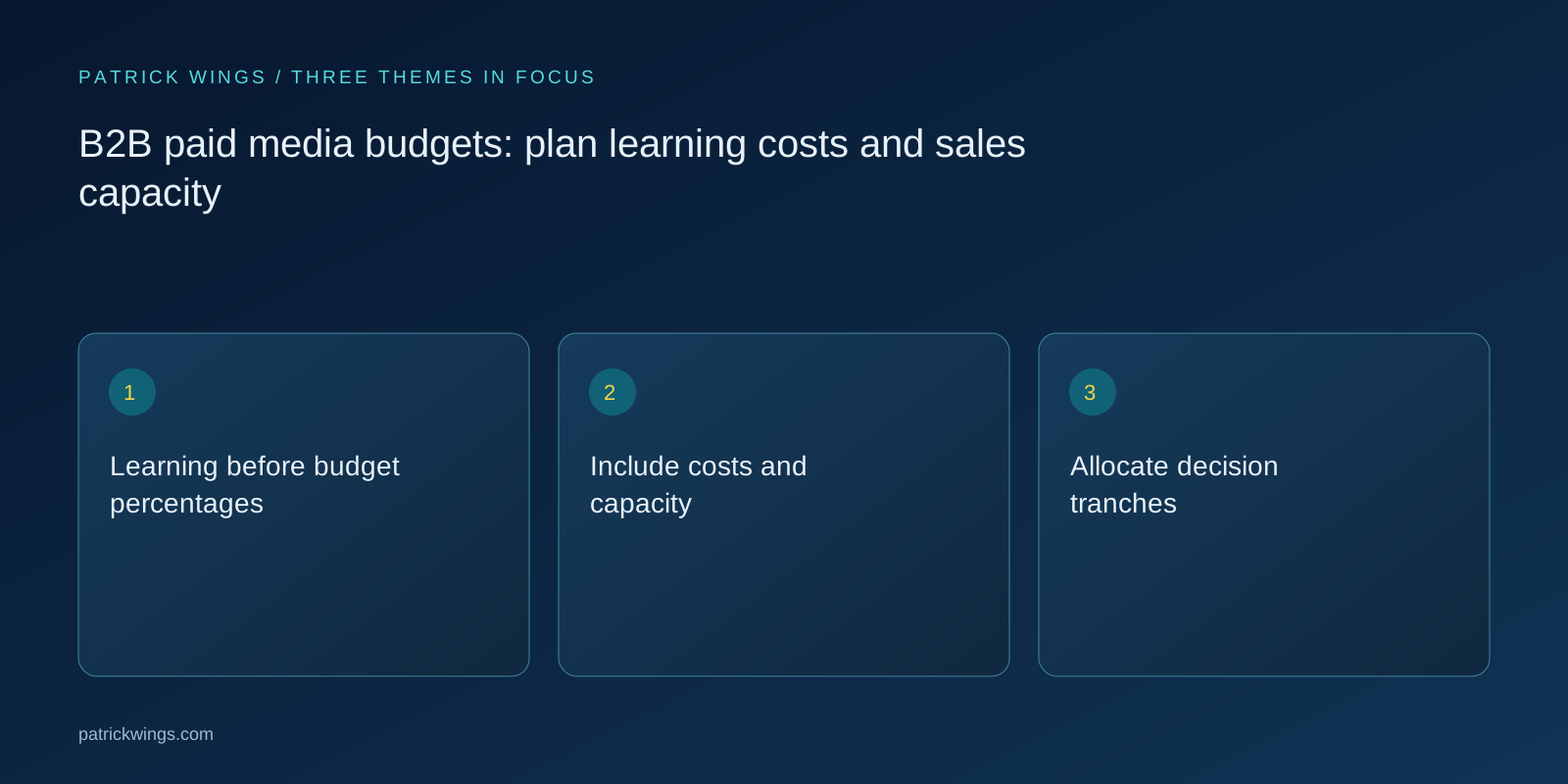
Allocate decision tranches
Define an initial allocation, maximum acceptable loss and a decision after the observation window. Verify the offer and measurement first. Reserve time for analysis and keep some funding uncommitted rather than allocating the entire amount before any meaningful quality feedback becomes available.
Release the next tranche against working measurement, a reviewed sample and understandable quality reasons. A calendar date alone is insufficient. A failed technical check may justify a small repair allocation without automatically opening another tranche of media expenditure.
Plan nine thousand euros with a reserve
An invented team has €9,000 available. It reserves €3,000 for a search test, €2,000 for landing page and measurement work and €4,000 for later expansion. At an assumed €300 per enquiry, ten contacts would result. If each needs two hours of work, twenty sales hours must be available.
The €4,000 reserve is not an invitation to spend whatever remains. It stays attached to the next documented decision. If the ten expected contacts are mostly unsuitable, that reserve may fund an offer correction before purchasing more of the same traffic.

Interpret CPL and spending pace
Low spending does not establish underinvestment; suitable demand may be limited. A high enquiry cost does not establish poor economics if valuable projects result. Avoid changing whether implementation, ongoing service and media costs are included while still presenting channels as directly comparable investments. Explore this further in the guide Compare channels through customer economics beyond CPL.
Show media CPL and complete test costs side by side. Disclose one-off measurement work so a small first test is not compared with an established channel on different cost bases. Conversely, recurring necessary work must not permanently disappear behind a one-time exception label.
Release funds through evidence
After the first allocation, inspect actual handled cases as well as cost and volume. Are quality, measurement and sales response sufficient for another decision? If one prerequisite is missing, fund its improvement before additional reach simply increases the existing constraint and makes more enquiries wait.
Examine the latest sufficiently mature group and how many suitable cases were actually accepted. Good quality with overloaded sales points toward capacity work. Poor quality despite proper handling points more strongly toward the offer, audience or search intent requiring a change.
Expand, repair or stop
Prepare three possible decisions: expand, repair a specific weakness or stop. Give each a condition and an accountable owner. The budget becomes a documented learning path that management and sales can assess together rather than an annual figure defended independently of operational evidence.
Each decision states the next bounded expense and intended learning. Preserve reasons and usable findings when stopping. A stopped test with a clear answer can be more valuable than an ongoing channel whose purpose nobody can still explain in concrete commercial terms.
INTERACTIVE / FROM READING TO ACTION
Three checkpoints for your implementation
Choose a checkpoint and track your reading progress. Checks are neither saved nor sent and do not score your business.
CHECKPOINT 01
Allocate decision tranches
Define an initial allocation, maximum acceptable loss and a decision after the observation window.
Explore in the article ↗CHECKPOINT 02
Plan nine thousand euros with a reserve
An invented team has €9,000 available.
Explore in the article ↗CHECKPOINT 03
Interpret CPL and spending pace
Low spending does not establish underinvestment; suitable demand may be limited.
Explore in the article ↗Frequently asked questions
How much budget is enough?
Enough to inform the defined decision, considering costs, maturity and risk.
Should landing page costs be included?
Yes for the investment decision; also show media and implementation separately.
When should we scale?
When quality, measurement and follow-up capacity support additional demand.
How can I put “Learning before budget percentages” into practice?
Plan paid media spending as a bounded investment decision with a learning objective and follow-up capacity. A fixed percentage of revenue does not explain the cost of useful evidence or how many additional enquiries sales can handle. Separate experimental funds from justified ongoing expenditure.
What matters when working on “Include costs and capacity”?
Connect available funds, scenario-based enquiry costs, qualification workload and outcome maturity. Include implementation, content and data maintenance as well. Label assumptions explicitly: an uncertain closing rate should not become an apparently reliable revenue forecast merely because it passes through several spreadsheet calculations.