
THE SHORT ANSWER
A B2B advertising test with few completed purchases can inform a useful decision while still failing to detect a modest effect reliably. Good planning therefore starts with the decision and the smallest commercially meaningful change. Only then should you assess whether volume, measurement and time can support the question. This article examines the evidential limits of small tests; it does not replace statistical planning by qualified specialists. An honestly inconclusive result is more valuable than a supposed winner created by repeatedly changing the evaluation rules until one variant happens to look favourable.
For the broader connection between paid channels, measurement and economics, read the pillar guide Performance marketing for B2B SaaS: manage channels, measurement and budgets.
Bound the question to a defined intervention
Specify one intervention and one primary outcome. Comparing two landing pages for the same qualified search traffic is more testable than asking whether an entirely new campaign is better. Define the included audience and the conditions intended to remain stable. If the ad, offer, price and sales script all change, the intervention is a package. That may be a legitimate business question, but it cannot identify each component’s contribution. Write the intended conclusion before launch. This prevents a conspicuous secondary metric from becoming the supposed original objective when the outcome that actually mattered produces an inconvenient or ambiguous result.
Separate commercial relevance from detectability
The effect worth acting on and the effect your volume can distinguish are different quantities. Planning requires a baseline rate, a relevant change, an approach to error control and a realistic observation count. Use suitable methods and disclose their assumptions; no universal number of leads guarantees sufficient evidence. Variable contract values and repeated responses from one account complicate simple calculations. A specialist review may show that the proposed test cannot answer the question affordably. That finding saves resources. Narrow the question, extend a defensible period or deliberately choose another evidence type rather than proceeding with an inadequate design and promising a decisive answer later.
| Finding | Permitted interpretation | Next action |
|---|---|---|
| Few events and a large observed gap | A signal with substantial uncertainty | Observe longer or narrow the test |
| No clear difference | The result is inconclusive | Do not automatically claim equivalence |
| Measurement changed during the test | Comparability is limited | Separate analysis or restart |
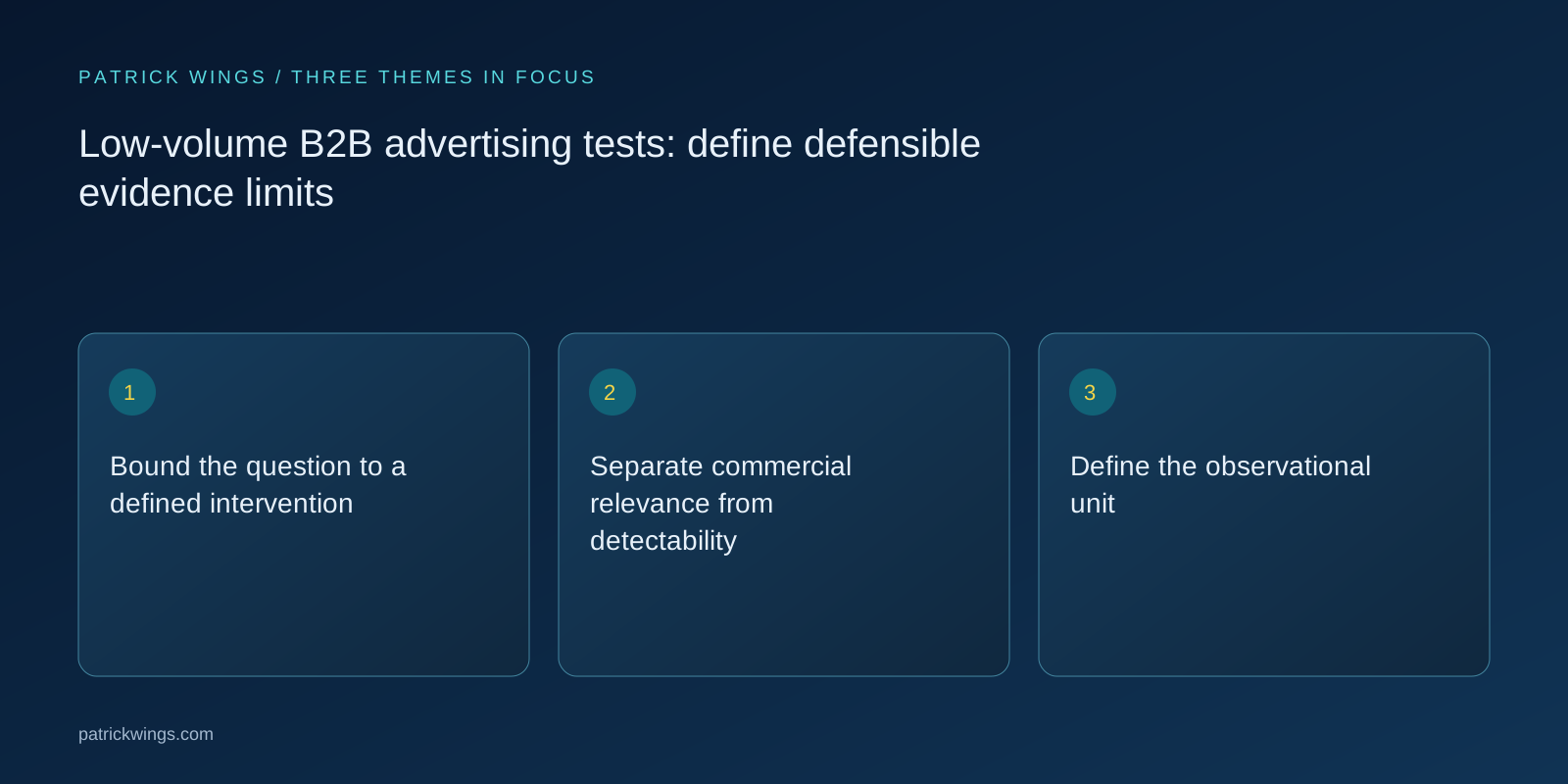
Define the observational unit
Visits, people and businesses are not interchangeable. Members of one buying committee may see different variants, and their responses can be related. Counting each response as an independent purchase opportunity overstates information. Decide whether assignment and analysis should occur at session, person or account level. Verify what the chosen platform actually supports and what remains outside that mechanism. Disclose possible overlap. The procedure must fit the decision: testing whether a form is comprehensible can use different units from assessing additional customers or economic pipeline. A large impression total does not eliminate the dependence between several actions originating from the same underlying commercial opportunity.
Check measurement and maturity before analysis
A wrong conversion definition does not become correct when more data accumulates. Test transmission, deduplication, variant assignment and CRM handover before launch. Agree how long outcomes will be followed after the last included contact. Google’s conversion-delay documentation describes its reporting context; your qualification and sales process may require additional time. Mark outages and retrospective changes. A period with broken measurement cannot automatically become valid by adding more days later. Decide whether unaffected periods remain comparable or a restart is needed. Record that choice before a few favourable outcomes tempt the team to convert a compromised dataset into a confident success announcement. Explore this further in the guide Paid media handover: preserve accounts, tests and decision context.
Which minimum effect would justify change?
Describe the smallest improvement that would matter after production, media and implementation costs. A tiny numerical gain may be commercially irrelevant even if a large account can detect it statistically. Conversely, a small B2B test may fail to distinguish a genuinely important effect. Separate business relevance from detectability before selecting a duration, rather than introducing that distinction only after the result is known.

Read a fictional example without inventing a winner
The fictional company MeridianSoft compares two messages using broadly comparable traffic. Assume variant A produces three qualified conversations and B produces five. These invented figures illustrate an interpretation problem only. Eight conversations do not by themselves establish that B is reliably superior: exposures, assignment, variability and decision rules still matter. One account has also generated responses from several people. MeridianSoft records the observed gap, examines conversation content and adopts B for a limited reversible follow-up phase. It does not claim statistical proof or extrapolate the observed rate across a year or into other segments. Its next action is pragmatic and bounded rather than falsely conclusive.
Account for repeated inspection and multiple outcomes
Inspecting many metrics daily and stopping at the first favourable fluctuation changes error behaviour compared with a single planned evaluation. Use a method appropriate to the observation schedule or retain the specified endpoint. Advertising platforms use different statistical approaches; consult current documentation and avoid silently combining their outputs with your own tests. Choose a primary outcome and treat other metrics as diagnostic unless the design explicitly says otherwise. Safety and cost stops remain possible, but should be labelled accordingly. A test interrupted because its financial limit was reached is not automatically a completed demonstration of effectiveness merely because the team must now make a decision. Explore this further in the guide Marginal acquisition cost: decide when extra ad spend is justified.
Supplement quantitative gaps with suitable qualitative evidence
When volume is low, conversation notes can reveal why a variant is understandable or misleading. Ask specific questions about expectations, confusion and missing prerequisites. These observations can improve a message without estimating how common the issue is across the market. Include negative cases and distinguish observed behaviour from stated preference. If both variants trigger the same technical objection, the highest-value intervention may sit outside the creative. Document how each observation connects to a proposed change. Two persuasive quotations should not become retrospective proof of an overall conversion effect. Qualitative evidence answers important questions, but its proper role differs from estimating a causal response rate.
Also inspect assignment across the observation period. A substantial difference between intended and observed traffic can come from technical faults or eligibility conditions. It is not automatically an error, but it requires explanation before interpreting effects. Handle bots, internal tests and ineligible use through rules established in advance. Do not remove cases retrospectively merely because their outcomes conflict with the preferred winner. Record exclusions and their reasons.
Hand over a finding with explicit limits
The final record names the question, valid observations, statistical method, unresolved outcomes, parallel changes and permitted conclusion. Show uncertainty intervals or other appropriate uncertainty measures when they can be calculated defensibly. Failure to find a clear difference does not automatically establish equivalence. Decide whether further information is worth obtaining. If a pragmatic variant choice is necessary, give its operational rationale, such as clearer expectations or easier maintenance. Specify the later evidence that would reopen the choice. A small test can then support real decisions without exceeding what its sample permits or removing inconvenient uncertainty from the presentation simply to create an appealing winner narrative.
How should an inconclusive test end?
Record the intervention, valid observation period, remaining uncertainty and effort consumed. Decide explicitly whether further information could be worth its cost. If not, make a reversible operational choice without calling it a statistical winner. Preserve the bounded finding so a future team does not accidentally repeat the same test while believing it is investigating an entirely new question.
INTERACTIVE / FROM READING TO ACTION
Three checkpoints for your implementation
Choose a checkpoint and track your reading progress. Checks are neither saved nor sent and do not score your business.
CHECKPOINT 01
Define the observational unit
Visits, people and businesses are not interchangeable.
Explore in the article ↗CHECKPOINT 02
Check measurement and maturity before analysis
A wrong conversion definition does not become correct when more data accumulates.
Explore in the article ↗CHECKPOINT 03
Read a fictional example without inventing a winner
The fictional company MeridianSoft compares two messages using broadly comparable traffic.
Explore in the article ↗Frequently asked questions
How many leads does a test require?
There is no universally sufficient count. Baseline rate, meaningful effect, variability, observational unit and the desired error control jointly determine requirements.
Does a non-significant result establish a tie?
Not necessarily. Evidence may be too imprecise to distinguish an important difference. Demonstrating equivalence requires a suitable question and method of its own.
May we inspect results every day?
Yes for diagnosis and financial control. Effectiveness decisions must handle repeated evaluation in a way consistent with the chosen statistical method.
Can one sales quotation settle the test?
It can explain a specific comprehension problem and justify revision. It does not produce a quantitative estimate for the entire target market.
What happens if tracking changes?
Document timing and consequences. Assess a restricted comparison or restart before treating changed events and earlier outcomes as one consistent dataset.
May we still make a pragmatic choice?
Yes. Describe a reversible operational decision and its rationale when the evidence cannot support a defensible claim that one variant is statistically superior.