
THE SHORT ANSWER
A creative portfolio brings together distinct, reasoned message approaches for a particular buying group. It is not simply a large collection of similar banners. Begin with open buyer questions and available evidence. Develop different explanation hypotheses, suitable presentations and a verifiable next step. This article proposes an original planning method for B2B campaigns. It promises neither a particular click-through rate nor a universal required number of variants. Assess message effects separately from format, delivery, offer and the handling of subsequent enquiries, and preserve uncertainty where those influences cannot be separated.
For the broader connection between paid channels, measurement and economics, read the pillar guide Performance marketing for B2B SaaS: manage channels, measurement and budgets.
Choose buyer questions as portfolio dimensions
Collect actual questions from evaluations and support alongside observed landing-page misunderstandings. Rank them by importance to the next decision. Problem understanding, an integration limitation and a financial concern need different explanations. Internal product categories do not automatically represent buyer questions. For each approach identify a role, situation and supposedly blocked next step. The initial selection can be small. What matters is that two approaches test different substantive assumptions rather than displaying the same claim in another colour. Keep the original question near the creative brief so later reviewers can challenge an incorrect interpretation. Explore this further in the guide After the demo: improve campaigns using evaluation friction.
Write the message as a testable hypothesis
State which explanation might help under which conditions. “Build more trust” is insufficiently specific. A more precise assumption might be that suitable buyers need to understand a verified implementation prerequisite before a conversation. Name the observation that could support or weaken it. The brief then contains claim, evidence, qualification and intended next action. This hypothesis is an editorial decision aid, not a scientifically validated model. Distinguish it from established product or customer facts so creative emphasis does not become an unsupported performance promise. Define what would make the explanation inappropriate for part of the audience.
What substantively distinguishes approaches?
Name the different buyer question and resulting explanation. If no difference can be stated, treat the editions as one hypothesis. This prevents visual production volume from being presented as breadth of the evidence actually investigated.
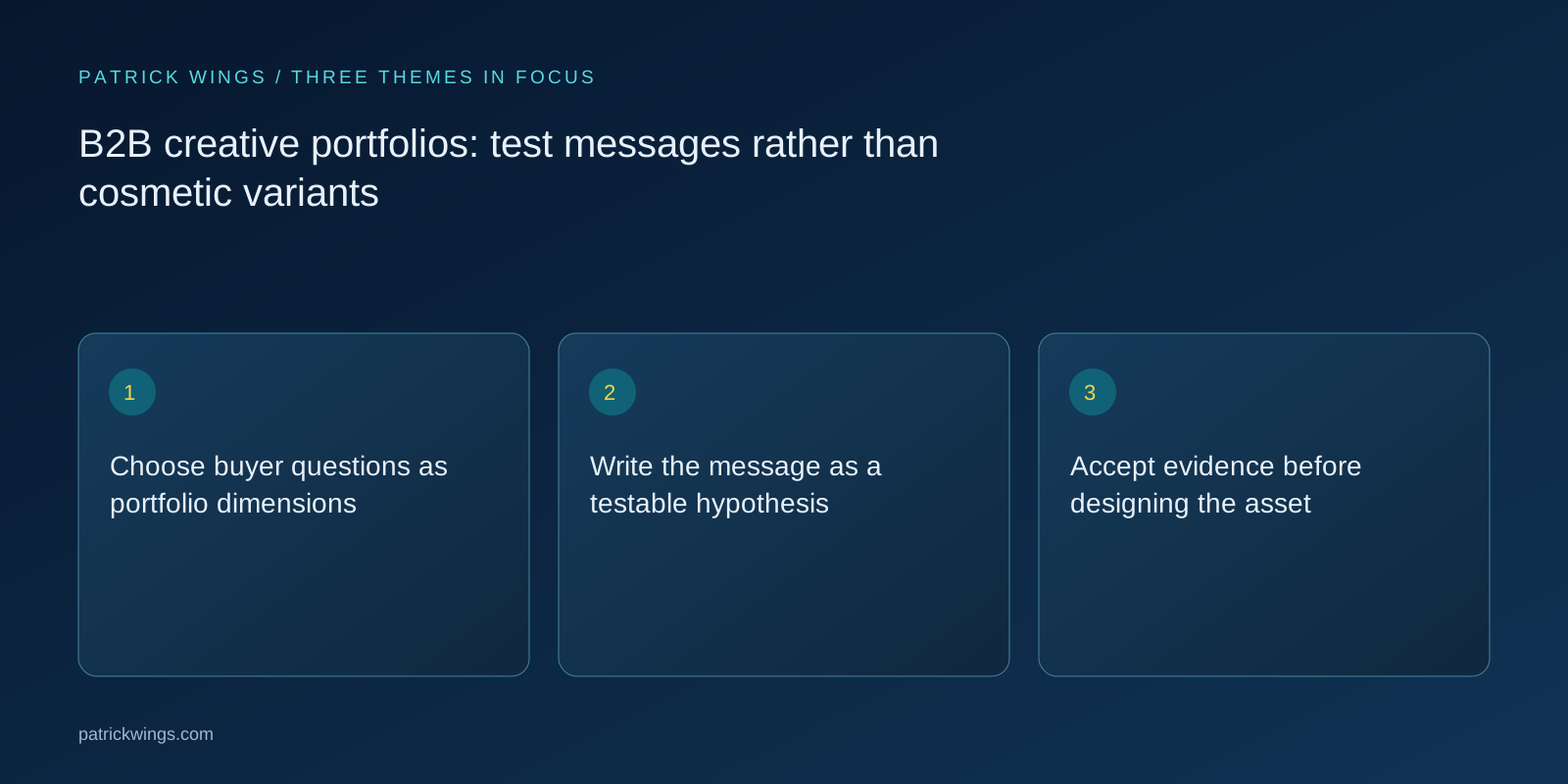
Accept evidence before designing the asset
Check the product capability, documentation, approved customer statement or transparent calculation supporting the approach. Evidence must match the actual claim and current scope. An invented illustrative value must not appear as an observed customer result. A technical restriction does not disappear because a banner offers little space. Decide which condition needs immediate visibility and which relevant detail page provides context. Resolve permitted use of external brands, quotations and materials with accountable owners. Good design strengthens the explanation; it cannot replace this review or establish a capability that the underlying product evidence does not support.
| Approach | Hypothesis | Required evidence |
|---|---|---|
| Explain problem | Buyer recognises relevant task | Observed buyer question |
| Show integration | Prerequisite becomes clear | Current technical confirmation |
| Explain cost | Assumptions are understandable | Transparent calculation |
Vary message, format and offer deliberately
Record which dimension changes between variants. If message, audience, image format and landing page all change together, the comparison investigates a bundle rather than an isolated format effect. That can support a practical decision, but should be described accurately. Begin with a comparison appropriate to available volume. Channels need suitable execution without silently changing the promise. Check current platform requirements before production. Formal creative acceptance does not establish comprehension or suitability for the reached buyers. Keep those separate review questions visible so production efficiency does not become a substitute for evidence about the actual buyer task. Explore this further in the guide Auditing message match across ads, landing pages and sales.

Maintain a traceable variant register
Assign identifiers to each approach and concrete edition. Connect text, image, role, offer, landing page, approval and delivery period. Describe the decisive difference from its comparison in one sentence. Preserve the version actually deployed rather than only an early design file. The register can remain small if another person can reconstruct the comparison. Without that context, good reporting may be attributed to the wrong variant. Retain rejected approaches and reasons too, so later teams do not repeat earlier mistakes as supposedly new ideas. Record material changes rather than overwriting the history of the original hypothesis.
Read results through the buyer task
First check suitable delivery and a functioning destination. Then review responses, comprehension questions and qualified progression. Higher click-through may reflect more unsuitable curiosity. A narrower explanation may receive fewer clicks while supporting more suitable conversations; that still requires actual evidence. Do not judge young contacts as mature commercial outcomes. At low volume, differences often remain directional clues. Avoid declaring a certain winning message while audience mix, handling or other explanations remain unresolved and the evidence cannot separate them. Report what changed, what was observed and what interpretation remains uncertain instead of awarding one creative a universal score.
Which observation triggers revision?
A repeated specific misunderstanding may require clearer wording. One favourable contact does not justify every claim. Record context and contrary observations before extending the revised message to additional audiences or treating it as generally proven.
Fictional example: three different explanation routes
An explicitly fictional SaaS provider considers three approaches to an approval workflow: clearer responsibility, a documented integration and a transparent cost illustration. These are invented planning scenarios, not customer outcomes. The team can identify supporting evidence and a suitable destination for each. It withholds the integration approach because the claimed configuration is not yet substantiated. The other two enter a bounded review. An early click-rate difference is not marketed as proof of revenue impact. The portfolio changes through resolved buyer questions and observed limitations, rather than an assumption that every new image is a meaningful new experiment.
Decide whether to continue, revise or retire
Continue an approach when its evidence remains current and observations support the next bounded use. Revision needs a specific diagnosis, such as a recurring misunderstanding. Retirement is appropriate when the claim no longer holds or the buyer task disappears. A falling isolated metric does not itself explain creative fatigue. Check delivery, audience and the follow-up journey. Record decision, ownership and next review point in the register. The portfolio remains a learning collection of verifiable explanations rather than continuous asset production without a clear purpose or defensible evidence. Preserve what the team learned even when a particular execution is no longer used.
INTERACTIVE / FROM READING TO ACTION
Three checkpoints for your implementation
Choose a checkpoint and track your reading progress. Checks are neither saved nor sent and do not score your business.
CHECKPOINT 01
Accept evidence before designing the asset
Check the product capability, documentation, approved customer statement or transparent calculation supporting the approach.
Explore in the article ↗CHECKPOINT 02
Vary message, format and offer deliberately
Record which dimension changes between variants.
Explore in the article ↗CHECKPOINT 03
Maintain a traceable variant register
Assign identifiers to each approach and concrete edition.
Explore in the article ↗Frequently asked questions
How many creatives does a portfolio need?
Enough to address meaningfully different hypotheses within available volume and capacity. This guide sets no universal number. A large variant count is not evidence of quality when the underlying buyer questions and claims remain identical.
Is a new image automatically a new test?
No. If claim, buyer task and next action stay the same, it may be a visual variant of one hypothesis. That is legitimate but answers a different question from comparing distinct messages or offers.
What evidence is suitable?
Current product evidence, approved specific customer observations and transparent calculations may be useful. Scope must match the claim. Fictional scenarios remain labelled illustrations and must never be presented as proof of actual performance.
Is click-through sufficient for evaluation?
It records one partial response and needs delivery, expectation and later quality context. Many clicks may reflect unsuitable curiosity. Limited observations also cannot establish a certain causal effect of one message over another.
When is creative fatigue established?
Deterioration needs diagnosis. Check audience, frequency, offer, technical function and handling before assigning the cause solely to the image. The label must not substitute for investigating other plausible causes of the observed change.
What should a handover preserve?
Actual deployed editions, hypotheses, evidence, approvals, comparison conditions and decisions. A file directory without this context cannot explain to the next team why an approach was used, revised or rejected.