
THE SHORT ANSWER
AI can organise research material, prepare drafts and develop alternatives. Your workflow must determine whether a piece is accurate, useful and ready for publication. Fluent wording is not sufficient for complex SaaS and IT services. A lean process combines useful automation with clear responsibility for the substance and its supporting evidence.
To see how this step fits into your content strategy, read the pillar guide B2B content marketing: From useful expertise to qualified demand.
1. Define the task and approval rules before drafting
Every brief needs an audience, a specific question, a useful reader outcome and a named subject expert. Add approved sources and known limitations. A request to “write about AI in sales” leaves too many important decisions unresolved. A precise brief identifies the process step and the question the reader should be able to answer afterwards, giving reviewers something concrete to assess. Explore this further in the guide Writing B2B case studies: Show evidence, decisions and limitations.
Also define which information cannot be entered into external tools. Confidential customer data and unpublished project details require an appropriate handling process. Establish that boundary with the responsible people in the business rather than leaving individual writers to improvise decisions while trying to meet a production deadline.
2. Separate collecting material from checking facts
Use assistance to organise material, but require a traceable basis for every verifiable assertion. A generated reference is not evidence on its own. Open the original source, inspect its contents and record which claim it actually supports. Current official documentation should take precedence over summarised third-party pages when checking specific product capabilities, setup requirements or technical limitations.
Maintain a small evidence register containing the claim, source, review date and responsible expert. This does not require an elaborate system. A well-maintained table can prevent a number being reused repeatedly after its context has been forgotten. Explicitly distinguish estimates, opinions and illustrative calculations from measured facts so that later adaptations do not accidentally change their status.
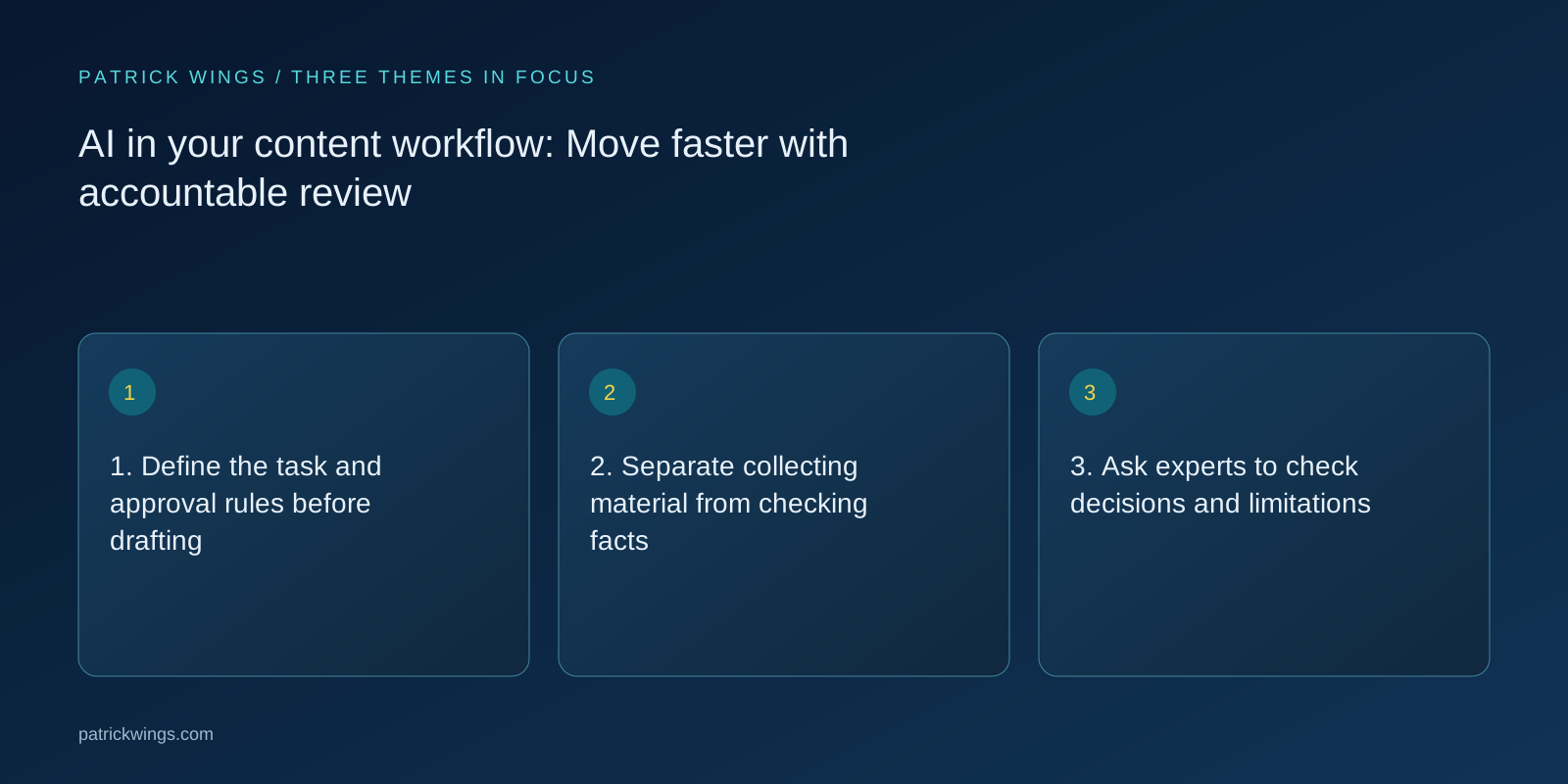
3. Ask experts to check decisions and limitations
Subject review must do more than correct spelling. Is the stated prerequisite accurate? Which exception is missing? Does the promise extend beyond the actual service? Could readers make an unsuitable decision based on the explanation? Small linguistic simplifications can hide important technical dependencies or responsibilities, particularly when an article discusses integrations between systems owned by different organisations.
Illustrative example: a draft claims that a system automatically transfers all data. The expert adds supported objects, required interfaces and manual checking steps. The revised text becomes more accurate and more useful to serious prospects. A stronger sales claim is not an improvement if the product cannot fulfil it or if necessary conditions have disappeared from the explanation. Explore this further in the guide Content repurposing: Turn expertise into a connected B2B topic.
4. Review voice, usefulness and readability deliberately
After technical review, edit the piece for the reader. Remove repeated generalities and replace them with examples, precise terminology and clear transitions. Answer the main question early, then explain the relevant conditions. Avoid several paragraphs of artificial suspense before providing a straightforward piece of information someone came to find. A clear sequence gives readers a reason to continue to the more detailed material.
Compare the draft with approved writing from your experts. Does the tone fit? Are uncertainties expressed consistently? Avoid invented personal experiences and unsupported customer outcomes. First-person wording does not automatically make generated text authentic. Authenticity depends on real knowledge and accountable statements, including the ability to explain how the conclusion was reached when a reader asks a follow-up question.

5. Publish with a maintenance plan and distinct value
Google describes the risk of scaled content that adds no value. This is not a blanket rejection of AI; it is a quality requirement. Every page should serve a distinct task. Before publication, check whether the article adds something useful beyond existing pages and whether its internal links give readers a coherent route to relevant further information rather than a collection of unrelated promotional destinations.
Assign responsibility for future changes to product features, sources and examples. Store the approved version with its supporting evidence. Evaluate the workflow through errors prevented, useful feedback and actual audience use. The number of texts produced says little about whether your content has improved, especially if faster output also creates more pages that someone must later review and maintain.
INTERACTIVE / FROM READING TO ACTION
Three checkpoints for your implementation
Choose a checkpoint and track your reading progress. Checks are neither saved nor sent and do not score your business.
CHECKPOINT 01
3. Ask experts to check decisions and limitations
Subject review must do more than correct spelling.
Explore in the article ↗CHECKPOINT 02
4. Review voice, usefulness and readability deliberately
After technical review, edit the piece for the reader.
Explore in the article ↗CHECKPOINT 03
5. Publish with a maintenance plan and distinct value
Google describes the risk of scaled content that adds no value.
Explore in the article ↗Frequently asked questions
Can AI replace subject review?
It can flag possible issues, but qualified people need to own factual accuracy, product claims and approval.
How should generated references be checked?
Open the original source and verify that it supports the precise claim in context. A plausible-looking URL is insufficient.
Is AI-assisted content automatically bad for SEO?
No. Google focuses on usefulness and compliance with its policies. Scaled production without additional value can create problems.
How can I put “1. Define the task and approval rules before drafting” into practice?
Every brief needs an audience, a specific question, a useful reader outcome and a named subject expert. Add approved sources and known limitations. A request to “write about AI in sales” leaves too many important decisions unresolved.
What matters when working on “2. Separate collecting material from checking facts”?
Use assistance to organise material, but require a traceable basis for every verifiable assertion. A generated reference is not evidence on its own. Open the original source, inspect its contents and record which claim it actually supports.