
THE SHORT ANSWER
A canonical audit checks whether duplicate URL variants consistently identify a suitable preferred page and whether search engines select that page. Begin with template families, compare declared and observed outcomes, and fix conflicting signals at their source. A list of canonical tags alone cannot establish that the underlying content relationship is correct.
For the broader picture of technical foundations, useful content and visibility measurement, read the pillar guide SEO, GEO and AEO for SaaS: visibility that supports buying decisions.
Build groups before counting errors
Export URLs from a site crawl, sitemaps, analytics and the CMS. Retain parameters initially so that the audit reveals variants rather than silently normalising them away. Group by template, content identity, language and parameter function. Record why each group exists: tracking, sorting, syndication, print view or accidental duplication. This inventory makes it possible to distinguish an isolated editorial mistake from a template generating thousands of inconsistent references. Keep commercially important and recently migrated pages visible even when they have little traffic. Explore this further in the guide Distinguishing noindex, robots and canonical controls.
Compare content and intended representatives
Read the main content of candidate duplicates. Similar titles do not establish equivalent answers, and a shared product name does not make two use cases interchangeable. Choose a representative that preserves the complete useful answer, has a stable address and can remain available. Check whether locale differences require separate representatives. Record the rationale for borderline cases so future editors do not reverse an intentional choice simply because a crawler flags similarity. Genuine unique pages should not disappear into a broad category canonical. Explore this further in the guide Separating search intent across similar articles.
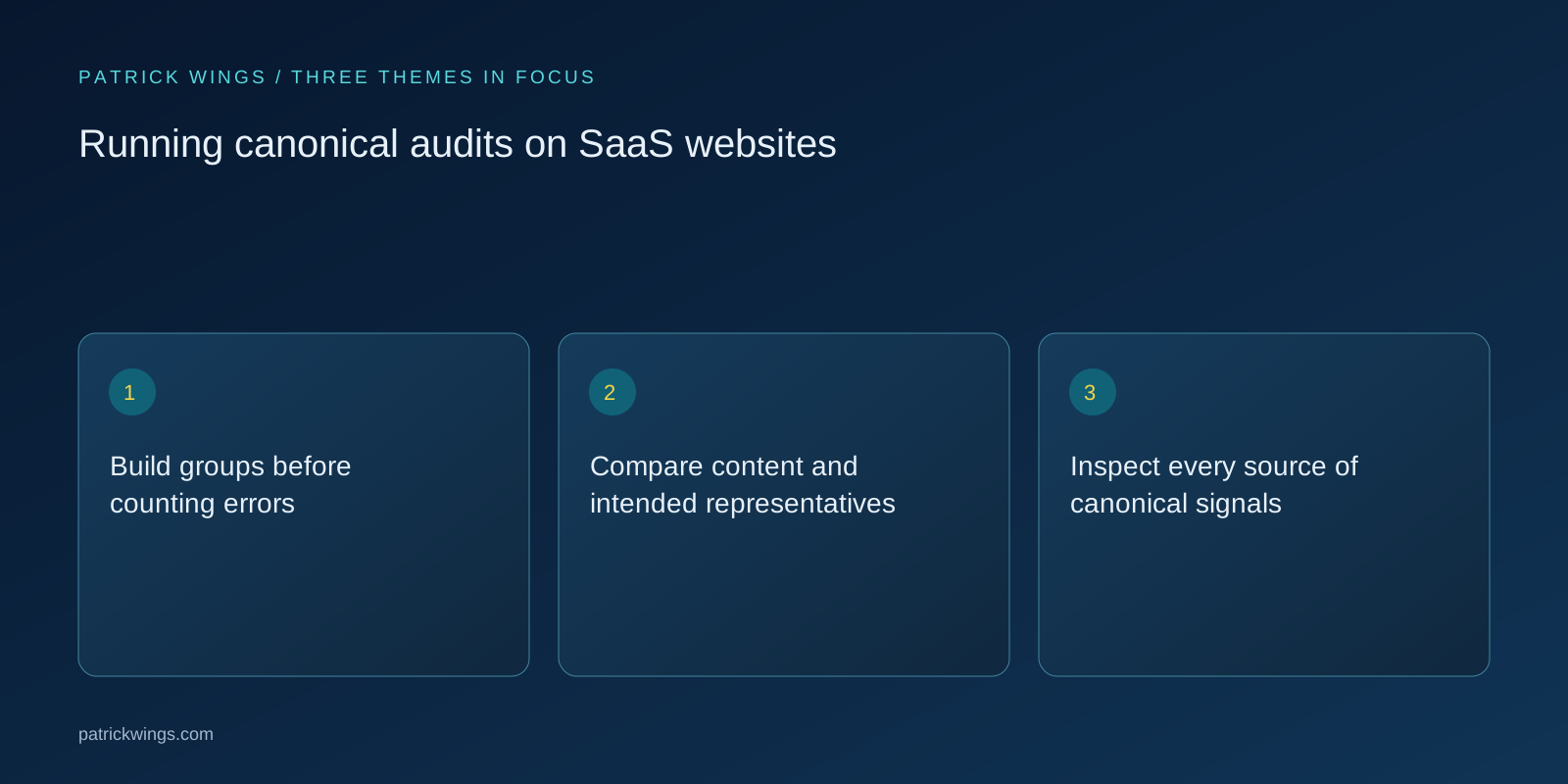
Inspect every source of canonical signals
Capture canonical annotations in the response HTML, rendered document and applicable HTTP headers. Follow the declared destination and record its final status, indexability and own canonical. Compare internal links, redirects and sitemap membership with that preference. Look especially for staging domains, outdated hostnames, parameter leakage and chains created by template updates. A canonical pointing to a redirect is an opportunity to simplify the reference. Conflicting declarations across delivery layers require an infrastructure fix rather than another annotation added by the editorial team.
Investigate selected canonicals carefully
For priority examples, compare your declaration with the canonical selected in Search Console where that information is available. A mismatch is a diagnostic lead, not automatic proof of a penalty. Check the last crawl date, the content Google could access and whether competing variants provide stronger consistent signals. Separate live implementation tests from stored index information. New code may be correct before the index reflects it. Maintain a dated evidence table so the team can tell a persisting problem from an outdated observation.

Illustrative example: campaign landing variants
Consider an illustrative integration guide available at a clean URL, with campaign parameters and an obsolete print address. The parameter variants contain the same guide, while a regional version includes a different procurement process. The team consolidates the equivalent campaign variants, redirects the retired print page when appropriate and retains a separate regional representative. It updates internal links and sitemap entries together. This example demonstrates decision logic, not an expected traffic gain; the regional page still needs an honest assessment of its independent usefulness.
Prevent regressions through acceptance rules
Convert recurring mistakes into template checks: one coherent preferred destination, no staging hostname, successful target response and agreement between navigation and sitemap output. Test new content, translated pages and legacy variants before releasing a shared component. Revisit representative groups after migrations or CMS upgrades rather than recrawling without a question. Canonicalisation remains a search-engine decision, so acceptance means consistent implementation plus investigated exceptions. Report affected valuable pages and resolved causes, not merely a falling count of tool warnings that may include deliberate, harmless alternatives.
INTERACTIVE / FROM READING TO ACTION
Three checkpoints for your implementation
Choose a checkpoint and track your reading progress. Checks are neither saved nor sent and do not score your business.
CHECKPOINT 01
Inspect every source of canonical signals
Capture canonical annotations in the response HTML, rendered document and applicable HTTP headers.
Explore in the article ↗CHECKPOINT 02
Investigate selected canonicals carefully
For priority examples, compare your declaration with the canonical selected in Search Console where that information is available.
Explore in the article ↗CHECKPOINT 03
Illustrative example: campaign landing variants
Consider an illustrative integration guide available at a clean URL, with campaign parameters and an obsolete print address.
Explore in the article ↗Frequently asked questions
Is every canonical mismatch harmful?
No. Investigate the content relationship, crawl date and other signals before deciding whether an observed mismatch needs intervention.
Should canonical targets redirect?
Prefer direct references to the final suitable canonical URL to reduce ambiguity and maintenance work.
Can one template fix solve many issues?
Yes, when the same verified root cause affects that template; test exceptions before deploying the change widely.
How can I put “Build groups before counting errors” into practice?
Export URLs from a site crawl, sitemaps, analytics and the CMS. Retain parameters initially so that the audit reveals variants rather than silently normalising them away. Group by template, content identity, language and parameter function.
What matters when working on “Compare content and intended representatives”?
Read the main content of candidate duplicates. Similar titles do not establish equivalent answers, and a shared product name does not make two use cases interchangeable. Choose a representative that preserves the complete useful answer, has a stable address and can remain available.