
THE SHORT ANSWER
An XML sitemap is a maintained inventory of the canonical URLs you want search engines to discover. Generate it from explicit publication rules, keep its dates truthful and monitor excluded or failing entries. Submission helps discovery but does not guarantee crawling, indexing, rankings or inclusion in generated answers.
For the broader picture of technical foundations, useful content and visibility measurement, read the pillar guide SEO, GEO and AEO for SaaS: visibility that supports buying decisions.
Define what belongs in the inventory
Agree an eligibility rule before selecting a sitemap plugin. A useful starting point is publicly accessible, canonical content intended for search results. Separate ordinary articles, product pages and other relevant formats when that helps ownership and diagnosis. Exclude preview addresses, internal search results and obsolete redirecting URLs from your intended inventory. Handle genuine exceptions deliberately rather than treating every database row as publishable. Document who can change the rule because a CMS field added later can accidentally expose an entire unreviewed section.
Generate entries from reliable publication state
Build sitemap output from the same authoritative content state that controls the website. A page should not enter the inventory before its route and content are available. Likewise, a retired page should leave it when the retirement takes effect. Use absolute preferred URLs with consistent hostname and protocol. Test escaping and encoding with titles or slugs containing unusual characters. For large inventories, split files and use a sitemap index within the documented protocol limits instead of creating one unbounded response. Explore this further in the guide Running canonical audits on SaaS websites.
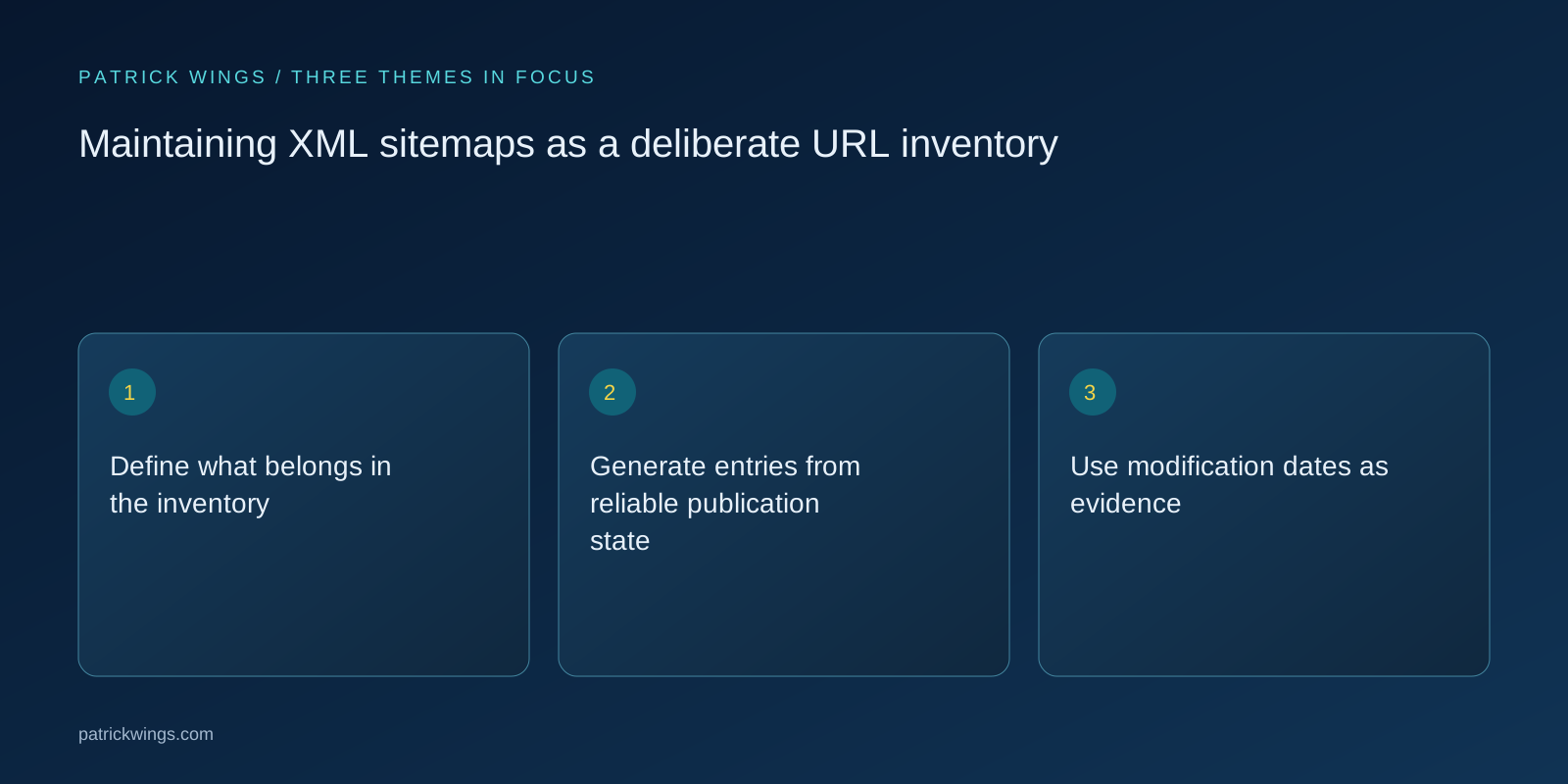
Use modification dates as evidence
Set lastmod to a meaningful content modification when your system can support that date accurately. A nightly build timestamp or a changing copyright year does not establish a substantive update to every article. If reliable dates are unavailable, avoid manufacturing precision. Distinguish the publication date shown to readers from later revisions in your content model. Editors should be able to explain what changed. Useful updates might include a corrected implementation step, a changed product limitation or a replacement source, rather than superficial punctuation edits.
Validate delivery and submission together
Fetch the production sitemap and any index files through the same public path available to crawlers. Check response codes, XML validity, file boundaries and representative listed URLs. Confirm that the submitted location remains stable after deployment. Search Console can show processing issues, but compare those reports with the current delivered file and record timestamps. A valid XML file can still list poor destinations. Sample indexability, declared canonicals and redirects, particularly after a bulk import, a language launch or a change in CMS publishing logic.

Illustrative example: a multilingual resource centre
Imagine an illustrative bilingual resource centre with guides, event recordings and draft customer stories. The team publishes separate sitemap groups for available language pages and excludes unpublished stories. A recording page joins only after its summary and public route are ready. When a guide receives a substantive correction, its modification date changes; the German equivalent waits for review instead of receiving a misleading automatic update. The group structure helps locate publishing mistakes. It is an operational design example, not evidence that segmented sitemaps create better rankings.
Review the difference between submitted and observed
Track submitted URLs against current live eligibility and the available index reports. Investigate unexpected exclusions by cause: duplicates, directives, inaccessible content or quality questions require different responses. Do not demand that every listed address be indexed. Prioritise missing pages that answer distinct important needs, and assign technical or editorial owners accordingly. Review the rules after migrations and content retirement. The valuable outcome is a dependable inventory supporting diagnosis; sitemap submission cannot compensate for inaccessible delivery, weak internal navigation or pages that provide little useful information. Explore this further in the guide Starting an SEO migration with a dependable URL inventory.
INTERACTIVE / FROM READING TO ACTION
Three checkpoints for your implementation
Choose a checkpoint and track your reading progress. Checks are neither saved nor sent and do not score your business.
CHECKPOINT 01
Use modification dates as evidence
Set lastmod to a meaningful content modification when your system can support that date accurately.
Explore in the article ↗CHECKPOINT 02
Validate delivery and submission together
Fetch the production sitemap and any index files through the same public path available to crawlers.
Explore in the article ↗CHECKPOINT 03
Illustrative example: a multilingual resource centre
Imagine an illustrative bilingual resource centre with guides, event recordings and draft customer stories.
Explore in the article ↗Frequently asked questions
Does submission guarantee indexing?
No. A sitemap helps discovery; search engines still decide what to crawl and index.
Should every build change lastmod?
Only if the build reflects a meaningful page modification. Do not substitute a deployment timestamp for evidence of content change.
Should redirecting URLs remain listed?
Normally list the intended final canonical URLs and remove retired redirect sources from the ongoing inventory.
How can I put “Define what belongs in the inventory” into practice?
Agree an eligibility rule before selecting a sitemap plugin. A useful starting point is publicly accessible, canonical content intended for search results. Separate ordinary articles, product pages and other relevant formats when that helps ownership and diagnosis.
What matters when working on “Generate entries from reliable publication state”?
Build sitemap output from the same authoritative content state that controls the website. A page should not enter the inventory before its route and content are available. Likewise, a retired page should leave it when the retirement takes effect.