
THE SHORT ANSWER
Account-based marketing organises commercial work around selected companies. Its value comes from relevance and coordination rather than simply uploading a company list. A useful pilot makes account selection, engagement and progression understandable to everyone involved.
For the broader picture of how target customers, channels and sales handoffs work together, read the pillar guide B2B demand generation: from attention to qualified pipeline.
Justify account selection commercially
Start with companies where product suitability and a plausible use case overlap. Add commercial potential and your actual ability to serve the account. A recognisable brand name alone does not justify substantial custom work. Record why each company belongs on the list, what you already know and the main unresolved question. An illustrative example could be a software business with multiple regional sales teams whose processes might suit your enablement product. Label that suitability as a hypothesis until you confirm a genuine need. This keeps research assumptions separate from verified knowledge and prevents a target list from becoming a wish list without an actionable business rationale.
Choose a realistic level of customisation
Not every account needs a completely individual campaign. Group companies with similar tasks and circumstances into understandable segments. Personal research can make sense for a few strategic accounts; larger groups need reusable themes and assets. The important constraint is your capacity for useful follow-up. A heavily personalised advertisement without coordinated selling remains an expensive isolated interaction. Define which information you collect for each account and which content you will actually adapt. Avoid superficial personalisation that substitutes a company name while showing no meaningful understanding of the organisation's situation, requirements or reason to consider change.
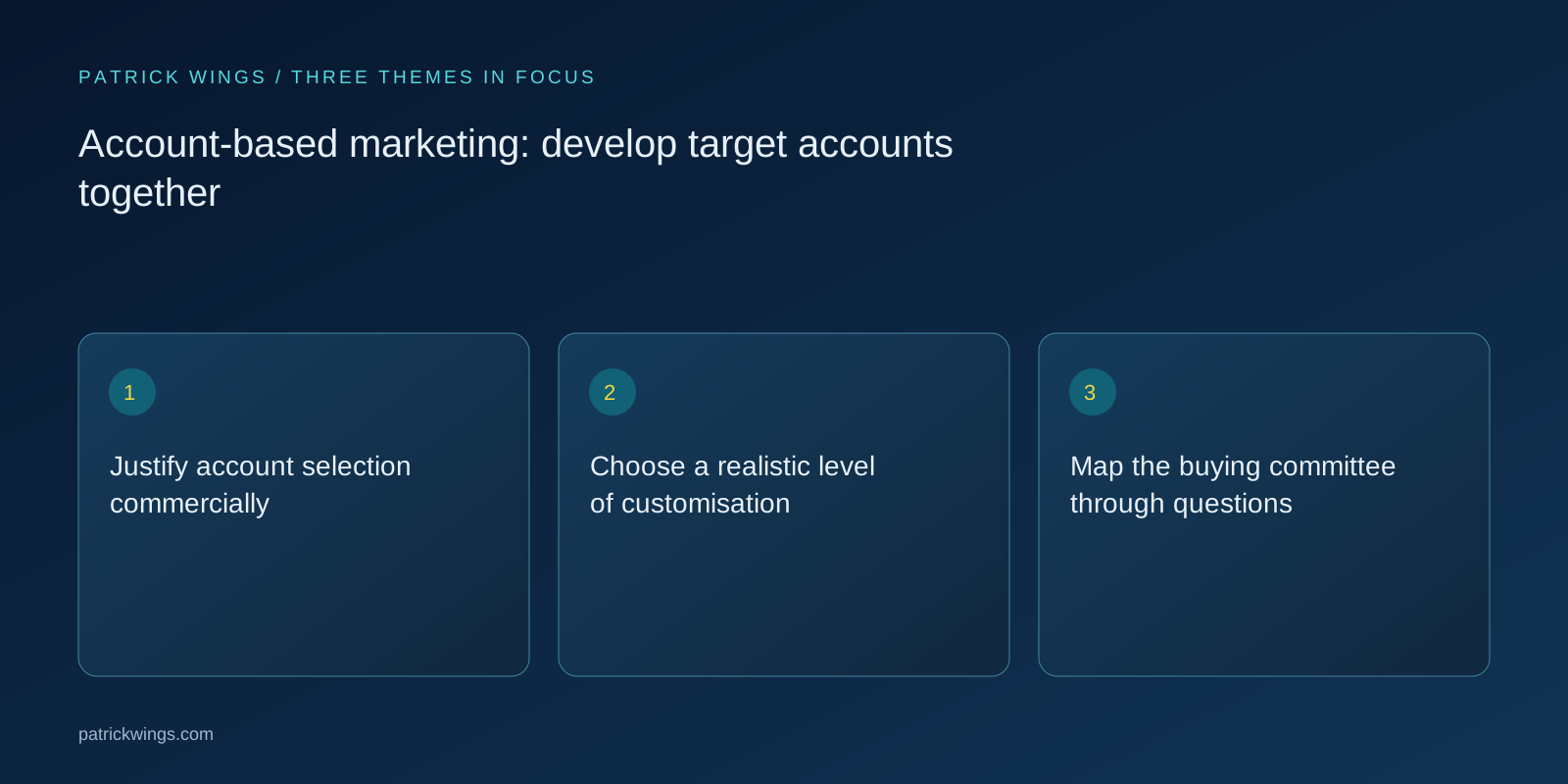
Map the buying committee through questions
Identify the roles that influence change: users, process owners, IT, procurement and potentially executive leadership. Organisations do not all use the same structure. Research responsibilities and unresolved decision questions rather than names alone. A business stakeholder may need a workflow example, IT an understandable integration description and procurement clarity about contractual terms. Create resources that can be shared internally. A clear evaluation guide may support several stakeholders simultaneously. Do not replace missing knowledge with supposedly personal statements about individuals or an unverified purchasing plan. The purpose of research is to ask better questions, not to manufacture certainty about a buyer's intentions. Explore this further in the guide Ideal customer profile: identify the right B2B customers systematically.
Coordinate channels around one argument
Arrange advertisements, expert content, events and conversations so they reinforce the same relevant perspective. LinkedIn documents company targeting within Matched Audiences; check current requirements and actual reach before designing your approach. A selected company is not automatically fully reachable through advertising. Plan alternative touchpoints and treat paid media as part of the work. Sales should know which themes an account might encounter without assuming a specific individual interaction. Avoid saying “you read our document” when you only have aggregate information. Coordinated messaging should make the experience clearer and more useful rather than feel like surveillance or scripted repetition. Explore this further in the guide LinkedIn Ads for B2B: from relevant audiences to useful conversations.

Evaluate progress at account level
Look beyond individual forms. Ask whether you are reaching the right organisation, involving relevant roles, understanding a concrete problem and agreeing a next action. Aggregate activity can orient the team but does not prove purchase intent or participation by every decision maker. Connect observations to documented CRM conversations. An account with fewer clicks and a clear project can matter more than a company showing broad informational interest. Define meaningful progression stages and avoid counting several contacts as separate opportunities when they belong to one buying process. The report then becomes a useful sales instrument instead of a larger engagement dashboard.
Run a pilot with clear ownership
Start with a manageable account group, a shared central hypothesis and named owners for research, content and sales. Agree how you will confirm, revise or abandon an assumption. Discuss weak relevance, inaccessible roles and missing product capabilities alongside positive responses. These constraints are useful evidence. Expand the list only when the team can work the existing accounts properly. Document which assets can be reused and where individual effort remains necessary. ABM becomes sustainable when extra effort leads to better decisions and useful commercial relationships, rather than merely creating a more expensive version of general reach advertising.
INTERACTIVE / FROM READING TO ACTION
Three checkpoints for your implementation
Choose a checkpoint and track your reading progress. Checks are neither saved nor sent and do not score your business.
CHECKPOINT 01
Map the buying committee through questions
Identify the roles that influence change: users, process owners, IT, procurement and potentially executive leadership.
Explore in the article ↗CHECKPOINT 02
Coordinate channels around one argument
Arrange advertisements, expert content, events and conversations so they reinforce the same relevant perspective.
Explore in the article ↗CHECKPOINT 03
Evaluate progress at account level
Look beyond individual forms.
Explore in the article ↗Frequently asked questions
Is ABM only suitable for large companies?
No. Consider account value, buying complexity and your capacity for coordinated engagement.
Is a LinkedIn company list enough?
No. A list supports targeting. ABM also needs justified selection, relevant resources and coordinated sales work.
How should ABM be measured?
Assess suitable accounts, relevant roles, confirmed problems and agreed progression. Clicks alone do not demonstrate a purchasing process.
How can I put “Justify account selection commercially” into practice?
Start with companies where product suitability and a plausible use case overlap. Add commercial potential and your actual ability to serve the account. A recognisable brand name alone does not justify substantial custom work.
What matters when working on “Choose a realistic level of customisation”?
Not every account needs a completely individual campaign. Group companies with similar tasks and circumstances into understandable segments. Personal research can make sense for a few strategic accounts; larger groups need reusable themes and assets.