
THE SHORT ANSWER
Lead routing finishes when a responsible person actually accepts the enquiry.
For the broader picture of how target customers, channels and sales handoffs work together, read the pillar guide B2B demand generation: from attention to qualified pipeline.
Follow assignment through acceptance
Lead routing finishes when a responsible person actually accepts the enquiry. Technical assignment alone prevents neither neglect nor conflicting outreach. Connect business rules with acknowledgement, cover arrangements and a visible exception queue for cases that cannot be allocated confidently through the normal rules.
Define handoff completion as confirmed acceptance or explicit rejection with a reason. An automated owner field is insufficient when the person is absent or lacks the necessary expertise. Every suitable enquiry therefore needs either active handling or visibly owned resolution, rather than disappearing behind a workflow message reporting technical success.
Separate precedence and ownership
Define precedence first: existing account owner, open opportunity, market, language and required expertise. Only then distribute work within eligible teams. Distinguish contact, company and deal ownership; they need not always mean the same person, but their relationship must not create an unclear handoff.
A rule matrix contains case type, required information, preferred owner and fallback route. An unknown company relationship first goes to a resolution role able to check existing account and opportunity ownership. Document which connected system supplies the authoritative ownership value so another workflow cannot immediately overwrite the intended distribution.
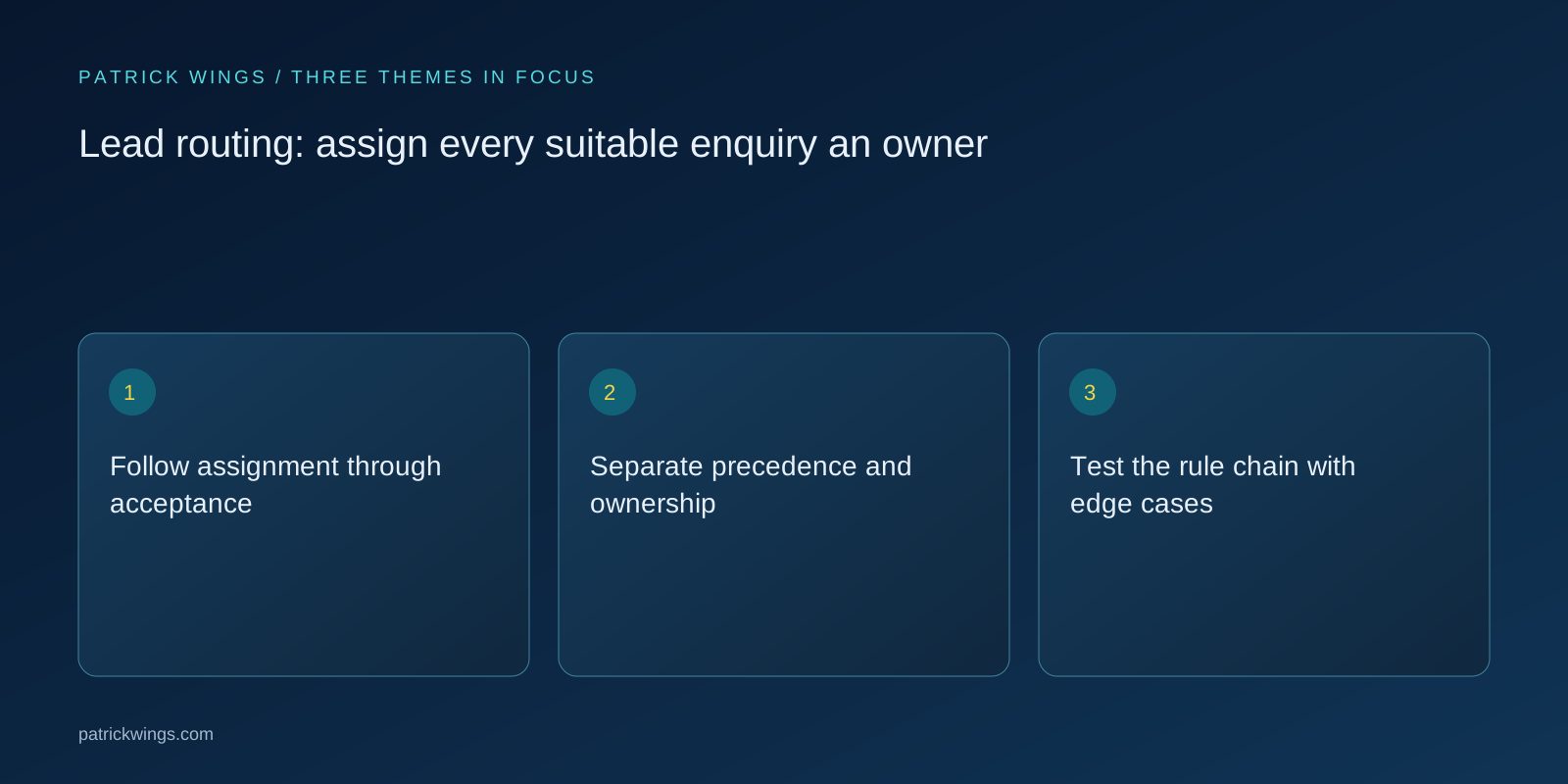
Test the rule chain with edge cases
Build an explainable decision sequence and test customers, new accounts, duplicates and unknown markets. Check availability and permissions. HubSpot documents conditions and limitations for automated owner rotation, including interactions with synchronised ownership; verify the actual result across connected systems rather than assuming assignment remains unchanged. Explore this further in the guide CRM data quality for trustworthy marketing decisions.
Create test cases for a subsidiary, personal email address, duplicate submission, leave and a contact with an open opportunity. Record expected and actual assignment together. Also check notification and acceptance. Correct CRM ownership does not help the buyer if the person never receives the request or receives an incomplete record without the original question.
Resolve account ownership versus country
An invented business receives an Austrian enquiry from an existing German customer. A country rule sends it to Austria while the account owner already manages an open opportunity. Explicit precedence prevents duplicate outreach. When the match is unclear, a named resolution queue receives the case instead of leaving ownership ambiguous.
In the invented country example, first establish project context: is the Austrian enquiry part of the existing German project or a separate purchase? That determines responsibility. An existing-account-first rule must not automatically block independent regional needs, just as a country rule should not bypass an active customer relationship without review.

Protect capacity and relationships
Equal distribution is not automatically fair or commercially useful distribution. Workload, expertise and absence still matter. Rotation may also overwrite an existing relationship. Investigate these side effects before treating a mathematically even allocation as a complete routing strategy or assuming all assigned people have equal capacity to respond.
Check rotation against required expertise and current capacity to accept work. Equal contact counts can conceal very different workloads. A rejected assignment also needs a controlled return route. Prevent one request from bouncing between teams that each point to the automated owner in another system instead of resolving responsibility.
Expose unresolved handoffs
Inspect unassigned cases, rejected handoffs, duplicate contact and time to acceptance. Review concrete exceptions rather than total assignment volume alone. If more records become formally owned while nobody responds, the technical metric improved without resolving the business problem of getting suitable enquiries handled. Explore this further in the guide Sales capacity: match campaigns to actual follow-up capacity.
Use a daily exception list containing case ID, rejection reason, previous owner and next resolver. Include formally assigned cases without confirmed acceptance. This separates data maintenance from actual handling. Recurring exceptions belong in rule maintenance, while individual cases still need prompt resolution without waiting for a comprehensive automation project to be completed.
Own rule maintenance and daily queues
Assign ownership for routing rules and separate responsibility for daily exception handling. Changes in teams, markets and synchronisation should trigger a test. Include sales feedback in the review so newly encountered case types do not permanently disappear into improvised rules that nobody else understands.
After team changes, operations tests the affected rule chain and sales checks real absence cover. Marketing supplies submission intent and necessary context. Inspect a small sequence of actual handoffs after release. The control point is understandable responsibility for the prospective buyer rather than merely an error-free technical workflow execution in the automation log.
INTERACTIVE / FROM READING TO ACTION
Three checkpoints for your implementation
Choose a checkpoint and track your reading progress. Checks are neither saved nor sent and do not score your business.
CHECKPOINT 01
Test the rule chain with edge cases
Build an explainable decision sequence and test customers, new accounts, duplicates and unknown markets.
Explore in the article ↗CHECKPOINT 02
Resolve account ownership versus country
An invented business receives an Austrian enquiry from an existing German customer.
Explore in the article ↗CHECKPOINT 03
Protect capacity and relationships
Equal distribution is not automatically fair or commercially useful distribution.
Explore in the article ↗Frequently asked questions
Should rotation always come first?
No. Existing relationships and specialist ownership need explicit precedence.
What about an unknown market?
A named exception queue takes responsibility for resolving it.
When is routing successful?
When the correct person accepts the case and its next step is visible.
How can I put “Follow assignment through acceptance” into practice?
Lead routing finishes when a responsible person actually accepts the enquiry. Technical assignment alone prevents neither neglect nor conflicting outreach. Connect business rules with acknowledgement, cover arrangements and a visible exception queue for cases that cannot be allocated confidently through the normal rules.
What matters when working on “Separate precedence and ownership”?
Define precedence first: existing account owner, open opportunity, market, language and required expertise. Only then distribute work within eligible teams. Distinguish contact, company and deal ownership; they need not always mean the same person, but their relationship must not create an unclear handoff.