
THE SHORT ANSWER
Publish regional variants when a reader in that region needs materially different information, not merely a different country name in the heading. Document the specific differences, maintain appropriate equivalents and review whether each page remains useful. Local presence, availability and regulatory claims must reflect reality rather than imply capabilities that the business does not provide.
For the broader picture of technical foundations, useful content and visibility measurement, read the pillar guide SEO, GEO and AEO for SaaS: visibility that supports buying decisions.
Identify a consequential regional difference
Ask what changes in the reader’s decision: product availability, implementation conditions, support hours, procurement, currency or a locally reviewed requirement. Separate language preference from those differences. German-speaking readers in multiple countries may share one useful answer, while two English-speaking markets may require genuinely different instructions. Document the evidence for each proposed variant and who can confirm it. A country keyword or a competitor’s page is not sufficient justification. The purpose is to help people act accurately in their situation, not to produce a larger geographic keyword inventory. Explore this further in the guide Separating search intent across similar articles.
Specify the shared core and local sections
Create a comparison of information that stays the same and information that differs. Keep shared product facts consistent while allowing local sections to explain real conditions with examples and clear boundaries. Identify which source supports each regional claim and when it must be reviewed. Do not manufacture local case studies or imply an office, support team or customer base that does not exist. When a difference is small, consider whether a well-labelled section in a shared guide would serve readers more clearly than another nearly identical page.
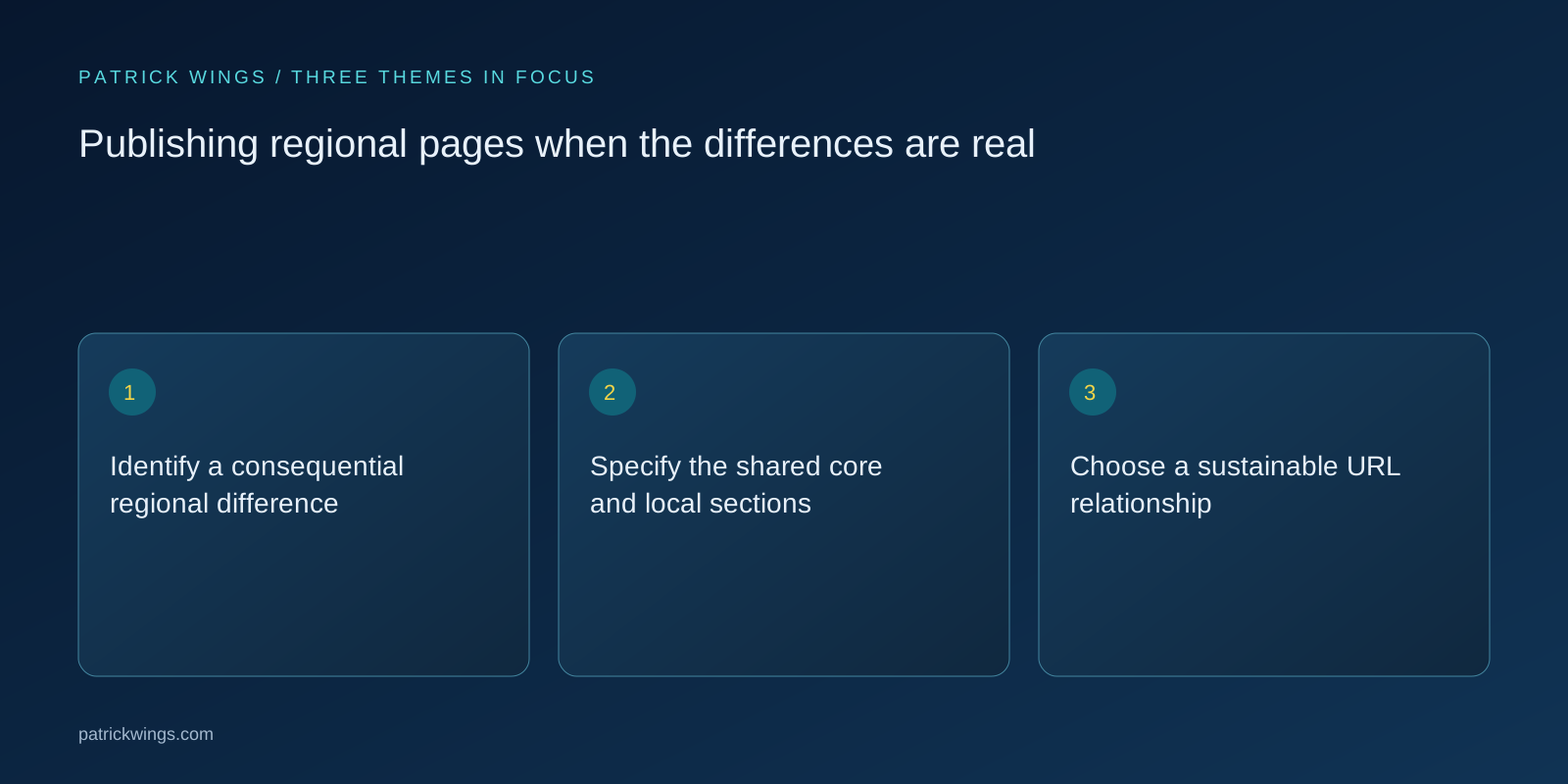
Choose a sustainable URL relationship
Use stable public addresses that make the intended versions available independently. Map genuine equivalents and apply appropriate language or regional annotations according to the supported implementation. Keep canonical decisions aligned with the actual content relationship rather than pointing every local page indiscriminately to a global page. For substantially identical same-language variants, assess the preferred representation carefully using the official guidance. Make switching understandable, and do not redirect visitors away solely because inferred location disagrees with the version they deliberately selected or received from a colleague. Explore this further in the guide Debugging hreflang through complete page groups.
Review local claims with qualified owners
Assign local business and subject-matter owners before publication. Verify commercial terms with the responsible team and route legal or regulatory statements to appropriate reviewers. Distinguish a factual description of a product feature from a claim that the feature satisfies a jurisdiction’s requirements. Include dates and scope when the information can change. Translation alone is not regional review. A fluent page can still describe an unavailable offer or an outdated process. Keep the publication blocked until consequential uncertainties are resolved or the wording honestly states the unresolved limit.

Illustrative example: regional implementation support
Imagine an illustrative software provider whose core integration works globally but whose assisted onboarding is available only in defined service hours and languages. It creates a regional explanation only where those conditions materially affect planning, using a shared technical core and verified local service details. It avoids creating near-identical pages for every nearby country. This scenario demonstrates usefulness and operational truth, not an expected search uplift. The page still needs maintenance when support coverage changes, and its availability does not guarantee that a search engine will select it for every local query.
Retest usefulness when the offer changes
Review regional pages when contracts, availability, support or applicable guidance changes. Compare user questions and local sales or support feedback with the page’s promise. Consolidate variants whose differences have disappeared, preserving appropriate URL handling and updating relationships. Track whether readers reach accurate information, not merely how many local pages are indexed. Success means truthful useful distinctions and sustainable ownership. Search systems may still select another version, and geographic annotations cannot compensate for thin content, contradictory claims or a market offering that exists only in the marketing copy.
INTERACTIVE / FROM READING TO ACTION
Three checkpoints for your implementation
Choose a checkpoint and track your reading progress. Checks are neither saved nor sent and do not score your business.
CHECKPOINT 01
Choose a sustainable URL relationship
Use stable public addresses that make the intended versions available independently.
Explore in the article ↗CHECKPOINT 02
Review local claims with qualified owners
Assign local business and subject-matter owners before publication.
Explore in the article ↗CHECKPOINT 03
Illustrative example: regional implementation support
Imagine an illustrative software provider whose core integration works globally but whose assisted onboarding is available only in defined service hours and languages.
Explore in the article ↗Frequently asked questions
Does each country need a page?
No. Publish a distinct page when the difference materially helps the reader and can be maintained.
Is translation enough for localisation?
No. Verify availability, terms, examples and other local conditions separately.
Can hreflang fix thin local pages?
No. Annotations describe relationships; they do not create substantive value or truthful local claims.
How can I put “Identify a consequential regional difference” into practice?
Ask what changes in the reader’s decision: product availability, implementation conditions, support hours, procurement, currency or a locally reviewed requirement. Separate language preference from those differences. German-speaking readers in multiple countries may share one useful answer, while two English-speaking markets may require genuinely different instructions.
What matters when working on “Specify the shared core and local sections”?
Create a comparison of information that stays the same and information that differs. Keep shared product facts consistent while allowing local sections to explain real conditions with examples and clear boundaries. Identify which source supports each regional claim and when it must be reviewed.