
THE SHORT ANSWER
Integration content should explain what actually happens between two systems and which task that movement supports. A partner logo or the phrase “seamlessly integrated” does not identify data direction or operating ownership. Start with a concrete event, describe the permissions required and show the expected state after handover. This guide is for editors and product marketers rather than an API implementation manual. Its output is an understandable, technically reviewed integration story with explicit limitations that buyers can share with technical colleagues without translating promotional language into assumed capabilities.
To see how this step fits into your content strategy, read the pillar guide Content marketing for B2B SaaS: strategy, formats and qualified demand.
Describe the supported task rather than just system names
Choose one trigger, one data transfer and an observable outcome. For example, an approved order creates a record in another system. Identify the manual step a particular user no longer performs. Connecting two familiar brands does not by itself explain business value. Check whether the current product supports the workflow or whether it is merely a possible custom development. Available API access does not mean every desired integration is offered as a finished capability. State the exact scope in the opening paragraph. Buyers can then recognise whether their workflow is addressed or whether a separate feasibility review is still required before making commitments. Explore this further in the guide Migration content: address switching risk before the sales call.
Identify data direction and the system of record
Show which system holds the authoritative value for each important field. A bidirectional connection does not solve conflicting edits automatically. Explain whether records are created, enriched, updated or only read. Distinguish event delivery from periodic reconciliation and describe observable delays without unsupported real-time promises.
Which system owns the information?
GitHub describes webhooks as notifications about events; that does not establish how every other integration behaves. Editors must ask about the implementation actually offered. A simple three-box diagram can explain the flow if direction, trigger and failure handling also appear in ordinary text. The objective is a shared understanding, not a decorative architecture picture that conceals the operating rules.
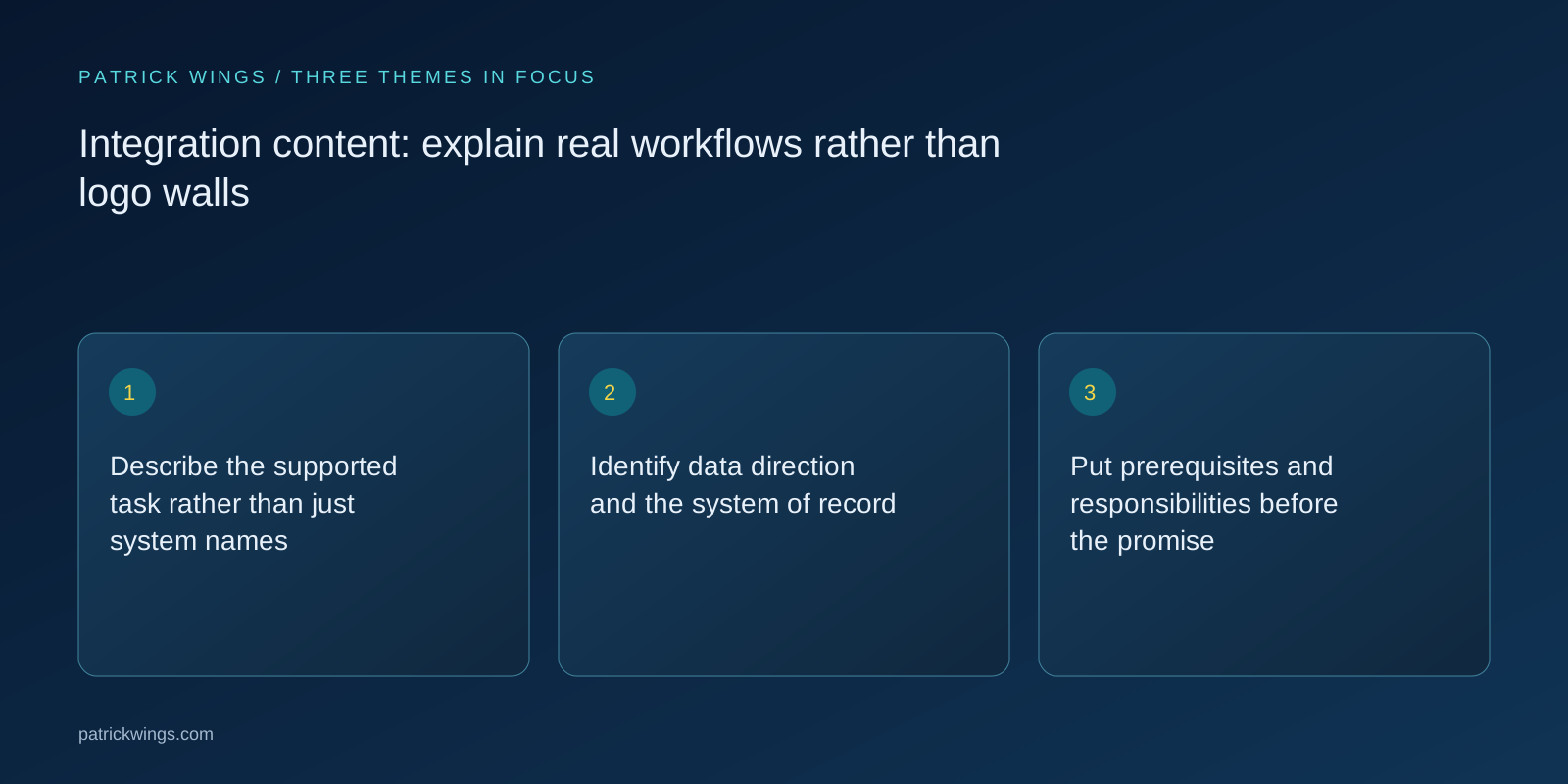
Put prerequisites and responsibilities before the promise
Record supported packages, versions, regions, accounts and administrative permissions. Explain who configures the connection and who provides necessary information. A customer-owned licence may be required even when it is absent from your price. Do not request secrets or credentials through public marketing forms. Agree with engineering which information an initial conversation genuinely needs. If a third party restricts particular interfaces, that dependency belongs in the offer context. After reading, buyers should identify an accountable person and the principal preparation tasks. A “minutes to connect” claim is defensible only when its conditions and verified limits are disclosed rather than implied to apply to every customer. Explore this further in the guide Onboarding content: guide customers towards a reliable first use.
| Review field | Evidence or observation | Next decision |
|---|---|---|
| Data direction | Documented flow and source of authority | Name the supported workflow precisely |
| ownership | Documented flow and source of authority | Name the supported workflow precisely |
| boundary | Documented flow and source of authority | Name the supported workflow precisely |
Explain normal operation and a relevant exception
Describe the successful workflow in a few inspectable steps. Add a material failure scenario: a missing required field, refused permission or unavailable destination. What matters is whether failure becomes visible, who receives it and how retry or manual handling works. Do not name a technical behaviour the product team has not confirmed. An accessible integration page need not reproduce every error message, but it must not imply invisible self-repair. Link detailed operating rules to the appropriate documentation. A screenshot can show an achieved state; alone, it cannot prove that the workflow works reliably under every load, permission model and data combination the buyer might use.

Fictional example: a bounded handover
This example is entirely invented. SaaS company Junctionworks wants to transfer approved service orders from system A to system B. In the assumed pilot, only newly approved orders move; subsequent changes remain manual initially. The content states that limit and identifies the person responsible for reconciliation. A general claim of complete synchronisation would be incorrect in this scenario. System names and capabilities are illustrative assumptions, not real customer results. The value is a comprehensible handover for a bounded task. Only after change handling has been assessed and supported may a later edition describe a wider synchronisation scope. That distinction prevents an attractive story from becoming an accidental implementation promise.
Translate technical evidence into readable explanation
Ask engineering to demonstrate a test workflow with permitted example data. Capture input, configuration, observed output and unresolved exceptions. Explain terminology without deleting conditions. A field-mapping table can show source, destination and rule, provided it reveals no confidential structures.
What does the evidence actually show?
Where transformation occurs, state whether values are renamed, normalised or discarded. Link to current technical documentation rather than an outdated presentation screenshot. Your editorial story explains relevance; documentation supplies implementation detail. Both need an identifiable version context and should not diverge after product changes. When they conflict, narrow the public benefit claim until the discrepancy is resolved instead of choosing whichever wording sounds more persuasive.
Organise discovery around actual integration questions
Use system names and the supported task in the heading, opening and descriptive links. “Which data moves?” is more useful than another abstract innovation statement. Answer boundaries directly, including whether historical records or deletions are included. Each question does not require a separate URL; related questions can sit in one coherent article. Explain technical terms and then use them consistently. This supports SEO, GEO and AEO through comprehension and verifiable claims, without guaranteeing indexation or citation. Do not put capabilities into structured data that the visible page does not substantiate. The page should remain helpful to someone who arrived through a colleague rather than a search engine.
Use operating feedback as an editorial input
Assign an integration owner and an editorial owner. Review triggers include API changes, permissions, supported packages and your own data model. Support cases can reveal prerequisites buyers repeatedly miss. Improve the relevant explanation rather than attaching an increasingly generic FAQ section. Separate documentation errors from genuine product problems and route the latter to engineering. A successful integration page enables suitable readers to understand scope and limits. Count more than visits or partner-logo clicks. In conversations, ask buyers to explain data direction, prerequisites and operating responsibility. If these remain unclear, additional distribution is not yet the appropriate next investment; the explanation needs a concrete correction first.
INTERACTIVE / FROM READING TO ACTION
Three checkpoints for your implementation
Choose a checkpoint and track your reading progress. Checks are neither saved nor sent and do not score your business.
CHECKPOINT 01
Put prerequisites and responsibilities before the promise
Record supported packages, versions, regions, accounts and administrative permissions.
Explore in the article ↗CHECKPOINT 02
Explain normal operation and a relevant exception
Describe the successful workflow in a few inspectable steps.
Explore in the article ↗CHECKPOINT 03
Fictional example: a bounded handover
This example is entirely invented.
Explore in the article ↗Frequently asked questions
Is a list of supported tools enough?
A list helps orientation but does not explain an actual workflow. Add direction, triggers, prerequisites and ownership for the connection your product currently supports, rather than implying every possible use.
Does API access mean a finished integration exists?
No. An API may enable development without a particular workflow being offered or tested. Distinguish supported product functionality from custom possibilities that still require feasibility assessment and implementation.
Should we promise real-time operation?
Only when the actual implementation and its conditions support that claim. Otherwise describe event delivery, scheduled reconciliation or observable delay without implying a universal timing guarantee.
How should failures be explained?
Describe at least one material exception and the intended handling route. Detailed documentation can cover implementation; the marketing page should not assert unconfirmed automatic recovery or invisible repair.
Which visual suits an integration story?
A clearly labelled flow or approved screenshot can help. It supplements the explanation: material prerequisites and limitations must remain understandable without the graphic or a particular visual presentation.
Who maintains the page?
An integration specialist confirms capabilities and an editor maintains the explanation. Together they respond to interface, package and permission changes, and to recurring misunderstandings observed in support conversations.