
THE SHORT ANSWER
Content repurposing means adapting a well-supported idea for different tasks and contexts. It involves more than cutting a blog post into shorter fragments. Effective reuse preserves the expertise while changing the introduction, depth and next step. You can then get more value from research without publishing the same message unchanged everywhere.
To see how this step fits into your content strategy, read the pillar guide B2B content marketing: From useful expertise to qualified demand.
1. Establish a reliable source asset
Start with material substantial enough to support further use: an expert interview, an approved case study, a documented method or a detailed analysis. Check which claims are supported before adapting anything. Producing more formats will not improve a weak original. Gather examples, objections and limitations so that the derivatives can answer different questions instead of stretching one superficial observation across several channels.
Create a topic sheet containing the main argument, three to five subquestions, sources and approved statements. Mark information that cannot be published. This becomes a common reference for writers, designers and sales colleagues. It keeps different versions consistent even when several people work on the material at different times.
2. Assign different jobs to different formats
Consider what someone wants to accomplish in each channel. A blog article can explain a relationship and link to detail. A LinkedIn post can challenge a common mistake. An email can answer one objection. A sales resource can help someone prepare an internal decision. The shared idea connects these assets, while the reader's specific task determines the shape, level of explanation and useful next action. Explore this further in the guide B2B visual storytelling: Make complex services understandable.
Illustrative example: an interview about software implementation can become a preparation guide, a LinkedIn post about missing ownership and a project-team checklist. The checklist provides practical checks; the post explores an observation. Neither needs to repeat the original wording or pretend to be a complete guide on its own.
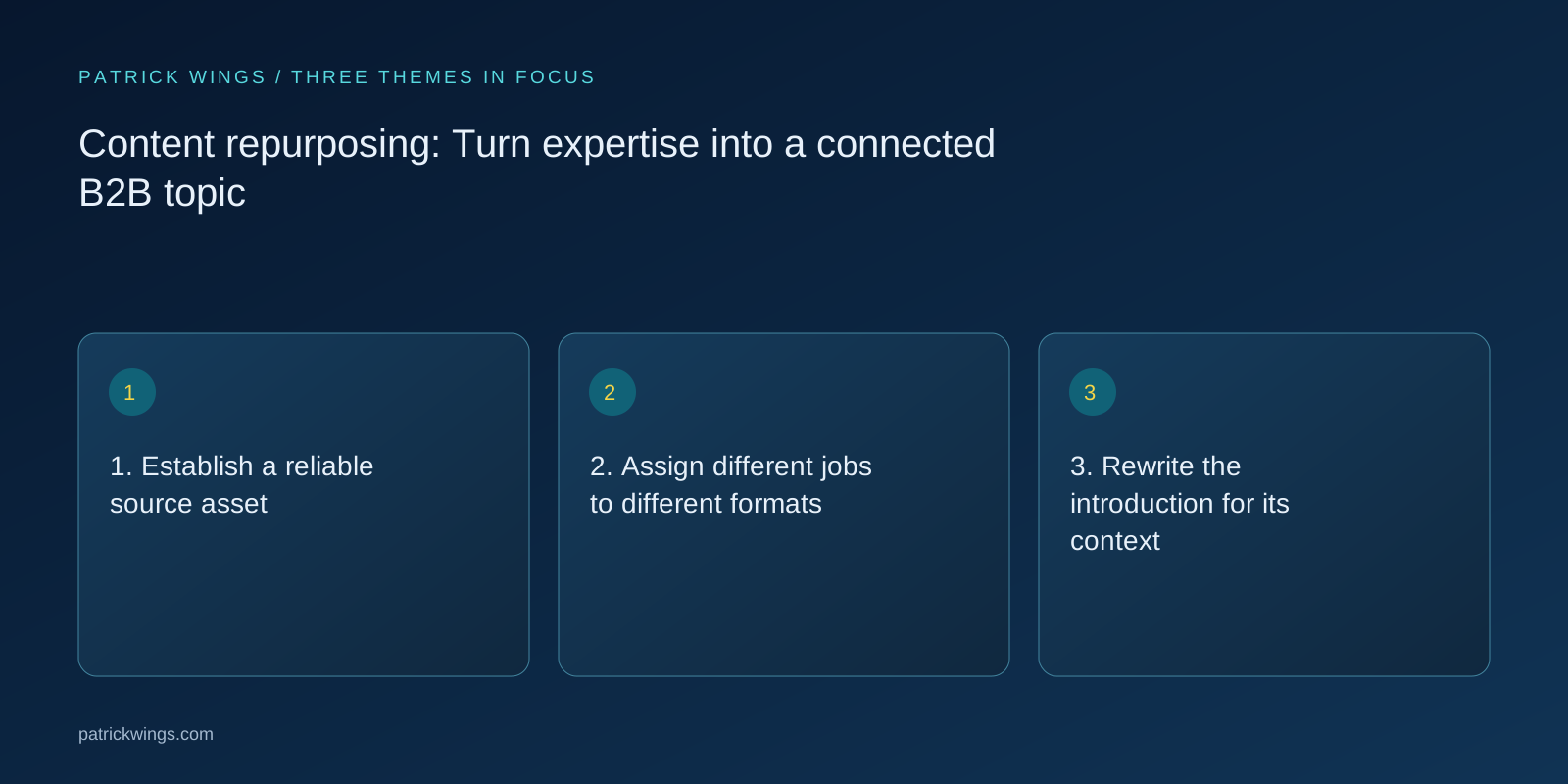
3. Rewrite the introduction for its context
Someone scrolling LinkedIn may not know your company or the original article. Begin with an understandable situation and establish why it matters. A contact in an active project does not need the same general introduction. A short email can connect directly with the unresolved question. Context determines which background information is necessary and which would simply slow the reader down.
Check every extract for completeness. Shortening a quotation can remove a qualification and turn it into a misleading claim. A process diagram needs explanatory labels when it appears outside the original whitepaper. Rewrite the connective material instead of automatically copying the same paragraph into several layouts and assuming that the meaning survives intact.
4. Plan production and approval together
Decide early which versions are genuinely needed. A small team may reliably maintain one strong article, two independent LinkedIn posts and a useful email. A much larger format plan can create more coordination work than value. Give each asset a named owner, an intended use and an explicit approval process so that distribution does not depend on somebody noticing a finished file in a shared folder.
Maintain one reference for numbers, product names and technical statements. If a prerequisite changes, dependent assets must be easy to find. Record the relationships between the original and its derivatives. Reuse is not only a production opportunity; it creates an ongoing responsibility to keep multiple versions accurate and consistent after the first campaign ends. Explore this further in the guide AI in your content workflow: Move faster with accountable review.

5. Turn new questions into useful depth
Look beyond the format with the highest view count. Ask which objections, relevant conversations or practical feedback emerged. A short post with limited reach but substantive comments from suitable people can provide valuable direction. Compare formats against their intended jobs rather than reducing every contribution to the same reach metric or assuming that all interactions have equal business significance.
When one subquestion appears repeatedly, give it a dedicated detailed article. Link it from the overview and related existing pages. If the topic attracts no relevant response, examine problem selection and distribution first. Additional formats alone cannot compensate for a topic that does not matter to the audience. The aim remains a useful body of knowledge that supports customers in their work.
INTERACTIVE / FROM READING TO ACTION
Three checkpoints for your implementation
Choose a checkpoint and track your reading progress. Checks are neither saved nor sent and do not score your business.
CHECKPOINT 01
3. Rewrite the introduction for its context
Someone scrolling LinkedIn may not know your company or the original article.
Explore in the article ↗CHECKPOINT 02
4. Plan production and approval together
Decide early which versions are genuinely needed.
Explore in the article ↗CHECKPOINT 03
5. Turn new questions into useful depth
Look beyond the format with the highest view count.
Explore in the article ↗Frequently asked questions
Is repurposing just republication?
It can include republication, but useful repurposing changes perspective, depth and next step to serve a different task.
What makes a good source asset?
Reviewed expertise, concrete examples and several worthwhile subquestions. An expert interview or methodological guide often works well.
How many derivatives should we produce?
As many as you can publish with distinct value and keep accurate. A fixed number is not a measure of quality.
How can I put “1. Establish a reliable source asset” into practice?
Start with material substantial enough to support further use: an expert interview, an approved case study, a documented method or a detailed analysis. Check which claims are supported before adapting anything. Producing more formats will not improve a weak original.
What matters when working on “2. Assign different jobs to different formats”?
Consider what someone wants to accomplish in each channel. A blog article can explain a relationship and link to detail. A LinkedIn post can challenge a common mistake.