
THE SHORT ANSWER
Technical SEO helps make your content reliably available at the intended URLs and understandable to search systems. It cannot replace a useful offer, but it can prevent strong content from being undermined by implementation errors. Rather than treating every audit warning as equally urgent, prioritise by the scope of the problem and the importance of the affected pages to your customers.
For the broader picture of technical foundations, useful content and visibility measurement, read the pillar guide SEO, GEO and AEO for SaaS: visibility that supports buying decisions.
First verify that important pages are available
Select a representative sample: homepage, service page, article, language variant and an older incoming link. Check status codes, redirects and access without signing in. A core service page returning a server error is more urgent than a small metadata issue on an unimportant archive. Inspect CDN and firewall rules if people can see a page but crawlers are blocked. Record affected templates as well as individual URLs. This reveals whether one defect potentially affects many pages across the website.
Distinguish crawling from indexing
robots.txt governs crawler access according to the relevant rules, but it is not a dependable substitute for a deliberate indexing decision. Several access signals may apply to a page and need to be assessed together. Review robots.txt, robots meta tags, HTTP headers and canonical references in context. Protect sensitive content using real access controls. Keeping a public URL out of search results is a different task from protecting confidential documents. Treat those requirements separately in both the implementation and the responsibilities assigned to your team.
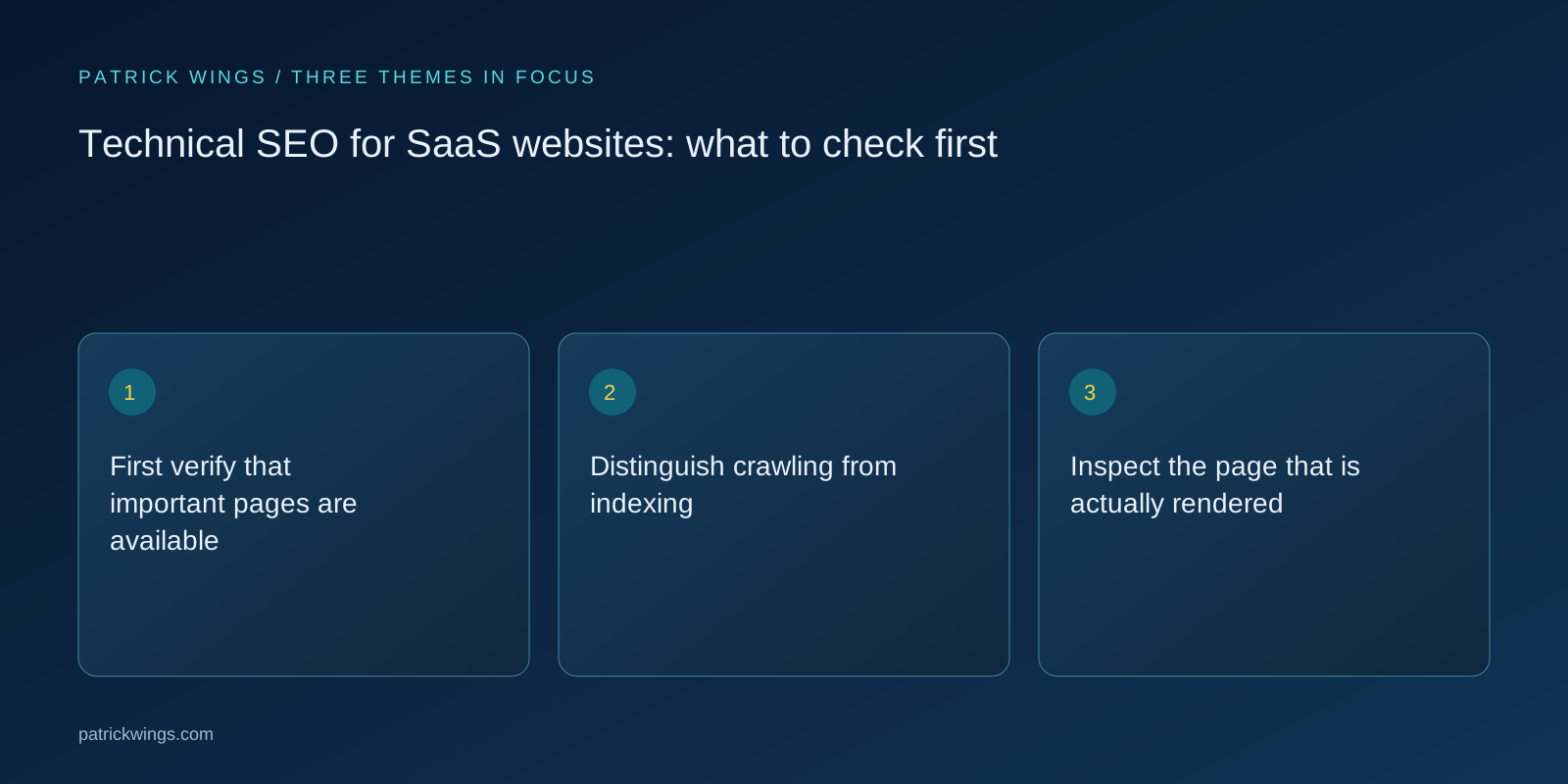
Inspect the page that is actually rendered
A JavaScript application is not automatically unsuitable for SEO. What matters is the content and links search systems can obtain and process. Check main text, headings, navigation and metadata through appropriate rendering and URL inspection tools. Look for information that only appears after a user-specific interaction and for failed API responses. Server rendering or static generation may suit your architecture, but the choice should follow actual requirements. A framework name alone cannot tell you whether important content is delivered reliably. Explore this further in the guide Structured data for SaaS: what schema can and cannot do.
Give every page a consistent URL identity
Check whether the same content appears at several addresses through parameters or inconsistent naming. Use consistent internal links, appropriate canonical references and a sitemap listing the intended URLs. Replaced pages need understandable redirects to a relevant successor. Do not automatically redirect every removed post to the homepage. A visitor arriving with a specific technical question still expects useful information. Consider existing links and relevant search queries when deciding how a migration should handle an old page and whether its content deserves to remain available. Explore this further in the guide SaaS topic clusters: connect content without creating a link maze.

Test templates and mobile usability together
A successful desktop layout may still hide information or cover controls on a phone. Inspect navigation, language switching, forms, tables and image dimensions on actual pages. Loading behaviour and visual stability are usability concerns as well as technical ones. Prioritise heavy images and unnecessary scripts when they obstruct the first interaction. Avoid optimising solely for a single tool score. The practical standard is a dependable website where prospects can find information and complete an enquiry without being interrupted by implementation problems.
Maintain a verifiable defect and release log
Give each issue affected URLs, expected behaviour, actual behaviour, an owner and a post-change check. Treat widespread defects as template-level work. After a release, inspect the same sample pages again and monitor relevant reports. Do not expect search engines to reassess every URL immediately. Technical acceptance initially confirms that your implementation behaves correctly. Whether content subsequently gains more relevant visibility is a separate question involving topic choices, competition and demand. Keeping those conclusions separate makes reporting more useful to the whole team.
INTERACTIVE / FROM READING TO ACTION
Three checkpoints for your implementation
Choose a checkpoint and track your reading progress. Checks are neither saved nor sent and do not score your business.
CHECKPOINT 01
Inspect the page that is actually rendered
A JavaScript application is not automatically unsuitable for SEO.
Explore in the article ↗CHECKPOINT 02
Give every page a consistent URL identity
Check whether the same content appears at several addresses through parameters or inconsistent naming.
Explore in the article ↗CHECKPOINT 03
Test templates and mobile usability together
A successful desktop layout may still hide information or cover controls on a phone.
Explore in the article ↗Frequently asked questions
Is JavaScript inherently an SEO problem?
No. Inspect actual delivery, rendering and the accessibility of important content and links.
Which issues deserve the highest priority?
Problems that make important pages unavailable or affect many pages at once. Context matters more than the warning count.
When will a fix improve rankings?
There is no fixed deadline or guarantee. Verify the implementation first, then monitor relevant search data.
How can I put “First verify that important pages are available” into practice?
Select a representative sample: homepage, service page, article, language variant and an older incoming link. Check status codes, redirects and access without signing in. A core service page returning a server error is more urgent than a small metadata issue on an unimportant archive.
What matters when working on “Distinguish crawling from indexing”?
robots.txt governs crawler access according to the relevant rules, but it is not a dependable substitute for a deliberate indexing decision. Several access signals may apply to a page and need to be assessed together. Review robots.txt, robots meta tags, HTTP headers and canonical references in context.