
THE SHORT ANSWER
Structured data describes information in a standardised, machine-readable format. It can explicitly identify an organisation, an article or other suitable content. It does not replace understandable pages. For a SaaS website, a small, accurate and maintained implementation is more useful than extensive markup containing details the visible page does not support.
For the broader picture of technical foundations, useful content and visibility measurement, read the pillar guide SEO, GEO and AEO for SaaS: visibility that supports buying decisions.
Start with what the page actually contains
First establish what the page represents. An editorial guide can be described as an article. An organisation page contains information about the business. A consulting service page is not automatically a software application merely because the consultancy works with SaaS clients. Choose the description based on the content rather than a desired search appearance. Also distinguish the general Schema.org vocabulary from features supported by individual search platforms. A valid type does not automatically mean that Google offers a corresponding enhanced result for that page.
Keep machine-readable and visible details consistent
Author names, page titles, images and dates should match the actual publication. If pricing is available only on request, do not invent a numeric price for the markup. Do not add star ratings without an appropriate, verifiable basis. Use consistent names for your organisation and describe the same entities consistently across pages. On multilingual websites, ensure titles and descriptions belong to the correct language version. This alignment matters particularly when templates combine information from several content fields or external systems. Explore this further in the guide Technical SEO for SaaS websites: what to check first.
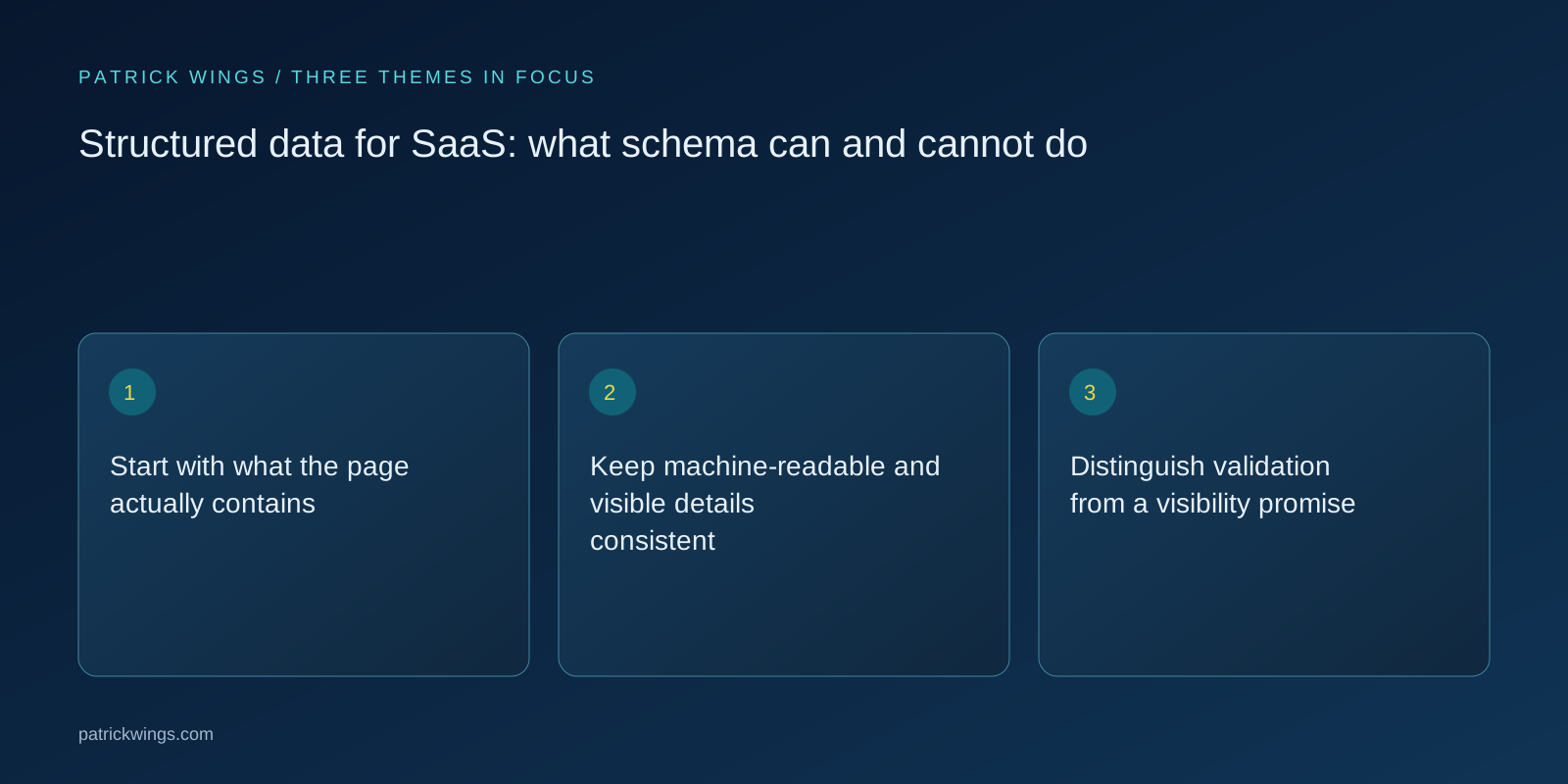
Distinguish validation from a visibility promise
A successful test establishes that certain technical requirements are met. It does not prove that a search system will select the page or display an enhanced appearance. Google explicitly does not guarantee rich results for correctly marked-up pages. Schema likewise provides no general guarantee of selection for AI answers. Treat claims to the contrary cautiously. A verifiable assignment is to model relevant information correctly, resolve technical errors and later observe actual appearances. That is a more precise objective than promising a particular position or citation. Explore this further in the guide Prepare content for AI answers: clarity, evidence and honest limits.
Plan maintenance before implementation
Decide which properties come automatically from the CMS and who checks exceptions. A modification date should reflect a real change rather than being regenerated on every visit. When an author changes or an offer is removed, structured descriptions must follow. Test templates against several realistic examples, including missing optional fields. Testing only one perfectly completed sample page often misses the problems that emerge during everyday editorial work. Clear ownership is usually more valuable than introducing another property nobody can reliably maintain.

A practical consulting website example
A fictional consultancy publishes a guide to CRM selection. The visible article identifies its author, subject and a meaningful revision date. The CMS supplies those details consistently to the structured article description. Breadcrumb navigation explains its place within the blog. The implementation does not invent product reviews, awards or a generic customer rating. Its value comes from clearly describing information that readers can also verify. Whether a search platform subsequently displays additional elements remains a separate decision by that platform, rather than proof that more markup always performs better.
Keep effort proportionate to the benefit
First correct false or contradictory information on important pages. Then add appropriate types whose properties you can maintain reliably. Avoid complex models that add no real information and are unlikely to stay current. Document the implementation and retest after template changes. Structured data belongs within technical and editorial quality assurance. It does not become more useful simply by accumulating attributes. Accuracy, consistency and a clear relationship to the visible content provide a better standard for deciding what to implement and what to leave out.
INTERACTIVE / FROM READING TO ACTION
Three checkpoints for your implementation
Choose a checkpoint and track your reading progress. Checks are neither saved nor sent and do not score your business.
CHECKPOINT 01
Distinguish validation from a visibility promise
A successful test establishes that certain technical requirements are met.
Explore in the article ↗CHECKPOINT 02
Plan maintenance before implementation
Decide which properties come automatically from the CMS and who checks exceptions.
Explore in the article ↗CHECKPOINT 03
A practical consulting website example
A fictional consultancy publishes a guide to CRM selection.
Explore in the article ↗Frequently asked questions
Does schema guarantee better rankings?
No. Correct markup can describe information and enable supported features, but guarantees neither rankings nor appearance.
Does every page need SoftwareApplication markup?
No. The type must fit the actual content. A consulting page is not automatically a software application.
Will more markup make us more visible to AI?
There is no general guarantee. Prioritise accurate content, technical accessibility and a consistent data model.
How can I put “Start with what the page actually contains” into practice?
First establish what the page represents. An editorial guide can be described as an article. An organisation page contains information about the business.
What matters when working on “Keep machine-readable and visible details consistent”?
Author names, page titles, images and dates should match the actual publication. If pricing is available only on request, do not invent a numeric price for the markup. Do not add star ratings without an appropriate, verifiable basis.