
THE SHORT ANSWER
A topic cluster combines an overview page with independent articles that explore specific questions. Useful internal linking explains those relationships and helps readers choose their next step. The objective is not to give every page as many links as possible. It is to answer a connected set of customer questions more coherently than a loose collection of individual posts can.
For the broader picture of technical foundations, useful content and visibility measurement, read the pillar guide SEO, GEO and AEO for SaaS: visibility that supports buying decisions.
Define the shared customer problem
Begin with a task your audience needs to accomplish, rather than the broadest possible category. “Digital transformation” is too vague for many SaaS businesses. “Resource planning for growing IT service providers” defines a clearer audience, situation and need. Map the associated decisions: establish capacity, assess utilisation, define responsibilities and select software. Check which questions you can answer credibly. A cluster needs an understandable centre so that its overview does not become an arbitrary list of posts that merely share the same label. Explore this further in the guide B2B search intent: which page does your SaaS buyer need?.
Make the pillar page useful in its own right
The overview should explain the subject meaningfully. It is more than a table of contents. Describe the situation, core concepts, decision path and common mistakes, then link to deeper explanations where appropriate. Readers should gain usable orientation without opening every supporting article. At the same time, avoid reproducing the full text of all those articles. Focus on context and relationships. A strong pillar page explains how the questions connect and which ones deserve attention first in different circumstances.
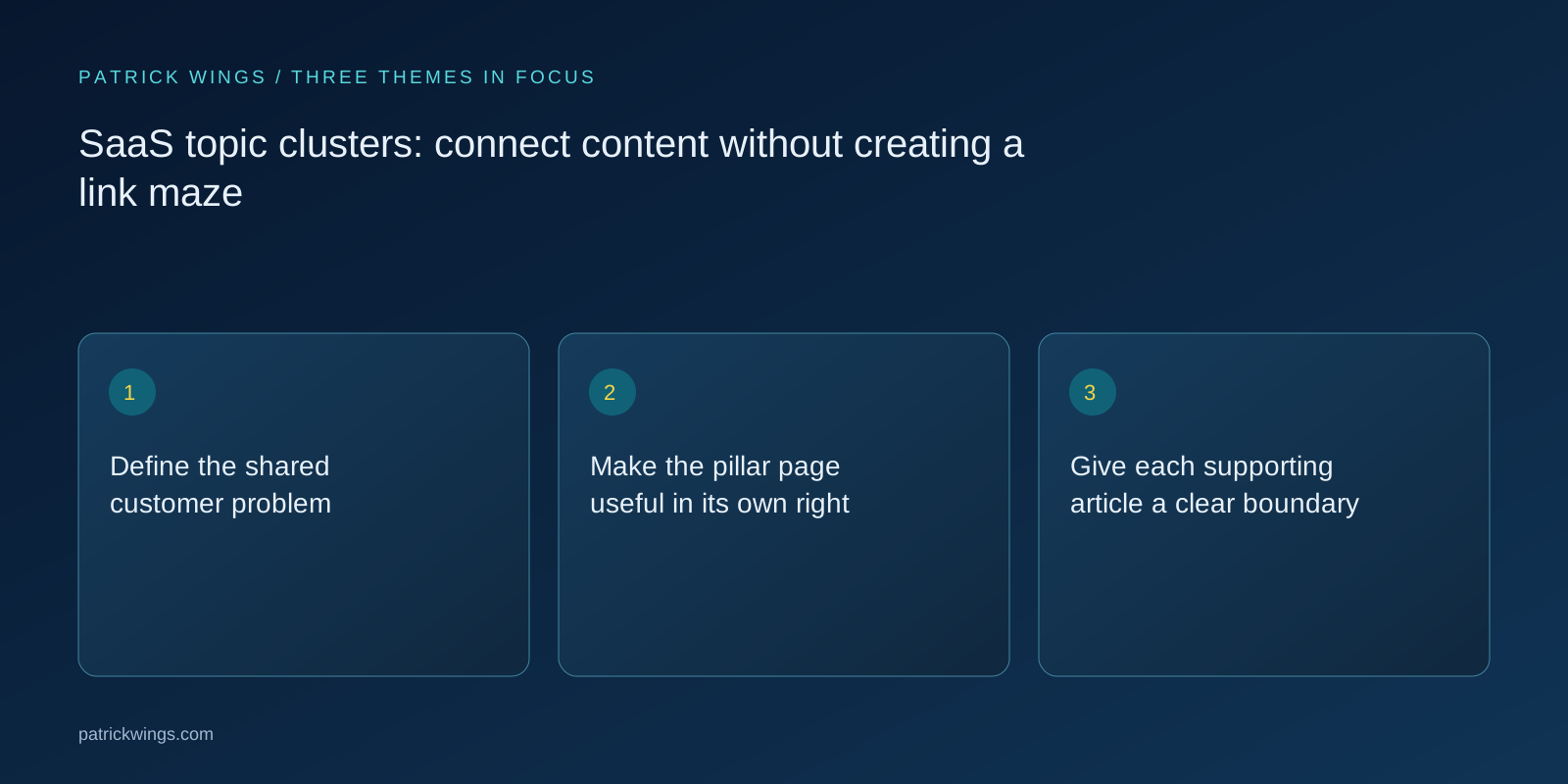
Give each supporting article a clear boundary
Each article needs a specific question that can be answered independently. If two drafts rely on the same examples and recommendations, their distinction is probably too weak. Sharpen the scope or combine the subjects. An article on calculating capacity might explain a calculation method, while another on utilisation metrics explains interpretation. That separation creates genuine value. Different titles for almost identical material create maintenance work without helping prospects make an additional decision. Make the editorial distinction before drafting, while changing the plan is still inexpensive.
Place links at understandable transitions
Link from an explanation when a natural follow-up question emerges. Anchor text should describe the destination, such as “check integrations before selecting software” rather than “click here”. Connect supporting articles back to the overview and add relevant neighbouring topics. Every article does not need to mention every other article. Use actual linked URLs and check they are reachable. An automatically generated related-content block can provide additional navigation, but it cannot replace a useful editorial connection within an argument or practical step.

Connect knowledge with relevant services
A blog cluster can introduce commercial support without turning every explanation into a sales interruption. Link a service when it genuinely helps with the problem being discussed. A technical audit fits an inspection guide; content consulting fits a topic planning article. Explain both the assistance available and what readers can do themselves. This makes the next step understandable. The service page must then describe the engagement, deliverables and prerequisites concretely, rather than simply repeating the vocabulary used throughout the blog and asking for a meeting.
Maintain the structure as it grows
Check new articles against your existing topic map. Add required return links and review older pages that could now direct readers to a better explanation. Remove broken links and update examples together when a central assumption changes. Evaluate the cluster as a whole: which questions are missing, which pages overlap and where does navigation stop making sense? This is an editorial maintenance process. Tools can support it, but a universal rule such as “every article needs ten links” cannot replace judgment about the reader’s next useful step. Explore this further in the guide Prepare content for AI answers: clarity, evidence and honest limits.
INTERACTIVE / FROM READING TO ACTION
Three checkpoints for your implementation
Choose a checkpoint and track your reading progress. Checks are neither saved nor sent and do not score your business.
CHECKPOINT 01
Give each supporting article a clear boundary
Each article needs a specific question that can be answered independently.
Explore in the article ↗CHECKPOINT 02
Place links at understandable transitions
Link from an explanation when a natural follow-up question emerges.
Explore in the article ↗CHECKPOINT 03
Connect knowledge with relevant services
A blog cluster can introduce commercial support without turning every explanation into a sales interruption.
Explore in the article ↗Frequently asked questions
Should every article link to the pillar?
A clear route back is useful. Provide it through navigation and appropriate editorial references rather than forced wording.
How many internal links are right?
There is no universal number. Add links that provide orientation or answer a meaningful follow-up question.
Should similar articles be combined?
If they largely serve the same purpose and offer little independent value, consolidation can improve the structure.
How can I put “Define the shared customer problem” into practice?
Begin with a task your audience needs to accomplish, rather than the broadest possible category. “Digital transformation” is too vague for many SaaS businesses. “Resource planning for growing IT service providers” defines a clearer audience, situation and need.
What matters when working on “Make the pillar page useful in its own right”?
The overview should explain the subject meaningfully. It is more than a table of contents. Describe the situation, core concepts, decision path and common mistakes, then link to deeper explanations where appropriate.