
THE SHORT ANSWER
With a long sales cycle, an earlier event can be a useful bidding candidate when it is captured promptly, consistently and with commercial meaning. Frequency alone does not make an event a good target. The central question is whether the signal represents suitable demand and later progress without being easily triggered by irrelevant activity. This article examines business selection and continuing validation of intermediate goals. Separately verify which strategy and data use the platform supports in the specific account through its current settings and documentation. An operational signal choice is a hypothesis to maintain, not permanent proof that a particular label represents customer value.
For the broader connection between paid channels, measurement and economics, read the pillar guide Performance marketing for B2B SaaS: manage channels, measurement and budgets.
Describe the gap between click and contract
Map actual events between the initial advertising interaction and the contract: enquiry, qualification, appointment, evaluation, procurement and signature. Separate waiting from absent progress. One buyer may wait for an agreed budget date while an unsuitable enquiry never enters genuine evaluation. Record when each status becomes reliable and who confirms it. This map explains why a completed purchase may arrive too late to provide immediate feedback. It does not establish which earlier status should replace it. Collect candidates with explicit meaning rather than automatically selecting the most frequent form event because its volume looks attractive in an advertising report.
Examine meaning and susceptibility to gaming
Ask whether each status is reproducible, promptly recorded, commercially relevant and vulnerable to unintended incentives. A pricing-page click can indicate interest but requires little commitment and proves no suitable buying context. A confirmed evaluation conversation may be stronger when a problem, role and next step are genuinely documented. Avoid arbitrary scoring that lets frequent events compensate for weak meaning. Define minimum prerequisites instead. A candidate with an unclear entry rule or serious duplication should be repaired before its apparent quantity is discussed as an advantage for automated bidding. Optimising an easy label can reward more activity without improving the commercial transition the business actually needs.
| Intermediate signal | Domain review | Possible use |
|---|---|---|
| Form submitted | Duplication and fit remain unresolved | Observation or a bounded working assumption |
| Evaluation call confirmed | Role, problem and next action documented | Candidate for validation against later outcomes |
| Opportunity accepted | Consistent CRM rule and timely feedback | Check eligibility for the chosen bidding strategy |
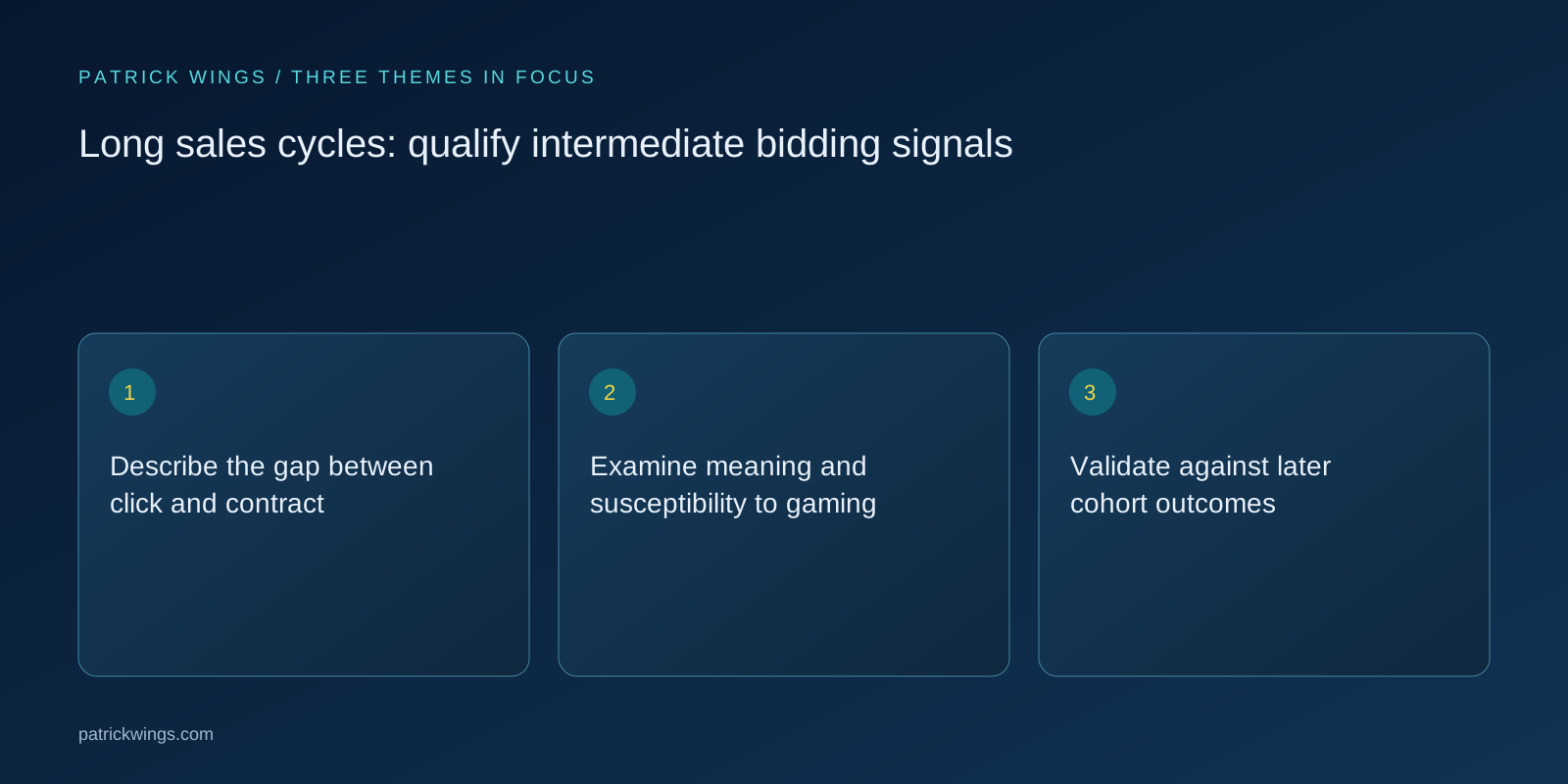
Validate against later cohort outcomes
Follow several sufficiently mature entry cohorts from the candidate event to later domain and commercial outcomes. Examine unsuitable cases as well as successful customers. Which groups reach real product evaluation, fail fit requirements or remain unresolved? Segment and sales motion matter because the same status can mean different things across contexts. Show uncertainty when counts are small. Historical association does not guarantee the same relationship after stronger optimisation. A system asked to generate more events can find different users from those previously observed. Continuing quality review therefore belongs inside the approval, rather than being treated as optional work after the original candidate has been chosen. Explore this further in the guide Paid pipeline forecasting: expose uncertainty and cohort maturity.
Accept transmission and goal configuration separately
Google distinguishes primary and secondary conversion actions and explains how goals consume them; actual effects depend on the campaign configuration. Check current rules and exceptions rather than equating the word secondary with every possible bidding consequence. Test event time, identifiers, duplicate handling and delivery failures. A commercially meaningful opportunity is technically unusable when transmitted unreliably or without the required authority. Conversely, a perfect interface does not repair inconsistent qualification. Record the two acceptance decisions separately with accountable owners. Permissions, consent and data-use obligations belong to the organisation’s approved implementation procedure; this editorial article does not substitute for that review or grant permission to transmit customer information.
Why is correlation alone insufficient?
An early stage may correlate with wins because sellers already select cases or only known accounts can reach it. Inspect the process that produces the label. A changed entry rule can erase the previous relationship. A bidding system should not receive an apparently strong label whose meaning the business can no longer reproduce consistently across people and time periods.

Assess a fictional signal candidate
The fictional SaaS business Brückenwerk sells through extended technical evaluations. Its invented working hypothesis uses a confirmed evaluation conversation instead of every submitted form. The status requires a suitable company, a named workflow and an agreed next action. The team follows historical and new cohorts, inspects negative cases and records unresolved procurement. All conditions are illustrative assumptions, not client results or universal benchmarks. Brückenwerk discovers that one sales region grants the status much more loosely. It therefore standardises the rule before changing bidding. Without that business correction, sending more events would simply give the advertising system more inconsistent feedback under an apparently identical label.
Plan a controlled transition rather than a blind switch
Record the previous state, proposed state, affected campaigns, observation phase and permitted financial exposure. Follow the platform’s current transition procedure instead of borrowing a generic waiting period from another setup. During the change, examine data acceptance and business quality without treating every short-term fluctuation as a causal effect. Document unavoidable parallel changes as interpretation limits. Parallel observation can be useful for some migrations, but is not a universal proof design. Require explicit acceptance and a fallback so an unexpected fault does not create indefinitely uncontrolled spending. The transition should make it possible to identify what changed and why continued operation remains justified.
Monitor signal drift after approval
Periodically review whether entry rules, segment mix and later outcomes remain sufficiently stable. A new form question, changed sales instruction or broader reach can alter a signal without changing its name. Show fit, later progress and recording coverage alongside event totals. Inspect cases where the system generates many intermediate events but little credible evaluation follows. The issue may be altered audiences or a definition that has become too easy to satisfy. Do not answer every deviation by introducing another target value. First identify whether transmission, the business process or actual demand changed; then choose the smallest suitable correction instead of constantly moving the measurement goalposts.
Before switching, inspect which campaigns actually consume the same goal. Account defaults, campaign-specific goals and special configurations can produce different effects. Have another authorised person review the intended change and preserve the previous setting. Commercial signal selection and technical implementation require separate acceptance. Only when both are correct can later quality changes be interpreted meaningfully; otherwise, the team may not know what the campaign was optimising.
Assign continuing responsibility for goal quality
An optimisable event needs a business owner and technical support. The business owner maintains its meaning and later relevance; technical support maintains transmission and configuration. Agree who approves CRM-stage changes and informs campaign teams. Version the definition and record review date, evidence and known limits. New colleagues should classify example cases consistently using the same rule. Reopen the decision when product, segment or sales process materially changes. An intermediate goal then remains a maintained hypothesis about customer relevance and commercial progress, rather than an overlooked configuration judged only by how many events it generates while its relationship to valuable outcomes quietly deteriorates. Explore this further in the guide CRM campaign feedback: build an actionable error log.
When should a signal be downgraded?
Define triggers such as rising unsuitable cases, altered qualification rules or persistently absent later progress. First inspect transmission and process changes. If the commercial relationship weakens, withhold expansion and use a documented fallback. A previously useful goal does not deserve permanent privileged status simply because it has already been configured across many campaigns and would be inconvenient to revisit.
INTERACTIVE / FROM READING TO ACTION
Three checkpoints for your implementation
Choose a checkpoint and track your reading progress. Checks are neither saved nor sent and do not score your business.
CHECKPOINT 01
Validate against later cohort outcomes
Follow several sufficiently mature entry cohorts from the candidate event to later domain and commercial outcomes.
Explore in the article ↗CHECKPOINT 02
Accept transmission and goal configuration separately
Google distinguishes primary and secondary conversion actions and explains how goals consume them; actual effects depend on the campaign configuration.
Explore in the article ↗CHECKPOINT 03
Assess a fictional signal candidate
The fictional SaaS business Brückenwerk sells through extended technical evaluations.
Explore in the article ↗Frequently asked questions
Is a more frequent event always better for bidding?
No. It also needs consistent meaning, prompt capture and commercial relevance. More events cannot reliably compensate for weak meaning or unsuitable demand.
Do primary and secondary goals work identically everywhere?
No. Check current documentation and the actual campaign configuration. Goal consumption and exceptions cannot safely be inferred from a simplified slogan.
Can a qualified enquiry replace a contract?
It may serve as a provisional signal candidate when supported by later outcomes. Actual contracts remain separately important for the business’s economic evaluation.
How often should the signal be validated?
Set a cadence appropriate to volume and sales duration, plus reviews for altered CRM rules, audiences, products or technical transmission.
What if goals increase while quality deteriorates?
Examine definitions, segment mix, transmission and mature later cohorts. Withhold expansion when the signal no longer carries a defensible business meaning.
Who is accountable for the goal?
Assign owners for business meaning and technical function. Communicate CRM-stage changes to campaign operators and verify their consequences in the actual configuration.