
THE SHORT ANSWER
A paid pipeline forecast describes possible commercial outcomes of paid demand under stated assumptions. It is neither a promise nor a substitute for pipeline already achieved. In B2B, volumes, qualification, contract values and timing must fit together. A useful forecast therefore presents several plausible cases and distinguishes observed evidence from assumptions. This article develops the planning logic for a bounded campaign scope. It supplies no universal win rate and does not guarantee that additional advertising expenditure creates proportionally more revenue. Its purpose is to support a specific commitment while making the uncertainty behind that commitment visible.
For the broader connection between paid channels, measurement and economics, read the pillar guide Performance marketing for B2B SaaS: manage channels, measurement and budgets.
Define the planning decision first
Ask why the forecast is needed: approving a test, adding sales capacity, planning cash or setting a revenue target? These purposes require different horizons and precision. A quarterly revenue plan must not imply that every contact generated in the quarter closes inside it. Define the campaign scope, segment, offer and responsible sales organisation. Note changes such as new pricing or market entry that weaken historical comparability. Without a concrete consequence, a forecast becomes a decorative management number. A bounded question instead identifies which assumptions deserve investigation because reducing their uncertainty could actually change the next financial or operational commitment.
Build the funnel from explicit events
Use documented stages such as suitable enquiry, confirmed evaluation conversation, accepted opportunity and signed contract. Each needs an entry event and counting rule. Do not silently mix people, accounts and opportunities. Several contacts within a company may belong to one commercial opportunity. Reopened cases also need a rule to prevent old deals from appearing as fresh demand. Put the definitions beside the arithmetic. If marketing and sales mean different things by opportunity, another decimal place will not repair the model. Resolve the shared meaning first, then test it against a small sample of actual CRM cases that includes ambiguous transitions and exceptions. Explore this further in the guide Long sales cycles: qualify intermediate bidding signals.
| Scenario | Fictional assumption | Interpretation |
|---|---|---|
| Conservative | Eight suitable conversations, one later win | Check cash resilience without quick revenue |
| Working case | Twelve suitable conversations, two later wins | Not a guaranteed expectation |
| Favourable | Sixteen suitable conversations, three later wins | Recheck capacity and dependencies |
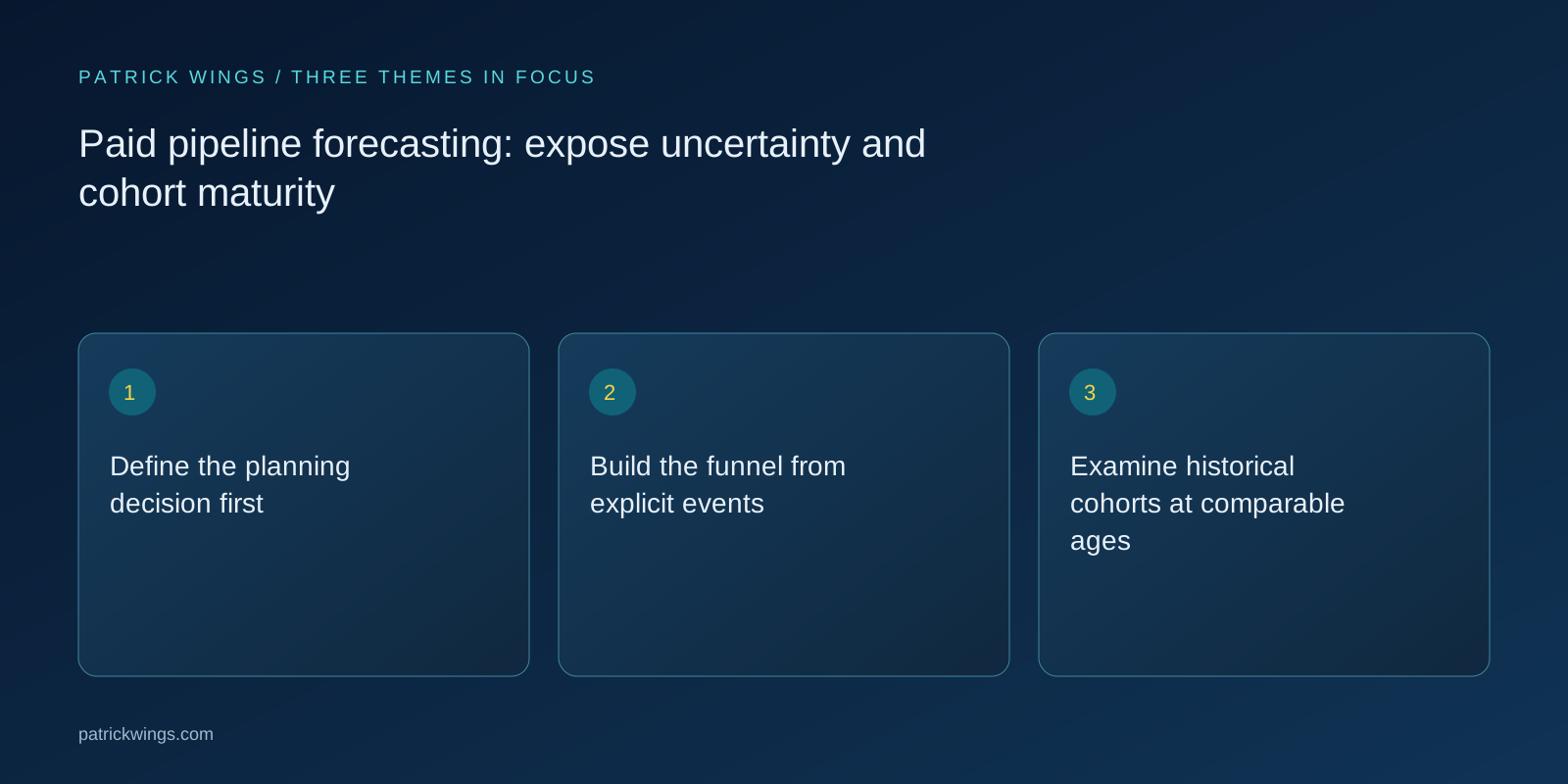
Examine historical cohorts at comparable ages
Choose references whose segment, offer and sales motion resemble the planned activity. Compare entry cohorts after similar follow-up periods. Young groups contain more unresolved cases; a lower current win proportion does not automatically establish poorer quality. Older cohorts may have formed under conditions that no longer apply. Examine sample size, exceptional large contracts and missing attribution. Platform guidance on conversion delay is a technical starting point, but CRM outcomes may mature later. When no suitable history exists, call the rates planning assumptions. A borrowed industry figure does not become first-party evidence because it has been entered into your company’s forecast spreadsheet. Explore this further in the guide Conversion lag: manage B2B campaigns by signal maturity.
Make quantities and values reproducible
A simple model connects planned suitable enquiries with the transitions through to contracts. Add an appropriate contract-value definition and distinguish recurring revenue, one-off work and expected cash receipts. Do not multiply attributed pipeline by platform leads indiscriminately: the units differ. Show intermediate stages so capacity constraints become visible. An appealing total may require twenty additional evaluations when the team can deliver only five. Also distinguish attributed from causally additional pipeline. A forecast using existing attribution rules initially describes that reporting perspective. It does not demonstrate that every included deal would have disappeared without advertising, even when the arithmetic is internally consistent.
Why keep unresolved cases separate?
An open opportunity is neither a customer nor necessarily a failure. Record its value, stage, next confirmed action and age separately. If probabilities are used, document their origin and calibration. A default percentage selected by a seller does not become an objectively measured revenue probability merely because it is multiplied by the proposed contract value.

Develop an explicitly fictional scenario range
The fictional SaaS company Klarfeld plans a bounded paid-media test. It assumes eight, twelve or sixteen suitable conversations and, later, one, two or three acquired customers. These invented cases are neither benchmarks nor actual client results. For each scenario, Klarfeld examines the handling workload, possible contract values and later payment timing. It does not simply adopt the favourable case as the company plan. Before approving expenditure, management asks whether the conservative case is financially survivable and what observation could narrow the range. This creates a research assignment around early quality signals rather than a promise to deliver a fixed number of completed purchases from the test.
Expose dependent assumptions and timing
Variables cannot always be selected independently at their most favourable levels. Larger companies may offer higher contract values while requiring longer procurement and more sales effort. Wider reach can also change the proportion of suitable enquiries. Represent those dependencies through coherent scenarios instead of combining unrelated best cases. For each cohort, add an earliest plausible outcome horizon and a more conservative one. Pipeline is not cash; contracts can carry payment schedules different from advertising expenditure. Finance and marketing should therefore share the same timing assumptions. Without that connection, an economically promising activity can still create an unacceptable short-term financing requirement before its eventual value becomes available.
Investigate the uncertainty that changes the decision
In a sensitivity review, vary one critical assumption and inspect the effect on the decision and workload. Which matters most: suitable demand, accepted opportunities, win probability, contract value or delay? Prioritise research where information could change an actual commitment. More dashboard detail offers little when the decisive uncertainty concerns the offer or delivery capacity. State which information cannot mature within the test period. Those unknowns remain in the downside case. A provisional approval can deliberately tolerate them, but daily spreadsheet updates should not be presented as though they have already eliminated uncertainty that only later customer behaviour can resolve.
An investigation may show that more media spend does not reduce the decisive uncertainty. Extra clicks offer little when technical delivery remains unresolved. When suitable demand is unknown, a bounded search test may improve the estimate. Assign each assumption to an appropriate evidence source: customer conversation, product trial, cost review or campaign observation. Invest the next unit of effort in the information actually needed, rather than automatically repeating the same advertising activity.
Review forecasts alongside actual development
Compare volumes, transitions, values and timing separately. Revenue can fall short despite suitable demand because procurement moved later; a target can also be met by one unusual contract. Document these explanations rather than automatically celebrating or rejecting a channel. Update the next forecast using new evidence and preserve the original version. The review should end with a decision about scope, resources or further learning. Forecasting then becomes a reviewable management process. It should not continually reshape uncertain future numbers to fit the desired target until earlier assumptions can no longer be distinguished from genuine improvement in the team’s understanding of demand.
What makes a forecast auditable?
Preserve the data version, assumptions and expected time horizons together. Compare later outcomes with that exact version, not a retrospectively adjusted spreadsheet. Identify whether deviations came from volume, quality, win rate, contract size or timing. Only this decomposition reveals which assumption should change in the next planning cycle, instead of labelling every difference a general marketing performance issue.
INTERACTIVE / FROM READING TO ACTION
Three checkpoints for your implementation
Choose a checkpoint and track your reading progress. Checks are neither saved nor sent and do not score your business.
CHECKPOINT 01
Examine historical cohorts at comparable ages
Choose references whose segment, offer and sales motion resemble the planned activity.
Explore in the article ↗CHECKPOINT 02
Make quantities and values reproducible
A simple model connects planned suitable enquiries with the transitions through to contracts.
Explore in the article ↗CHECKPOINT 03
Develop an explicitly fictional scenario range
The fictional SaaS company Klarfeld plans a bounded paid-media test.
Explore in the article ↗Frequently asked questions
Is attributed pipeline the same as incremental pipeline?
No. Attribution assigns observed business through a model. Incremental impact requires separate causal investigation or an explicitly limited interpretation of the available evidence.
How should young cohorts be treated?
Show their observation age and unresolved cases. Do not compare them uncritically with fully followed groups, and label provisional rates accordingly.
May industry conversion rates be used?
Clearly labelled uncertain planning assumptions can structure questions. They do not replace suitable first-party evidence and should not be presented as a secured expectation.
How many scenarios are useful?
A few coherent, understandable cases are usually more useful than many falsely precise variants. Scenarios should expose relevant uncertainty and practical decision consequences.
Why is pipeline different from cash?
Open and even signed contracts can have later payment dates and different terms. Compare expenditure and expected receipts along the same time axis.
When should forecasts be revised?
Revise for material new evidence or changed assumptions. Preserve the original version so retrospective editing does not conceal the differences the business should learn from.